
Diwali Diyas in Condos and Apartments: A Fire-Safe Celebration

The Diwali diyas condo question arrives every autumn in my consultations. A family has moved from a house with a porch into a tower, and they want rows of lamps without a fire alarm emptying the building at midnight. In North York, Mississauga and downtown Toronto, high-rise living is now the norm for many Hindu, Sikh and Jain households, and the old way of lining every ledge with flame does not translate directly. Over more than forty years I have lit lamps in every kind of home, and I can tell you the meaning of Diwali survives perfectly well with fewer real flames. This article explains how to find out what your building allows, why ghee and camphor trip smoke alarms, how to place a diya so it cannot tip or catch fabric, when electric diyas are a fine choice, and exactly what to do if a lamp flares up.
Are you allowed to light diyas in a condo or apartment?
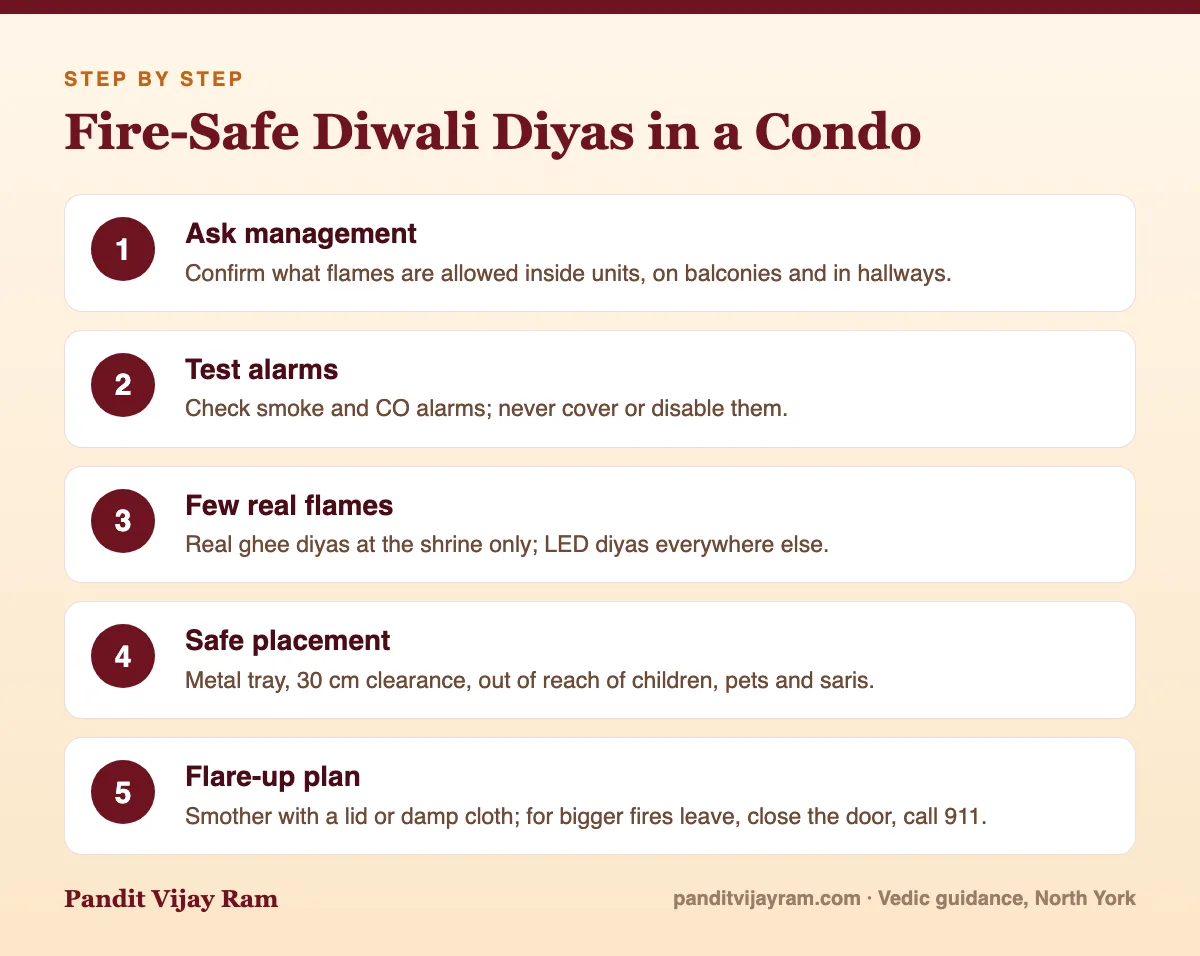
It depends on your building. Many condos permit small candles or lamps inside a unit but ban open flame on balconies, in corridors and in shared rooms. Rental buildings may have lease clauses about flame. Read your condo's rules or lease and ask management before Diwali rather than assuming.
Every condo corporation sets its own rules, and every landlord writes a different lease. There is no single GTA answer, so the honest first step is to read your documents and send a short, friendly email to management.
Useful questions to ask:
- Are open-flame lamps or candles allowed inside units?
- Are any flames allowed on balconies or terraces?
- Can residents decorate their door or the hallway outside it?
- Is there a policy for religious or cultural celebrations in the party room?
Hallways are usually common elements, so a row of diyas or a lit rangoli outside your door is likely to be refused even where indoor lamps are fine. Fire doors must never be propped open for guests. Put the answer you get in writing so there is no confusion on the night.
If you rent and want a bigger ceremony, our guide to puja or havan in a rented Ontario home covers the landlord conversation in more detail. For the wider picture of smoke-free spiritual practice in towers, see cleansing a condo without smoke.

Will a ghee diya set off the smoke alarm?
A single clean-burning ghee or oil diya rarely trips an alarm on its own. Trouble starts with many lamps together, a wick that is too long, camphor, dhoop or a kitchen already full of frying smoke. Trim wicks, light fewer lamps, run the range hood and keep flames well away from the detector.
Smoke alarms respond to particles in the air. A well-made cotton wick in good ghee produces very little. The common triggers on Diwali night are different:
- Camphor aarti. Kapoor burns hot and produces visible smoke. In a small unit, hold the aarti briefly and away from the ceiling detector, or use a single ghee lamp for aarti instead.
- Long or doubled wicks. A tall flame soots. Trim wicks so the flame stays small and steady.
- Cheap oil blends. Some lamp oils smoke more than ghee or plain sesame oil.
- The kitchen. Frying puris and pakoras while twenty diyas burn adds up quickly. Switch on the range hood early.
Never cover, unplug or remove a smoke alarm to avoid a false alarm. Working alarms are a legal requirement in Ontario homes, and a disabled one is the most dangerous thing in the room. Press the test button the week before Diwali, and check your carbon monoxide alarm at the same time. For more on smoke and ritual fire indoors, our camphor cleansing guide has extra safety detail.
Where is the safest place to put diyas in a small apartment?
Put real diyas on a metal or ceramic tray on a stable, uncluttered surface at least 30 centimetres from anything that can burn, out of reach of children and pets, and not under a smoke detector. Avoid windowsills with curtains, bookshelves, crowded doorways and anywhere people walk in loose clothing.
Use this placement rule for every real flame in the unit:
- Hard, flat base. A brass thali or a ceramic plate under each diya catches drips and stops a tipped lamp reaching wood or cloth.
- Clear space all round. Keep roughly 30 centimetres from curtains, paper decorations, flowers, books and the edge of the table.
- Above small hands and tails. Coffee tables are the worst spot when toddlers, cats or dogs are around. A high shrine shelf with nothing above it is better.
- Out of the walkway. Saris, lehengas and dupattas catch flame easily, especially synthetic fabrics. Keep diyas away from where guests stand and greet.
- Away from drafts. An open balcony door or a fan can push a flame sideways into something.
- Counted in and counted out. Know how many you lit, and put every one out before you sleep or leave.
Keep a damp cloth and a lid or metal plate near the shrine. A working ABC extinguisher by the kitchen exit is worth having all year. For many families, the safest arrangement is a few real diyas at the mandir and electric ones everywhere else.
Are electric or LED diyas acceptable for Diwali puja?
Yes, for decoration they are a sensible choice, and many priests accept them where flame is unsafe or banned. Diwali celebrates light overcoming darkness, and an LED diya on a balcony honours that idea. For the actual puja and aarti, most families still keep at least one real ghee lamp at the shrine.
People sometimes worry that an electric lamp is a lesser offering. The tradition has always adapted to circumstance. Clay diyas themselves replaced older lamps, and families have used whatever clean light they had.
A practical division works well in towers:
- Real flame: one akhand or main ghee diya at the shrine during Lakshmi puja, plus the aarti lamp, both watched by an adult.
- Electric: window rows, balcony railings, door frames, rangoli centres and children's rooms.
Choose battery or plug-in lights rated for the place you use them. Outdoor balconies need outdoor-rated sets, and cords should not run under rugs or through doors that close on them. Rechargeable tea-light diyas are easy to place inside clay diya shells, which keeps the traditional look.
The spirit of the festival lies in welcoming Lakshmi into a clean, peaceful, well-lit home. If your family follows a Lakshmi-Ganesh puja on the night, a Ganesha puja performed with care counts for far more than the number of flames in the window.
What should you do if a diya catches fire to something?
For a tiny flare, smother it with a lid, metal plate or damp cloth; never pour water on burning ghee or oil. If fabric, furniture or anything larger catches, leave at once, close the door behind you, pull the fire alarm, call 911 and use the stairs, not the elevator.
Decide this plan with the whole family before guests arrive, not in the moment.
A spilled lamp, small flame. Ghee and oil behave like a pan fire. Water makes burning fat spit and spread. Slide a metal lid or plate over it, or drop a damp cotton cloth on top, and leave it covered until cold.
Anything bigger. If curtains, a sofa, clothing or decorations catch, do not try to be a hero. Get everyone out, close the unit door to slow the fire, activate the building's alarm on your way and call 911 from a safe place. In a high-rise, use the stairs. Your building's fire safety plan, usually posted near the elevators or available from management, explains whether residents should evacuate or shelter in other situations.
Clothing on fire. Stop, drop and roll, and cover the face. Cool burns with running water and seek medical care.
Your local fire service publishes seasonal safety advice and many run public education sessions, so check its website before the festival. Calm preparation is part of a good Diwali. If the season brings strain rather than joy, our guide to a practical festival plan for busy GTA families may help you pace things.
The bottom line
A Diwali diyas condo celebration works best when you check your building's rules first, keep real flames few and well placed, and use LED lights everywhere flame is risky or banned. Look after your smoke alarm instead of fighting it, and agree a fire plan before guests arrive. The festival's meaning lives in light and devotion, not in the number of flames.
Key takeaways
- Ask condo management or check your lease before lighting any flame.
- Balconies and corridors often prohibit open flame even when units allow it.
- Never cover or disable a smoke alarm; trim wicks and run the range hood instead.
- Smother a ghee or oil flare with a lid or damp cloth, never water.
- LED diyas are a respectful choice for windows, balconies and doorways.