
Marriage Problems After Immigrating to Canada

Moving to Canada is often a shared dream, planned for years. Then the couple lands, and the dream meets basement rentals, survival jobs, snow and a phone that rings with worried parents back home. Many of the marriage problems after immigration that families bring to me in North York are not about love at all. They are about two tired people carrying more than they expected, without the aunts, cousins and neighbours who used to absorb some of the weight. This guide looks at the couple, not only the individual. It covers why newcomer marriages strain, how changing roles and money create resentment, ways to rebuild connection when you are lonely, the free and low-cost help available across Canada, what to do if one spouse feels controlled because of sponsorship or money, and how a simple prayer routine can anchor a new home. In more than forty years of practice I have seen many couples rebuild after a hard first few years, usually once they stop blaming each other for what the move itself was doing to them.
Why do marriages struggle after moving to Canada?
Immigration changes almost everything at once: work, income, status, language, climate, friendships and family support. Each change is manageable alone. Together they leave both partners exhausted and short-tempered, and the marriage absorbs the stress. Conflict often shows up as arguments about money, chores, in-laws or time, when the deeper issue is overload.
Researchers describe the process of adapting to a new culture as acculturation, and it rarely moves at the same speed for both partners. One may make friends at work while the other is home with children. One may enjoy the independence while the other misses the old social order.
Common pressure points I hear about:
- Underemployment. An engineer driving deliveries, or a teacher stocking shelves, can feel a quiet shame that turns into irritability.
- Shift work. Partners on opposite schedules barely see each other awake.
- Winter. Short dark days and staying indoors deepen low mood, which our guide to winter low mood in Toronto discusses.
- Housing. Shared rentals or living with relatives leave no private space to talk.
- Expectations from home. Families abroad may assume the couple is now wealthy.
If one of you feels personally heavy and unsettled since the move, our earlier post on negative energy after moving to Canada focuses on that individual experience. This post is about what happens between the two of you.

How do changing roles and money affect immigrant couples?
Roles often flip after immigration. A wife may find work first, a husband may lose professional status, and both may need to share cooking and childcare for the first time. Money sent to parents, debts from the move and unequal earnings add tension. Couples cope best when they renegotiate roles openly instead of assuming the old arrangement.
In many households the old division of work made sense in the home country, with family help and one main earner. In Canada it may simply not fit. When nobody says this aloud, resentment builds on both sides.
A practical renegotiation, done over a calm weekend:
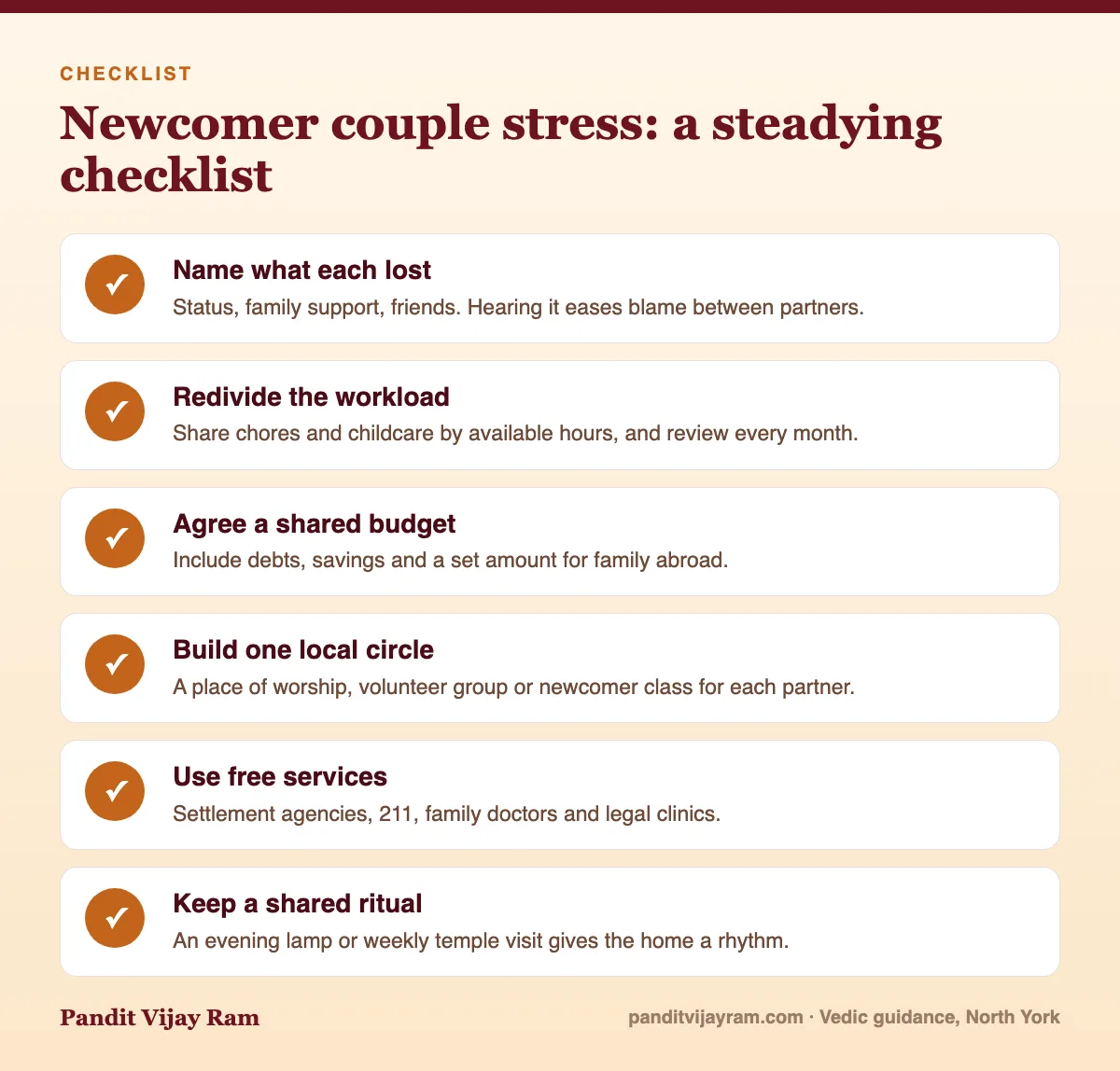
- List the real workload. Paid shifts, commute, cooking, cleaning, children, paperwork, calls home.
- Divide by time, not tradition. Whoever has the free hours takes the task, and that can change month to month.
- Make a shared budget. Include rent, savings, debt payments and an agreed amount for family abroad.
- Give each partner a small personal sum that needs no explanation.
- Review monthly. A new job, a course or a baby changes the plan.
Pride is often the hidden wound. A husband who is now earning less may hear every request as criticism. A wife who is now earning more may feel unappreciated. Naming the loss of status, kindly, often softens arguments that seemed to be about dishes.
Where parents or in-laws are part of the household or the budget, our guide to in-law problems suggests ways to keep the couple united.
How can newcomer couples cope with loneliness and missing family?
Build a small new circle on purpose: a temple, gurdwara, mosque or church community, a neighbourhood group, or classmates from a newcomer program. Keep calls home regular but limited, so they comfort rather than drain. Protect one weekly time just for the two of you, even if it is only a walk.
Back home, a quarrel might cool off because a sister-in-law stepped in or a friend took one partner for tea. Here, the couple may have only each other, and that is a lot to ask of one marriage. Loneliness turns small irritations into big fights.
Ideas couples have found useful:
- Join one community activity each. Volunteering at a place of worship or a food bank brings friends quickly.
- Take a free course together. Language, computer or job-search classes at a settlement agency double as social time.
- Set a call schedule. Daily long calls with parents can keep a spouse emotionally in the old country.
- Plan festivals locally. Celebrating Diwali, Vaisakhi, Eid or Christmas with new friends makes Canada feel like home.
- Keep a weekly couple hour. Phones away, no talk of money, just company.
If one partner feels low for weeks, loses interest in everything or stops sleeping, it may be depression rather than simple homesickness. Please book with a family doctor or a walk-in clinic. In a crisis, call or text 988 any time of day. Couples living apart during the move face their own version of this, covered in our guide to long-distance relationship problems.
Where can newcomer couples get marriage help in Canada?
Government-funded settlement agencies offer free help with jobs, language, housing and family adjustment, and many run family or counselling programs. Calling 211 finds local services. Family doctors can refer for counselling, workplace assistance programs offer confidential sessions, and community legal clinics help with immigration or family law questions.
Many newcomers do not know how much help exists, or worry that asking will affect their status. Using community services is ordinary and confidential. A sensible order:
- Settlement agency. These are free for permanent residents and many others. Ask specifically about family support or couple counselling.
- 211. By phone or online, it lists counselling, women's and men's services and support groups near you.
- Family doctor or walk-in clinic. For sleep, mood, anxiety or alcohol concerns, and referrals.
- Employee assistance program. If either of you has a job with benefits, check for free short-term counselling.
- Cultural counselling agencies. Some agencies offer counsellors who understand your community's expectations around marriage and family.
- Legal clinics. For questions about sponsorship, separation or rights, before making big decisions.
Spiritual guidance can sit beside these. When a couple sees me, I first ask what practical support they already have, then look at both charts for the timing of this hard period, and suggest a prayer they can share. The marriage problem service page describes that approach.
What if one spouse feels controlled because of sponsorship or money?
Control is not a rough patch. If a spouse takes your documents, restricts money, isolates you or threatens your immigration status, that is abuse. Call 911 in danger and 211 for shelters and help. Immigration authorities have options for people facing family violence, and a legal clinic can explain your situation confidentially.
Newcomers can be especially vulnerable. A sponsored spouse may not know the rules, may depend on the other for income and language, and may be told, falsely, that leaving means deportation. Signs of control include:
- Your passport, PR card or bank card kept from you.
- No access to your own pay or the household accounts.
- Being forbidden from classes, work or making friends.
- Threats to call immigration, take the children or send you back.
- Relatives here or abroad pressuring you to stay silent.
Please know that help exists regardless of gender or faith. Shelters and women's helplines can speak with you confidentially, and men facing abuse can find support through 211 as well. A community legal clinic or settlement worker can explain how your status works and what options exist if you are experiencing family violence.
I do not suggest rituals to keep someone in a controlling marriage, or to make a controlling partner change by force. Safety and legal advice come first. Once you are safe, prayer can help you rebuild strength. Our decision guide on whether a relationship is worth saving may help you think it through.
Can a shared prayer routine help a marriage after immigration?
Yes, as an anchor rather than a fix. A small shared ritual, such as lighting a lamp together each evening or a weekly visit to your place of worship, gives a new home a rhythm and reminds both partners that they are a team. It works best alongside the practical changes above.
Many couples tell me the hardest thing about the first years was that home stopped feeling like home. Ritual helps restore that feeling. Suggestions that fit small apartments and busy schedules:
- A corner mandir. Even a shelf with a picture, a lamp and a bell. Our guide to caring for a home mandir covers simple upkeep.
- Evening aarti together. Five minutes, whoever is home. On opposite shifts, leave the lamp ready for the other.
- A shared sankalp. Once a month, state together what you are praying for as a family.
- Monday Shiva-Parvati worship is traditionally associated with marital harmony.
- Festival continuity. Keep at least one festival exactly as your families did, to honour where you came from.
If a reading is useful, I look at both partners' dashas for the period of the move. Sometimes a Saturn transit or a demanding dasha coincides with the hardest months. Knowing that a difficult phase has a shape can ease blame. It does not replace the budget conversation or the doctor's appointment, but it can make both of them easier to face together.
The bottom line
Marriage problems after immigration usually come from overload, not from a failure of love. Renegotiate roles and money openly, rebuild a local circle, and use the free settlement, counselling and legal services Canada offers. Treat control over documents, money or status as abuse that needs safety help, and use a shared prayer routine to give your new home a steady rhythm.
Key takeaways
- Immigration changes work, money, status and support at once, and marriages absorb the strain.
- Divide household work by available time, not by the old tradition.
- Settlement agencies and 211 connect newcomer couples to free help.
- Taking documents, money or threatening status is abuse, not a rough patch.
- A small shared ritual helps a new home feel like home again.