
South Asian Heritage Programmes at GTA Libraries

Grandparents often worry that children raised in Canada will lose the language of their prayers and stories. Parents worry too, but between work and school runs there is little time to teach. The Toronto Public Library South Asian collections, and those of other GTA libraries, are one of the quietest and most generous answers to that worry. Families in North York, Brampton and Scarborough who ask me how to keep heritage alive at home often have a library card already but have never looked at the shelves in their own language. In more than forty years of guiding families, I have seen that a child who hears the Ramayana in their grandmother's tongue carries something steady into adult life. This guide covers verified library resources across the GTA: multilingual collections, Dial-a-Story by phone, newcomer information in South Asian languages, Brampton Library's writers' groups, heritage-month programming, and simple ways to turn a library visit into a family ritual.
Does Toronto Public Library have books in Hindi, Punjabi, Tamil and Urdu?
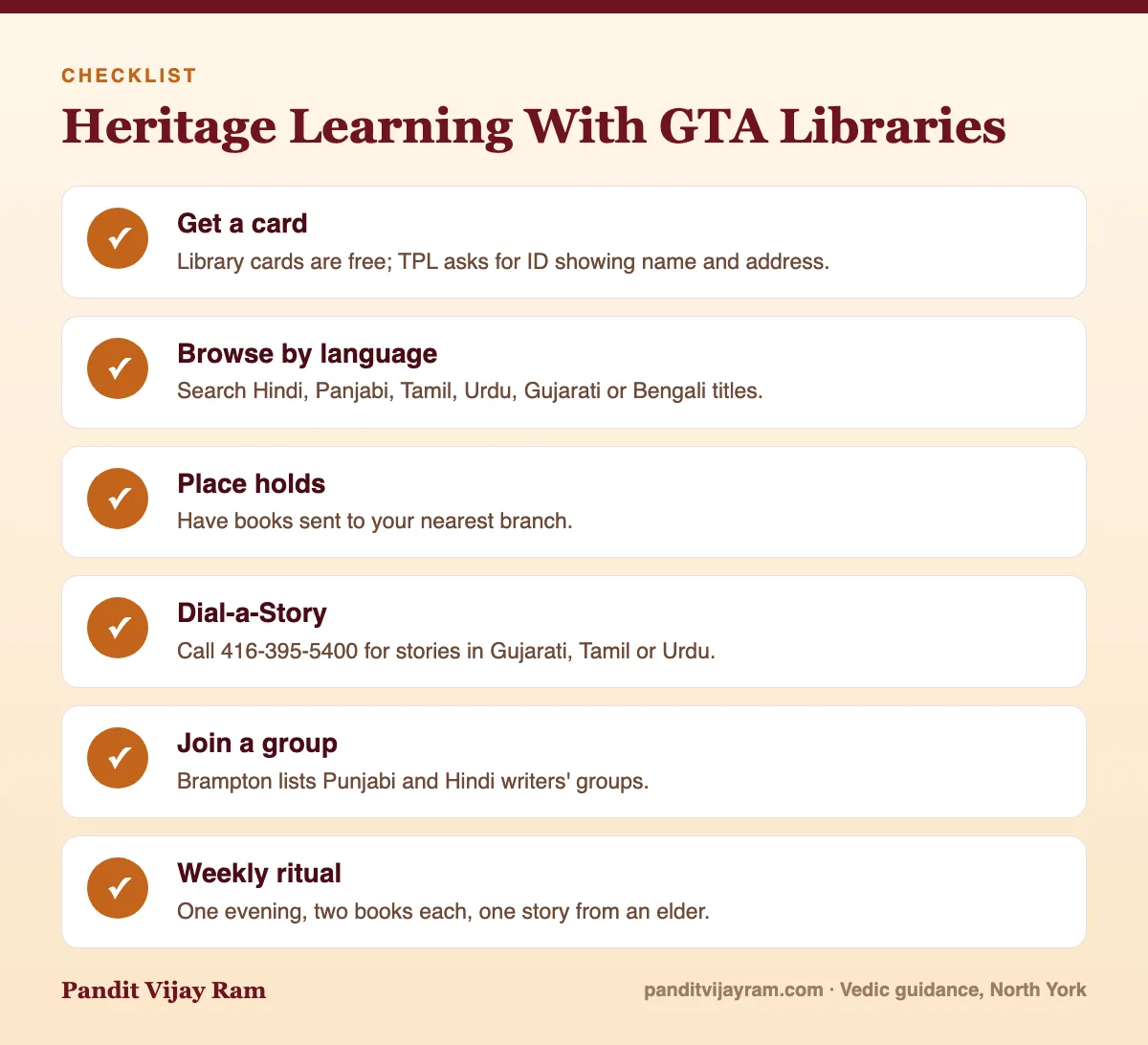
Yes. Toronto Public Library says it holds books, movies, music and digital content in over 40 languages. Its branch list shows where each language is collected; Albion branch, for example, has mid-sized Gujarati, Hindi, Panjabi and Tamil collections and smaller Bengali and Urdu ones. Holds bring items to any branch.
TPL's Material in your language page lets you browse the catalogue by language and links to a list of branches with collections in each one. Formats include print books, DVDs, eBooks, audiobooks, magazines and newspapers, depending on the language.
Collections are spread across the city, often in neighbourhoods where speakers live. Branch pages list the size of each collection. Albion in Etobicoke is one example with mid-sized Gujarati, Hindi, Panjabi and Tamil holdings. Agincourt in Scarborough lists a medium Tamil collection and smaller Hindi and Urdu ones, and other branches carry South Asian films and books too.
Practical tips for families:
- Place holds. You do not have to travel to the branch that owns the book. Request it and pick it up at your local branch.
- Search by script and by transliteration. Try the title in Devanagari, Gurmukhi or Tamil script and in English spelling.
- Look at the children's shelves. Bilingual picture books are often the easiest bridge for young readers.
- Ask staff. TPL's newcomer page notes that staff at all branches can answer questions.
Elsewhere in the GTA, ask your own library. Brampton Library's world languages collection, described below, is one of the strongest for South Asian languages. If you are new to Toronto, TPL is also a gateway to settlement help; our guide to family and newcomer support in Toronto lists other services.

What is TPL's Dial-a-Story and which South Asian languages does it offer?
Dial-a-Story is a free Toronto Public Library service where children and families listen to a story by phone at any time of day by calling 416-395-5400. It is offered in 16 languages, including Gujarati, Tamil and Urdu, alongside English, French and others. It suits car rides, bedtimes and grandparents.
Dial-a-Story is one of the simplest heritage tools in the GTA. No library card or app is needed, only a phone. TPL lists its 16 languages as English, French, Cantonese, Gujarati, Italian, Korean, Mandarin, Persian, Polish, Portuguese, Russian, Somali, Spanish, Tamil, Tagalog and Urdu.
Ways families use it:
- Bedtime with a grandparent who can then retell the story in their own words.
- Language practice for children who understand Gujarati, Tamil or Urdu but are shy to speak it.
- Long drives on the 401 or 407, on speakerphone.
- Waiting rooms, when a screen is not ideal.
Hindi and Panjabi are not on the current Dial-a-Story list, so families who speak those languages can turn to the print and digital collections instead, or ask staff about storytime programmes.
In many families I speak with by video, the grandparent is the natural storyteller but feels out of place in Canadian routines. Giving them a fixed role, such as the Sunday evening story, restores their dignity. Our guide on spiritual support for caregivers of elderly parents discusses giving elders purpose in the household.
What does Brampton Library offer South Asian families?
Brampton Library collects world-language books for adults and children in Gujarati, Hindi, Punjabi, Sinhalese, Tamil and Urdu, among others. It also runs a Library Settlement Partnership with community agencies, English conversation circles, and community groups such as a Punjabi Writers Book Club and a Hindi Writers Guild.
Brampton has one of the largest South Asian communities in the GTA, and its library reflects that. According to Brampton Library's own pages:
- World languages: adult and children's collections include Gujarati, Hindi, Punjabi, Sinhalese, Tamil and Urdu, along with Arabic, Chinese, Spanish, Tagalog and others.
- Library Settlement Partnership: settlement workers, offered with the Brampton Multicultural Community Centre, Achēv and Immigration, Refugees and Citizenship Canada, help newcomers with jobs, housing, schools and health care, speaking with people in their own language.
- Writers' and readers' groups: the newcomer services page lists a Punjabi Writers Book Club and a Hindi Writers Guild.
- Free legal information sessions with the South Asian Legal Clinic of Ontario for low-income residents, by booking.
- English conversation circles at several branches and online.
These groups are a gentle way for a parent or grandparent to find peers who love the same poets and stories. For families settling in, our guide to family and newcomer support in Brampton lists further services, and settlement services for new immigrants in the GTA covers the wider region.
Do GTA libraries run South Asian heritage programmes?
Yes, especially around Asian Heritage Month in May. Toronto Public Library's Asian Heritage page lists free author talks, films, music and reading lists, and past sessions have included a talk on Hindu epics and a Diwali cooking session. Check your library's events calendar each spring and around Diwali.
Ontario proclaims May as South Asian Heritage Month, and Canada marks May as Asian Heritage Month. Libraries across the GTA use that season to host events. TPL's Asian Heritage page lists free author talks, film screenings and music, with recorded past events available to watch again. Among those past sessions were a talk titled Hindu Epics Today and a Diwali cooking programme, alongside reading lists for adults, teens and children.
How to make the most of heritage programming:
- Check calendars early. Many events need registration and fill quickly.
- Bring three generations. A talk on the epics means more when a grandparent can add the version they grew up with.
- Borrow the reading list. Pick one book per child and discuss it over dinner.
- Watch recordings together if timing does not work.
For the background on the month itself, see our guide to South Asian Heritage Month in the GTA. In November, Ontario's Hindu Heritage Month brings another chance for library displays and family reading; our article on Hindu Heritage Month in Ontario suggests ways to observe it.
Programmes change each season, so treat any list you see online as a starting point and confirm on the library's calendar.
How can families turn library visits into heritage learning at home?
Make it a ritual. Choose one evening a week for a family library trip or online borrowing session, let each child pick one book in English and one in the home language, and close with a short story from the Ramayana, Mahabharata or Panchatantra told by an elder. Repetition matters more than volume.
Heritage is passed on through small, repeated acts rather than grand lessons. A library card turns that into something free and regular. A simple plan that many families in the GTA can follow:
- One fixed evening. Children remember rituals tied to a day, such as Friday library night.
- Two books each. One chosen freely, one in Hindi, Punjabi, Tamil, Gujarati, Urdu or Bengali, even if it is a simple picture book.
- A story circle. Ten minutes after dinner, an elder reads or retells a story while children ask questions.
- Festival tie-ins. Borrow books about Diwali, Navratri or Vaisakhi before each festival. Our guide to Lohri, Vaisakhi and Diwali in the GTA offers context, and Lakshmi–Ganesh puja for Diwali at home pairs well with a festival picture book.
- A home altar corner. Place the week's story book near the family mandir and light a lamp before reading, as many families do for Saraswati, the goddess of learning.
When parents ask me for a remedy to help a child concentrate, I sometimes suggest this before any mantra. A child who sits with a book and a grandparent each week is already practising focus and devotion. If you would like a reading of a child's strengths, our kundli and horoscope service looks at aptitudes, but the library habit matters more.
The bottom line
Toronto Public Library South Asian collections, Dial-a-Story and Brampton Library's world-language shelves give GTA families free tools to keep language and heritage alive. Place holds so books come to your local branch, and look for writers' groups and heritage-month programmes each season. Above all, make reading a weekly family ritual that gives elders a role and children a living connection to their stories.
Key takeaways
- Toronto Public Library holds materials in over 40 languages, including major South Asian ones.
- Dial-a-Story at 416-395-5400 offers free phone stories in Gujarati, Tamil and Urdu.
- Brampton Library collects Punjabi, Hindi, Gujarati, Tamil, Urdu and Sinhalese for all ages.
- Heritage-month programmes appear each May and around festivals; check calendars early.
- A weekly family library ritual matters more than any single event.