
Caring for Elderly Parents: Spiritual Support for Caregiver Stress

You drive to a parent's appointment before work, sort pills at night, and wake when you hear a sound from their room. Caregiver stress builds quietly in many North York homes, often in sons and daughters who would never call themselves caregivers. In South-Asian, Caribbean and many other families, looking after ageing parents is simply expected, and admitting exhaustion can feel like a betrayal of love. This guide explains how to recognise caregiver burnout, what kinds of practical help exist in Ontario and across Canada, how to share the load fairly with siblings, and how the idea of seva can give meaning to care without demanding that you destroy yourself in the process. It also touches on recognising elder abuse, which sometimes grows from exhausted families. For forty years I have counselled people caring for parents, and the ones who last are those who accept help early rather than waiting until they collapse.
What are the signs of caregiver burnout?
Caregiver burnout shows up as constant tiredness, poor sleep, irritability, withdrawal from friends, frequent illness, loss of interest in things you enjoyed, resentment followed by guilt, and feeling that nothing you do is enough. Some caregivers neglect their own medical appointments. These signs mean you need more support, not more willpower.
Many caregivers do not notice burnout until a friend points it out or their own body forces a pause. A quick self-check I sometimes share:
- Sleep. Are you sleeping through most nights, or always half-listening?
- Health. When did you last see your own doctor or dentist?
- Mood. Are you snapping at your spouse or children more than before?
- Isolation. Have you stopped seeing friends or going to temple, gurdwara or church?
- Feelings toward your parent. Do you feel resentment, and then intense guilt for feeling it?
- Body. Back pain from lifting, headaches, frequent colds.
If several of these are true, please take them seriously. Speak to your family doctor about your own health, not only your parent's. Low mood that lasts most days deserves care, and if you ever feel hopeless or think about harming yourself, call or text 9-8-8.
Hospitals and long-term care visits can also leave you drained in a way that is hard to name. The post on resetting after hospital visits offers a gentle personal routine. Our health and wellbeing guidance explains how prayer support sits alongside medical care.

What help is available for caregivers in Ontario?
Ontario offers caregiver supports through home and community care services, which can assess a parent for in-home help, and through non-profit organisations offering helplines, education and peer groups. Adult day programmes and respite stays give caregivers a break. Dial 2-1-1 to find local services, and ask your parent's doctor or hospital social worker for referrals.
Many families never ask for public help because they assume they will not qualify, or because accepting outside help feels shameful. It is neither. These services exist precisely for families like yours.
Types of support to ask about:
- Home care assessment. Ontario's home and community care services can assess whether a parent qualifies for personal support workers, nursing or therapy at home. A doctor or hospital can refer you, or you can contact them directly.
- Caregiver organisations. Non-profit groups such as the Ontario Caregiver Organization offer helplines, information and peer support.
- Adult day programmes. Supervised daytime activities for older adults, which give caregivers working or rest hours.
- Respite care. Short stays in a care setting, or a temporary worker at home, so the main caregiver can rest or travel.
- Condition-specific groups. Bodies like the Alzheimer Society run caregiver programmes for families living with dementia.
- Financial and tax supports. Federal and provincial caregiver credits exist. Check canada.ca or ask an accountant for current rules rather than relying on hearsay.
- Culturally specific services. Some GTA agencies offer seniors' programmes in South-Asian, Caribbean and other community languages.
Phone 2-1-1 or visit its website to find services near you. Programmes and eligibility change, so confirm details directly with each provider.
How do siblings share the care of ageing parents fairly?
Hold a family meeting, list every task, and divide them by ability rather than expecting one child to do everything. Siblings far away can handle finances, paperwork, calls and funding respite. Write the plan down and review it regularly. Fair sharing protects both the parent and the relationships between brothers and sisters.
In many families one child, often a daughter or the one living closest, quietly becomes the main caregiver. Over time resentment builds, and a care arrangement turns into a sibling rift.
A practical way to share the load:
- List all tasks. Appointments, medication, meals, bathing, bills, insurance, home repairs, emotional company.
- Match tasks to people. A sibling in another city can manage bills online and phone the parent daily. A sibling nearby can cover weekend visits.
- Money counts too. Siblings who cannot give time can contribute to paid help or respite.
- Name a lead for health decisions, and make sure legal documents such as powers of attorney are in place with a lawyer's help.
- Review every few months. Needs change; plans should too.
Thank the main caregiver openly. Recognition does not replace help, but its absence wounds deeply.
When care disputes have already damaged sibling bonds, our posts on adult sibling conflict and family property disputes may help, since unequal caregiving often surfaces again when inheritance is discussed.
What does seva for parents mean in Hindu tradition?
Seva means selfless service, and caring for one's parents is honoured as one of its highest forms. Stories such as Shravan Kumar carrying his blind parents on pilgrimage express this ideal. Yet the tradition also values balance and dharma toward oneself and one's own family. Seva done with exhaustion and bitterness is not what the scriptures ask.
The Taittiriya Upanishad teaches matru devo bhava, pitru devo bhava: treat your mother and father as divine. Many families raised on these words feel that any limit on caregiving is a failure of devotion.
I gently offer another reading. Seva is service offered freely and with love. When care becomes a crushing weight carried in silence, love often turns into resentment, and the parent can feel it. Accepting help so that you can be patient and present is itself a form of seva.
Ways to keep care feeling like service:
- Begin the day with a sankalpa. A short intention: "Let me serve my mother with patience today."
- Make small rituals together. Light the lamp with your parent, read a few verses aloud, or play bhajans they love.
- Offer the hard moments. When a task is difficult, offer it silently to God rather than holding it as grievance.
- Let others serve too. Grandchildren, siblings and paid workers can all share in seva. You do not have to be the only one.
Remember that your spouse and children also have a claim on your care. Dharma asks for balance among all these duties, not the sacrifice of one family member for another.
For prayer during a parent's illness, the guide to Mahamrityunjaya jaap explains a traditional practice offered alongside medical care.
How do I recognise and prevent elder abuse in a family?
Elder abuse includes physical harm, neglect, emotional cruelty, and financial exploitation such as taking pension money or pressuring a parent to sign over property. It can happen in loving families under extreme stress. Signs include unexplained injuries, fear, withdrawal, missing money or poor hygiene. In Ontario, the Seniors Safety Line offers confidential support, and police respond to danger.
This is a hard subject, and I raise it with care. Most families who look after parents do so with great love. But exhaustion, money worries and crowded homes can push even good people to harsh words, neglect or rough handling. Naming the risk helps prevent it.
Forms to be aware of:
- Financial. Using a parent's bank cards without agreement, pressuring changes to a will, or controlling their pension.
- Emotional. Shouting, threats, humiliation, or isolating a parent from friends and other relatives.
- Neglect. Missed medication, poor nutrition, unchanged clothing, left alone too long.
- Physical. Pushing, rough handling or restraint.
If you notice yourself becoming harsh, treat it as a signal to get respite urgently, not as proof that you are a bad person. Call your parent's doctor or a caregiver helpline and say you need a break.
If you suspect another relative or a worker is harming your parent, keep notes and speak to the doctor. Ontario's Seniors Safety Line provides confidential advice, and in any emergency call 911.
I never treat such situations as black magic or nazar. They are human problems needing human protection. Spiritual practice can support everyone's patience, and the guidance on low mood and negative energy explains why professional care comes first.
The bottom line
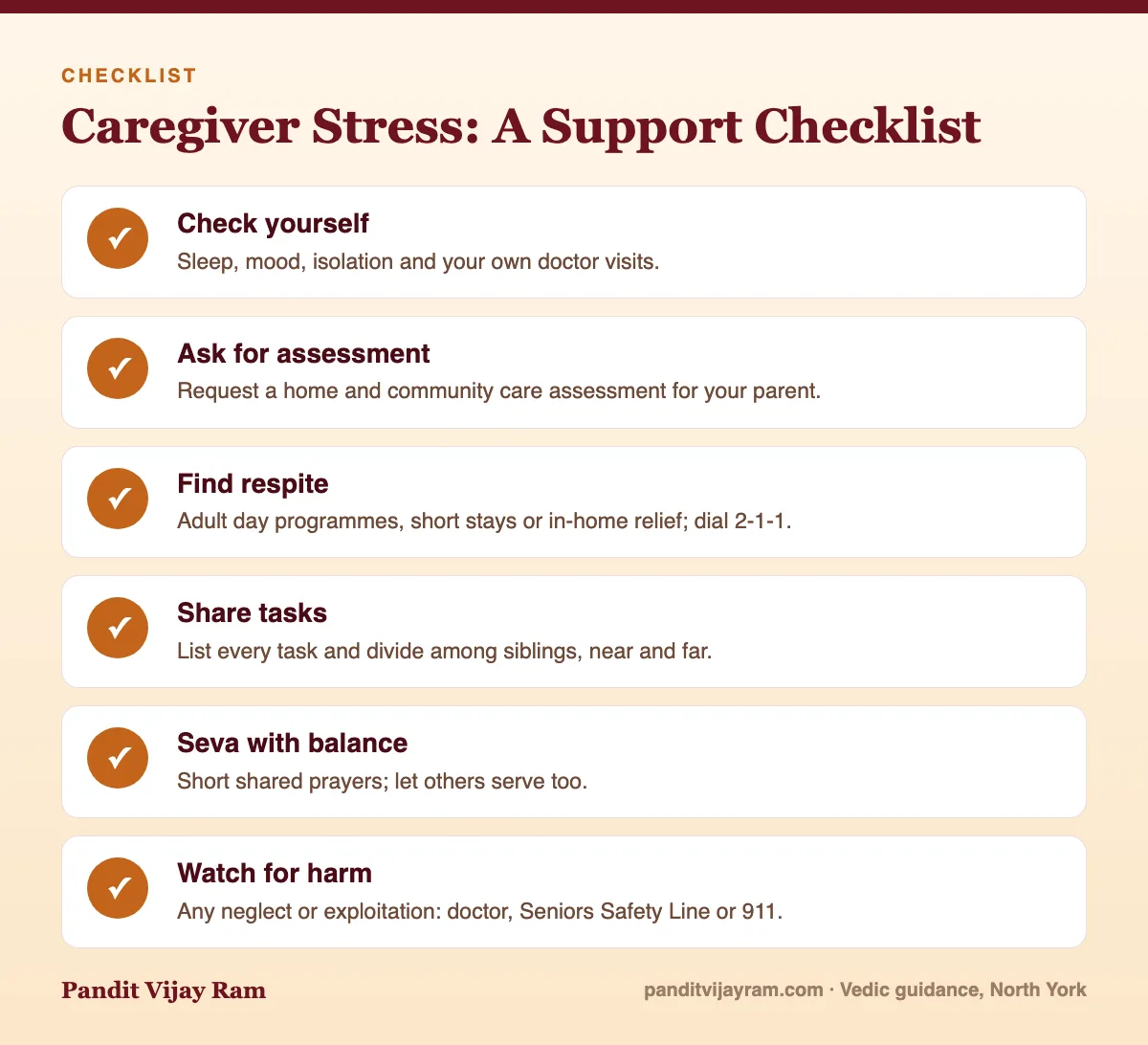
Caregiver stress is a natural result of love carried without enough support, and burnout signs should prompt you to seek help rather than push harder. Ontario home care, caregiver organisations, adult day programmes and respite care exist for families like yours, and 2-1-1 can point the way. Sharing tasks fairly among siblings protects both parents and family bonds. Seva is honoured in tradition, but true seva includes caring for your own health and recognising when everyone needs protection.
Key takeaways
- Burnout signs mean you need more help, not more willpower.
- Ontario home care, respite and caregiver groups support families; dial 2-1-1.
- Divide caregiving tasks among siblings, including those living far away.
- Seva done with patience and support honours parents better than exhaustion.
- Elder abuse can occur in stressed families; the Seniors Safety Line can help.