
South Asian Heritage Month in the GTA

Every spring my phone fills with photos from family celebrations, school assemblies and library displays, and someone always asks the same thing: is South Asian Heritage Month official, and when exactly is it? The confusion is understandable, because the United Kingdom marks a separate month in summer, while Canada and Ontario use May. Families in North York, Brampton and Mississauga want to celebrate without getting the facts wrong in front of their children's teachers. In more than forty years of serving Hindu, Sikh, Muslim and Indo-Caribbean families, I have seen how much it means to a child when their heritage is named and honoured in public. This guide explains how Ontario law recognises South Asian Heritage Month and South Asian Arrival Day, how it relates to Canada's Asian Heritage Month, which other heritage months matter to our communities, and simple, respectful ways GTA families, schools and workplaces can mark the month together.
What is South Asian Heritage Month in Ontario?
It is a month proclaimed by Ontario's South Asian Heritage Act. The Act declares May as South Asian Heritage Month and May 5 as South Asian Arrival Day. Its preamble links May to the arrival of South Asians from the Indian subcontinent to the Americas and recognises their contributions to Ontario.
The Legislative Assembly of Ontario's record of the bill shows two short proclamations:
- South Asian Arrival Day: May 5 in each year.
- South Asian Heritage Month: the month of May in each year.
The preamble explains why May was chosen. It says that for South Asians the month has long been a time of celebration and commemoration of their arrival from the Indian subcontinent to the Americas, which began on May 5. It also notes that South Asian immigrants began arriving in Ontario at the start of the twentieth century, and it pays tribute to the contributions South Asians have made, and continue to make, to the development and general welfare of the province.
That arrival history matters deeply to Indo-Caribbean families across the GTA, whose ancestors travelled from India to Guyana, Trinidad and Tobago and Suriname as indentured labourers before many of their descendants came to Canada. Our guide to Indo-Caribbean Hindu traditions in the GTA explores that heritage further.
The month is a recognition, not a statutory holiday. Schools and workplaces are not required to close, but many choose to mark it.

How is South Asian Heritage Month different from Asian Heritage Month?
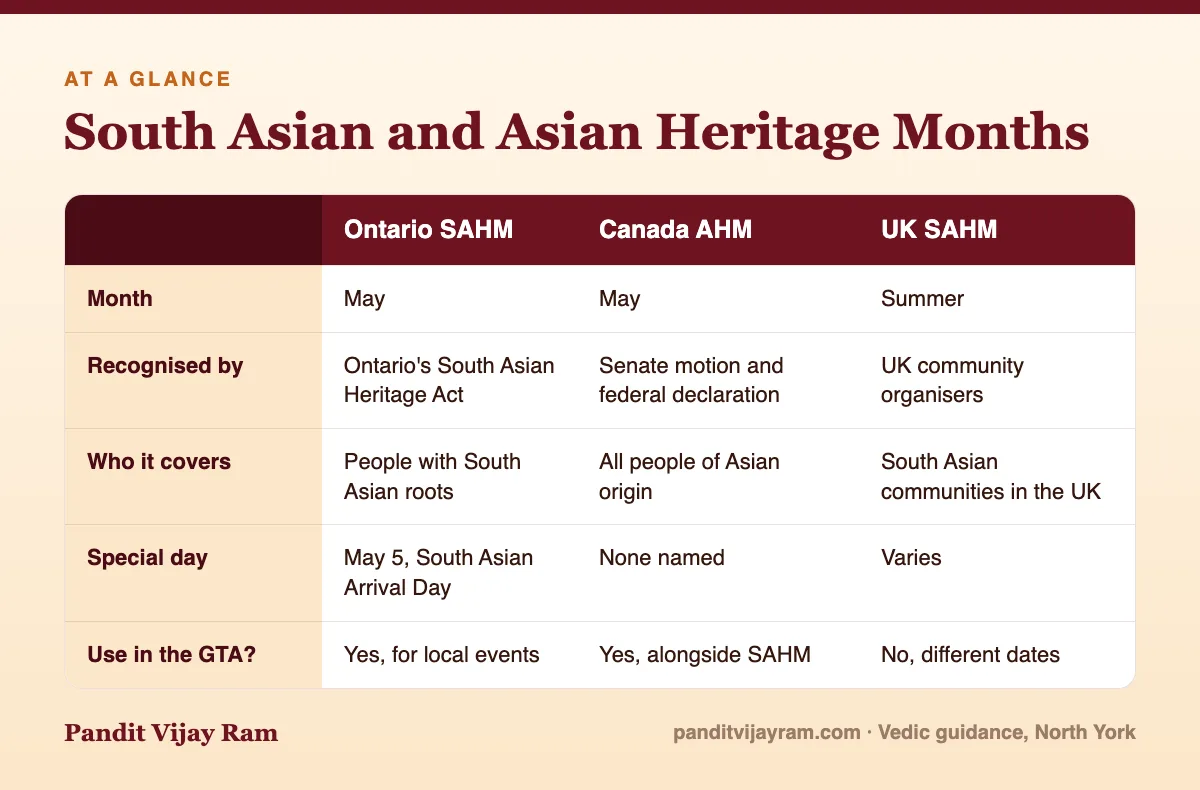
Ontario's South Asian Heritage Month, in May, focuses on people with roots in the Indian subcontinent. Canada's Asian Heritage Month, also in May, recognises all people of Asian origin, including South Asians. The federal month followed a Senate motion and a Government of Canada declaration. The UK observes a separate South Asian month in summer.
Three observances often get mixed up online:
- Ontario's South Asian Heritage Month (May). Proclaimed by provincial law, with May 5 as South Asian Arrival Day.
- Canada's Asian Heritage Month (May). Canadian Heritage explains that the Senate adopted a motion by Senator Vivienne Poy to designate May, and the Government of Canada then signed an official declaration. Its scope includes people whose roots lie in East, Southern, Western, Central and Southeast Asia.
- The UK's South Asian Heritage Month (summer). A separate British observance. Social media posts from the UK may use different dates, which is the usual source of confusion in the GTA.
The two May observances fit together well. A Toronto school might mark Asian Heritage Month across all Asian communities while giving South Asian Arrival Day a special assembly.
Canada's list of important and commemorative days also includes Tamil Heritage Month in January, Sikh Heritage Month in April and Hindu Heritage Month in November. Ontario has its own laws for Hindu, Sikh, Tamil and Bangladeshi heritage months as well. Our article on Hindu Heritage Month in Ontario covers the November observance.
Who does South Asian Heritage Month include?
It includes everyone with roots in South Asia: India, Pakistan, Bangladesh, Sri Lanka, Nepal, Bhutan and the Maldives, and the diaspora communities of the Caribbean, East and South Africa, Fiji and Mauritius. Hindu, Sikh, Muslim, Christian, Buddhist, Jain and secular families all share in it.
South Asian identity in the GTA is wonderfully varied. A single Brampton street may hold Punjabi Sikh, Gujarati Hindu, Tamil, Pakistani Muslim and Guyanese families. Each brings different languages, foods, festivals and histories.
A respectful celebration keeps that variety in view:
- Many faiths. Diwali, Vaisakhi, Eid, Christmas in Kerala, Vesak and Paryushana all belong to South Asian heritage.
- Many languages. Hindi, Punjabi, Urdu, Tamil, Gujarati, Bengali, Sinhala, Malayalam, Telugu, Nepali and more.
- Many routes to Canada. Some families came directly from the subcontinent; others came through the Caribbean, Africa or the Gulf.
- Shared and painful history. Partition, civil war and displacement live in many family memories. Approach them gently.
When I speak with a mixed group, I avoid presenting Hindu customs as the whole of South Asian culture. I am a Vedic practitioner, and I speak from that tradition, but the month belongs to everyone. Our guide to Lohri, Vaisakhi and Diwali in the GTA shows how Sikh and Hindu families share festivals, and interfaith marriage and family disapproval speaks to homes where several traditions meet.
How can GTA families celebrate South Asian Heritage Month?
Keep it personal and simple: record a grandparent's migration story, cook a regional dish together, borrow heritage books from the library, attend a local cultural event, visit a museum or temple with children, and share one tradition with a neighbour or classmate. A small, repeated act matters more than a large party.
Ten ideas that suit households across the GTA:
- Record an elder's story. Ask how they came to Canada, what they carried and what they missed. Save the recording for grandchildren.
- Map your roots. Mark ancestral villages and cities on a map with the children.
- Cook one regional dish from each side of the family.
- Borrow books and films in the home language. Our guide to South Asian heritage programmes at GTA libraries explains collections and Dial-a-Story.
- Attend a public event at a library, civic centre or community hall. Check municipal and library calendars each spring.
- Teach one word a day in Punjabi, Tamil, Gujarati or Urdu.
- Share music, from classical ragas to bhangra and baila.
- Visit a place of worship respectfully; our list of Hindu temples across the GTA includes etiquette tips.
- Invite a neighbour for chai and explain one family tradition.
- Give back through seva at a community kitchen or food bank.
For families who keep a home altar, lighting a diya on South Asian Arrival Day in honour of ancestors who made the journey is a gentle custom. A short prayer for pitrus, the ancestors, fits naturally, and our family peace prayers offer simple words for the whole household.
How can schools and workplaces mark the month respectfully?
Invite communities to lead rather than speaking for them, represent several faiths and regions, avoid treating culture as costume, and pair food and dance with history and present-day contributions. Check dates against Ontario's Act and Canada's Asian Heritage Month so materials are accurate, and never single out one student or employee as spokesperson.
Many parents ask me how to suggest ideas to a school or employer without seeming pushy. A short, friendly note with concrete offers usually works best.
Good practice for organisers:
- Ask, do not assume. Invite South Asian staff, parents or student clubs to shape the plan, and accept a no.
- Show variety. Include Sikh, Muslim, Hindu, Christian, Buddhist and Indo-Caribbean voices.
- Go beyond food and dance. Add history, such as arrival stories, alongside present-day contributions in medicine, business, arts and public service.
- Avoid costume play. Turbans, bindis and religious symbols carry meaning; explain them rather than handing them out as props.
- Get the facts right. Cite Ontario's South Asian Heritage Act and Canada's Asian Heritage Month, not UK dates.
If a festival in May or any other month requires time off, Ontario human rights guidance on creed applies. Our guide to religious accommodation in Ontario explains how to ask politely.
Families who want a reading for a new venture or a blessing during the month can explore our Vedic astrology and healing services, including pitra dosh prayers for ancestors. Heritage, though, is lived in daily kindness more than in any ceremony.
The bottom line
South Asian Heritage Month in Ontario is May, proclaimed by provincial law along with South Asian Arrival Day on May 5. It sits comfortably beside Canada's Asian Heritage Month and is distinct from the UK's summer observance. GTA families can mark it with elders' stories, food, books and seva, while schools and workplaces do best by letting communities lead and showing the full variety of South Asian life.
Key takeaways
- Ontario's South Asian Heritage Act proclaims May as South Asian Heritage Month.
- May 5 is South Asian Arrival Day in Ontario, marking arrivals to the Americas.
- Canada's Asian Heritage Month, also in May, includes South Asian communities.
- The month includes every South Asian faith, language and diaspora route.
- Simple family rituals, such as recording an elder's story, matter most.