
Interfaith Marriage and Family Disapproval: Holding Love and Family Together

A Hindu woman and a Muslim man, a Sikh man and a Hindu woman, a Christian and a Hindu raised two streets apart in Scarborough: these love stories are common in the GTA, and so is the pain that often follows when families find out. Interfaith marriage problems rarely begin with the couple. They begin with parents afraid of losing a child to another community, grandparents worried about rituals and funerals, and relatives asking what people back home will say. Couples in North York and across Canada come to me hoping for a way to keep both their love and their families. This guide covers that path. It explains how to respect both faiths without either partner disappearing, practical choices for the ceremony, how to speak with parents, and how a reading can be used gently rather than as a weapon. It is also clear about safety, because some families move from disapproval to threats. In more than four decades of practice, I have seen many disapproving parents soften over time. The couples who reached that point were patient, united and respectful of both traditions.
Why do families oppose interfaith marriage?
Most opposition comes from fear rather than hatred: fear that a child will abandon their faith, that grandchildren will be raised outside the tradition, that rituals such as marriage, festivals and funerals will be lost, and that the community will judge the family. Understanding which fear is strongest helps a couple respond to it.
When parents say no to an interfaith match, the reasons they give are often not the deepest ones. In conversations with families, I usually hear some mix of these worries:
- Loss of faith. Will my daughter stop praying? Will my son be asked to convert?
- The grandchildren. Which festivals will they celebrate, which name will they carry, which prayers will they learn?
- Food and home. Practical worries about vegetarian kitchens, beef or pork, alcohol, and whether elders will be comfortable visiting.
- Last rites. Many parents quietly fear that their child will not perform their funeral rites according to tradition.
- Community and history. Partition, regional conflicts and old wounds shape how some families see each other's communities.
- What others will say. The weight of reputation, especially for daughters.
Each fear has a different answer. A parent worried about faith may be reassured by seeing their child continue to pray. A parent worried about funeral rites may soften when the couple promises to honour them.
Inter-caste couples face some similar pressures, and our guide to inter-caste marriage and parents' approval covers that situation. For a step-by-step conversation plan with parents, see how to talk with parents about a love marriage.

How can an interfaith couple respect both religions?
Agree that neither partner will pressure the other to convert, learn the meaning of each other's key prayers and festivals, decide together how you will mark major holidays, and discuss in advance how children will be introduced to both faiths. Respect means curiosity and participation, not competition over whose tradition wins.
The strongest interfaith marriages I have seen are not the ones where faith is ignored. They are the ones where each partner has learned to honour what matters to the other.
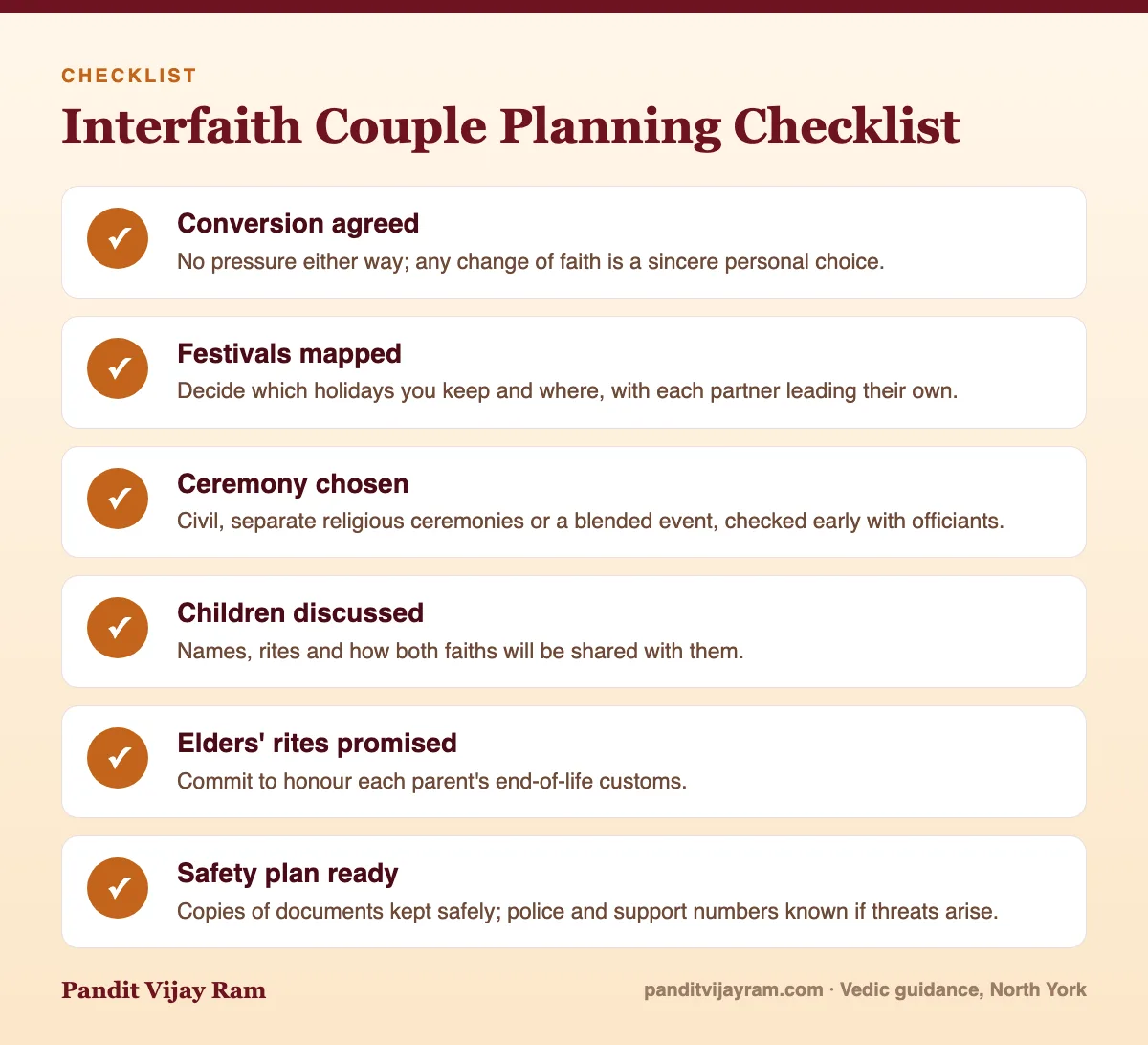
Topics worth agreeing before the wedding:
- Conversion. If either partner is considering conversion, it must be a sincere personal choice, never a condition set under family pressure.
- Festivals. Diwali and Eid, Vaisakhi and Navratri, Christmas and Holi. Many couples celebrate both sets, with each partner leading their own.
- Home practices. Is there a shared prayer space, separate spaces, or both? What food will be cooked at home?
- Children. Names, religious education, rites such as mundan or aqiqah, and how you will answer when they ask what they are.
- Elders' rites. Promise each other to support the rites your parents will want at the end of life.
A useful habit is attending each other's place of worship a few times before the wedding, with curiosity rather than as a performance. Parents often notice when a future son-in-law or daughter-in-law has quietly learned to fold their hands at aarti or stand respectfully during prayer.
I welcome couples of different faiths and do not ask anyone to adopt my tradition. For a Muslim partner who values prayer for guidance, our page on istikhara guidance explains that practice respectfully.
What kind of wedding ceremony can an interfaith couple have in Canada?
Couples in Canada can marry in a civil ceremony and add one or more religious ceremonies, combine traditions in a single event, or hold separate ceremonies for each family. Religious bodies set their own rules, so ask your pandit, imam, granthi or minister early. The legal marriage is what the licence and officiant register.
Ceremony planning is often where family tension comes to a head. Knowing the options helps the couple propose something realistic.
- Civil ceremony only. A licensed officiant, a small gathering, and family blessings afterward. Simple and legally complete.
- Civil plus two religious ceremonies. For example, a Hindu ceremony and a nikah on different days, each led by its own family. This lets both sets of parents see their tradition honoured.
- A blended ceremony. Some officiants combine elements such as the exchange of garlands, readings from both scriptures and a shared vow. Not every religious leader agrees to this.
- One religious ceremony with gestures from the other faith. A reading, a blessing from an elder or a piece of music from the other tradition.
Religious rules vary. Many gurdwaras perform Anand Karaj only when both partners are Sikh. Islamic scholars differ on interfaith nikah, and an imam may ask about conversion. Many Hindu pandits will perform a ceremony for an interfaith couple, while some follow stricter rules. Ask early and directly.
Families marrying in India sometimes use the Special Marriage Act, which allows a civil marriage without conversion. In Canada, a civil ceremony serves the same purpose.
Our guide to Hindu wedding rituals in the GTA explains the meaning of each rite, which can help a partner from another faith take part comfortably.
How do you get family acceptance for an interfaith marriage?
Acceptance usually comes slowly. Tell parents yourself, not through relatives, introduce your partner in small, ordinary meetings, address each specific fear with a concrete answer, involve a respected elder who is open-minded, and give parents time. Stay united as a couple, respectful in tone and firm about your decision.
Most parents need to move through shock, anger and grief before they can reach acceptance. The couple's job is to make that journey possible without giving up their relationship.
- Tell them yourself. Hearing it from a cousin or social media is far more hurtful.
- Small meetings first. Tea at home, a festival visit, helping with errands. Let parents see an ordinary, kind person before they see a symbol of another community.
- Answer fears specifically. "I will not convert. We will celebrate Diwali at your house every year. Our children will know your prayers."
- Find an ally. An aunt, uncle or family friend who is respected and open can carry messages more gently than you can.
- Hold your ground kindly. You can say "I love you, and I am going to marry them" in the same breath.
- Leave the door open. If parents refuse to attend the wedding, keep inviting them to birthdays and festivals afterward.
Some families value a chart reading. Used gently, it can become a bridge: an elder hears from a pandit that the couple's temperaments suit each other. Where the other partner's family does not share this tradition, a reading should only happen with both partners' consent and should never be used to veto the marriage.
The love marriage guidance page describes how I help couples prepare for these family conversations.
What if my family threatens me over an interfaith relationship?
Threats of violence, confinement, taking your passport, being sent abroad to marry someone else, or harming your partner are serious and illegal in Canada. Adults have the right to choose whom they marry, and forced marriage is a crime. Contact police, call 911 in an emergency, and reach out to a family violence service for a safety plan.
Disapproval is painful but survivable. Coercion is different, and it needs a different response. I have spoken with young people who were told they would be taken "on holiday" and married off, or who had phones and documents confiscated. These are signs of danger.
Warning signs to take seriously:
- Your passport or identity documents are taken from you.
- You are told you will travel abroad suddenly, with no clear reason.
- You are kept from school, work or friends.
- Your partner is threatened, or you are told someone will be harmed if you continue.
- Relatives monitor your phone and movements.
In Ontario, adults aged eighteen and over can marry without parental consent, and Canadian criminal law prohibits forced marriage. If you fear being taken abroad to marry, Global Affairs Canada can assist Canadians overseas, and police can help before you travel. Keep copies of your documents somewhere safe outside the home.
Spiritual guidance is never a substitute for safety. If someone offers a ritual to make you give up your partner, or to make your family accept them, please understand that neither is a way I work. Prayer is for your own strength, not to control anyone.
Once you are safe, the family problem support page describes how I help people rebuild relationships with family on their own terms.
The bottom line
Interfaith marriage problems often grow from parents' fears about faith, grandchildren and community rather than from hostility, and naming each fear helps a couple answer it. Respecting both religions, agreeing on conversion, festivals and children beforehand, and choosing a realistic ceremony give the marriage a stable base. Patient, united conversations with family usually do more than confrontation. Where disapproval turns into threats or forced marriage, safety and the law come first.
Key takeaways
- Family opposition usually comes from specific fears that can be addressed.
- Conversion must be a sincere personal choice, never a family condition.
- Civil, separate or blended ceremonies are all options in Canada.
- A chart reading may bridge families but should never veto a marriage.
- Threats, confiscated documents or forced marriage plans call for police help.