
Salt Water Mopping (Namak Pocha): Does It Clear Negative Energy?

Ask an aunty how to freshen a heavy-feeling house and there is a good chance she will say: put salt in the mop water. Salt water mopping is one of the most widely shared home remedies in South Asian families, passed down without much explanation. Readers in North York, Scarborough and Mississauga write to ask whether it really works, which salt to use, and why their mother-in-law insists it must never be done on a Thursday. This guide takes that one method and looks at it closely. You will learn the reasoning behind salt in Vedic and folk practice, the difference between rock salt, sea salt and table salt, the traditional day rules, and, most importantly for Canadian homes, which floors can take salt and which will be damaged by it. I will also be honest about what namak pocha can and cannot do. In more than forty years of guiding households, I have found it to be a useful weekly habit, provided no one expects a bucket of salty water to fix what a conversation or an electrician should.
Why is salt used to remove negative energy?
Salt absorbs moisture and has preserved food for thousands of years, so many cultures see it as a purifier that draws out what does not belong. In Indian folk practice it is believed to soak up heaviness from a space. That is a belief, not a measured effect, but the custom is widespread and harmless when done carefully.
Salt shows up in protective customs on nearly every continent. Japanese households place small cones of salt at entrances. Some European families once sprinkled salt across thresholds. In South Asia, a pinch of salt is circled around a child's head to remove nazar and then dissolved in water. The common thread is the idea that salt pulls something out and holds it.
In Vedic symbolism, the sea is associated with the Moon and with the churning of the ocean in the Samudra Manthan, from which both treasures and poison emerged. Salt from the sea carries that double meaning: it preserves and it cleans away. Rock salt, mined from the earth, is considered especially pure because it is untouched by processing and is allowed during many fasts.
There are also practical reasons the habit feels effective:
- A thorough mop removes dust, grit and spills, which improves how a room smells and feels.
- The weekly routine gives the household a moment of care and order.
- Opening windows while the floor dries brings in fresh air.
None of that is mystical, and that is fine. Tradition often bundles a sensible habit with a meaning that keeps people doing it. For the full traditional kit beyond salt, see the Vedic cleansing toolkit. Other home methods are gathered on the cleansing and protection hub.

Which salt is best for mopping the floor?
Coarse rock salt (sendha namak) or plain sea salt is traditionally preferred. Both dissolve easily and carry the meaning of purity. Ordinary iodised table salt works physically but is seen as less pure. Avoid scented bath salts, Epsom salt and dishwasher salt, which are different chemicals and can leave residue.
Here is how the common options compare in practice:
- Sendha namak (rock salt) – Pink or white crystals sold in South Asian grocery stores. Used in fasting food and many rituals. Most families choose this.
- Samudri namak (sea salt) – Coarse grey or white sea salt. Favoured in some coastal and South Indian households. Equally suitable.
- Himalayan pink salt – Essentially a rock salt. Fine to use, though there is no ritual reason to pay more for it.
- Iodised table salt – Works but contains anti-caking agents. Some families avoid it for puja purposes.
- Epsom salt – Magnesium sulphate, not sodium chloride. Not traditional and not needed.
How much? One small handful, roughly two tablespoons, in a standard bucket of water is enough. More salt will not add anything except a sticky film and a risk to your floors.
Some families add other ingredients:
- A few drops of Ganga jal or a little cow's urine (gomutra), in more orthodox homes.
- A pinch of turmeric, though it can stain pale grout.
- A few drops of camphor-infused water or neem leaves for fragrance.
Keep it simple if you are unsure. Plain water with rock salt and a brief mantra is the core of the practice. Use warm, not boiling, water so the salt dissolves fully before it touches the floor.
What is the Thursday mopping rule and which days are avoided?
Many North Indian families avoid salt water mopping on Thursday, the day of Brihaspati (Jupiter) and of Lakshmi in some regions, believing it washes away prosperity. Some also avoid mopping after sunset. Saturday and Tuesday are popular choices instead. These rules vary by family and region, so follow your own household custom.
Thursday, or Guruvar, is ruled by Jupiter, the planet of wisdom, wealth and growth. In parts of Uttar Pradesh, Bihar, Punjab and Rajasthan, households avoid washing hair, cutting nails, doing laundry and mopping with salt on this day. The reasoning is that heavy cleaning "washes out" Jupiter's blessings. Other communities have no such rule at all.
Common timing customs, as families describe them:
- Avoided: Thursday in many North Indian homes; after sunset in many homes across India, because Lakshmi is believed to visit at dusk.
- Preferred: Saturday, linked with Shani, for clearing heaviness; Tuesday, linked with Hanuman and Mars, for protection.
- Neutral: Sunday and Monday are used by many families for ordinary weekly cleaning.
A simple decision rule I suggest:
- If your family has a custom, follow it. Peace at home matters more than debating the rule.
- If you have no custom, choose Saturday morning.
- Mop before the evening lamp, not after it.
For deeper timing questions such as lunar days and rahu kaal, read the guide to the best day for spiritual cleansing. It explains how to check a local panchang without needing specific dates.
Can salt water damage floors?
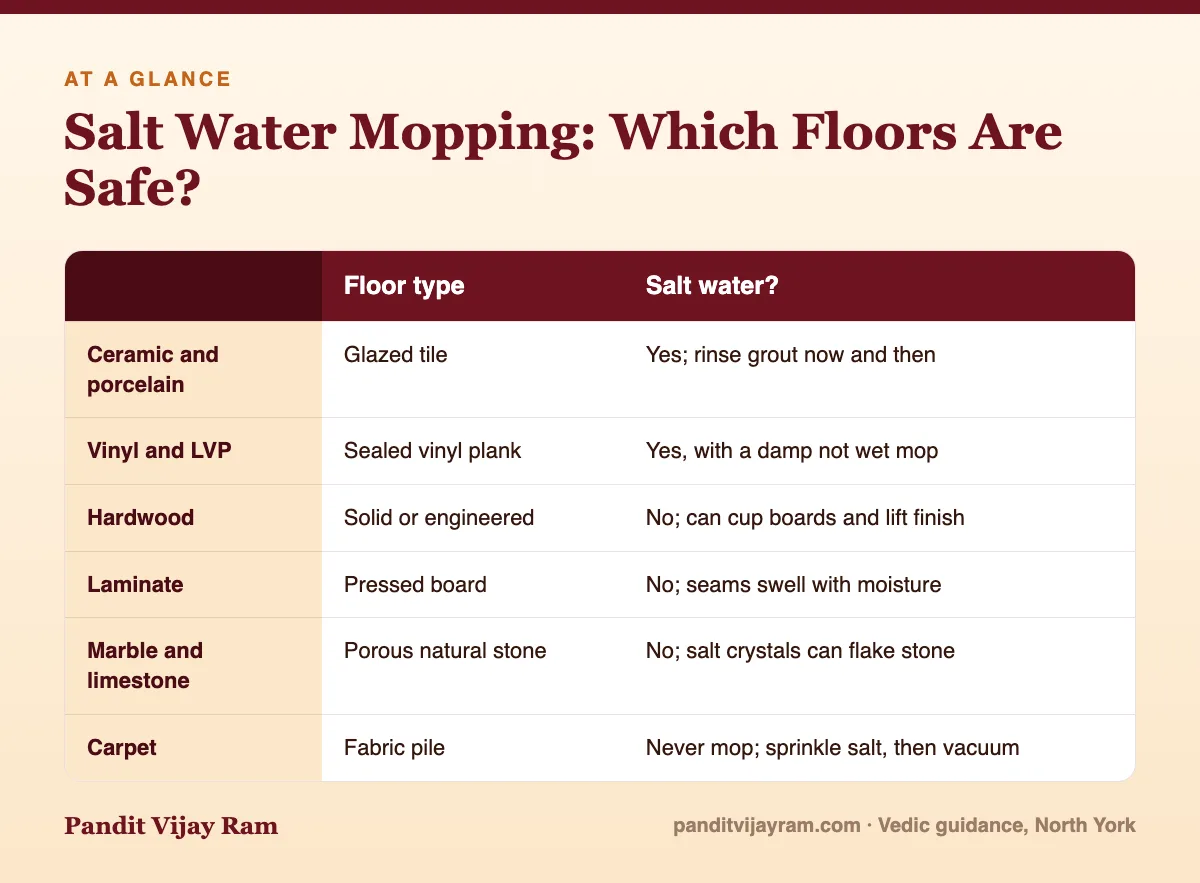
Yes. Salt can dull or etch marble, limestone and travertine, swell the seams of laminate, and soak into hardwood, raising the grain and leaving white marks. It is safest on glazed ceramic, porcelain tile, sealed vinyl and luxury vinyl plank. Always rinse or wipe with plain water if residue appears.
This is the part most online advice skips, and it can cost you real money. Toronto homes and condos have very different flooring from the stone and terrazzo floors where the custom began.
Floor-by-floor guidance:
- Glazed ceramic and porcelain tile – Safe. Rinse grout lines occasionally to stop salt building up.
- Vinyl and luxury vinyl plank (LVP) – Generally safe with a damp, not wet, mop.
- Engineered hardwood and solid hardwood – Avoid. Water and salt can lift the finish and cause cupping. Use a dry or barely damp microfibre pad without salt.
- Laminate – Avoid. Moisture enters the seams and the boards swell.
- Marble, limestone, travertine, slate – Avoid unless your installer confirms the sealer is intact. Salt crystals can grow inside porous stone and cause flaking.
- Polished or sealed concrete – Usually fine, but check with the installer.
- Carpet – Never mop. Sprinkle a little salt, leave it for an hour, then vacuum thoroughly.
For floors that cannot take salt, there are gentle options. Mop the tile areas, such as kitchen, bathrooms and entry, with salt water, and treat the wood areas with a dry microfibre pass followed by a Ganga jal sprinkle. You can also place a small bowl of rock salt in a room corner for a few days, then dissolve it in water and pour it outside.
Never mix salt water with bleach or other cleaners in the same bucket. If your building has rules about water on hallway floors, keep the practice inside your unit.
How do you do namak pocha the traditional way?
Sweep first, then dissolve a handful of rock salt in warm water. Mop from the innermost room toward the main door, ending at the threshold, while chanting quietly. Pour the used water outside or into a toilet, not a kitchen sink, then rinse the mop and bucket and wash your hands.
Most households follow this order, with small regional differences:
- Sweep or vacuum. Salt water on top of grit just moves dirt around.
- Mix the water. Two tablespoons of rock salt in a bucket of warm water. Add a few drops of Ganga jal if you have it.
- Start inside. Begin in the room furthest from the entrance, often a bedroom or the kitchen, depending on layout.
- Move toward the door. Mop each room in turn so that you finish at the main entrance. Mop the doorstep last.
- Chant softly. The Gayatri, Om Namah Shivaya or a simple Om keep the mind on the task.
- Dispose respectfully. Pour the water into a toilet or an outside drain. Many families avoid the kitchen sink and the puja room drain.
- Air and wash. Open windows while the floor dries, rinse the mop and wash your hands and feet.
Many families skip salt in the puja room itself and use plain water or Ganga jal there instead.
On honest limits: if the house still feels wrong after weeks of weekly mopping, salt is not the answer. Check for damp, mould behind furniture, noise, or strain between the people living there. The question-led guide is my house cursed? walks through ordinary causes first. If you then want a fuller look, the negative energy removal service explains how an assessment works.
The bottom line
Salt water mopping is a simple, much-loved custom that many families use weekly to keep a home feeling fresh, though its spiritual effect is a matter of faith. Choose rock or sea salt, use only a small handful, and mop from the innermost room toward the main door. Follow your household's day rules, with Thursday commonly avoided. Above all, protect your floors by keeping salt off hardwood, laminate and natural stone.
Key takeaways
- Namak pocha is a folk custom of mopping with rock or sea salt water.
- Two tablespoons of salt per bucket is plenty.
- Many North Indian families avoid salt mopping on Thursday and after sunset.
- Salt is safe on tile and vinyl but damages hardwood, laminate and stone.
- Mop from the inner rooms toward the door and dispose of the water respectfully.