
Vastu Remedies Without Demolition: Changes That Need No Renovation

You have been told your home has a vastu dosh, and the suggested fix involves moving a kitchen, knocking out a wall or buying a box of copper pyramids. That can feel overwhelming, and for most families it is simply not possible. The good news is that vastu remedies without demolition are the normal starting point, not a second-rate compromise. Homeowners and tenants in North York, Downsview and Brampton bring me the same worry in different forms: a cut corner, a toilet in the wrong zone, a door in a cautioned position. This guide lays out the practical fixes in order of cost, explains how to balance a missing corner, looks honestly at pyramids, strips and yantras, and describes the devotional remedies that tradition has always offered. It also explains when a problem is not about vastu at all, but about damp, wiring or a cracked foundation that needs a contractor. In more than forty years of practice I have recommended structural change only rarely. Care, order and prayer resolve most of what people bring to me, and they cost very little.
Can vastu dosh be corrected without breaking walls?
Yes. Classical vastu texts were written for planning new buildings, so they describe ideal layouts rather than demolition. For existing homes, practitioners work with three layers that need no construction: how rooms are used, how furniture and objects are arranged, and devotional practice. Most families can address their main concerns through these layers alone.
It helps to understand where the idea of a vastu dosh comes from. Texts such as the Mayamata and Manasara give guidance for choosing land, laying out rooms and orienting doors before building starts. They say far less about fixing a house that already stands. Remedies, or upaya, developed later as practitioners adapted the system to real homes.
I think of non-structural remedies in three layers:
- Use. Change what a room is for. A northeast bedroom can become a study or prayer room; a southwest store room can become the master bedroom.
- Arrangement. Move weight, light, water, colour and plants into the zones where vastu wants them.
- Devotion. Regular lamp-lighting, mantra and an occasional vastu shanti puja to bless the home as it is.
Each layer reinforces the others. Rearranging furniture without changing habits has limited effect, and prayer in a cluttered, neglected home feels hollow to most people.
Demolition is a big step with permits, costs, dust and disruption. It should only be considered when you are already renovating for practical reasons. Even then, vastu should be one voice among the architect, the contractor and your budget. If you want an independent view of a specific layout, a vastu consultation starts from this no-construction approach.

What are the simplest vastu fixes that need no renovation?
The simplest fixes are repairs and order. Mend leaking taps and broken fittings, clear clutter from the northeast and centre, place heavy furniture in the southwest, brighten dark corners, add healthy plants in the north and east, and keep the entrance clean and lit. These cost little and are recommended by almost every school of vastu.
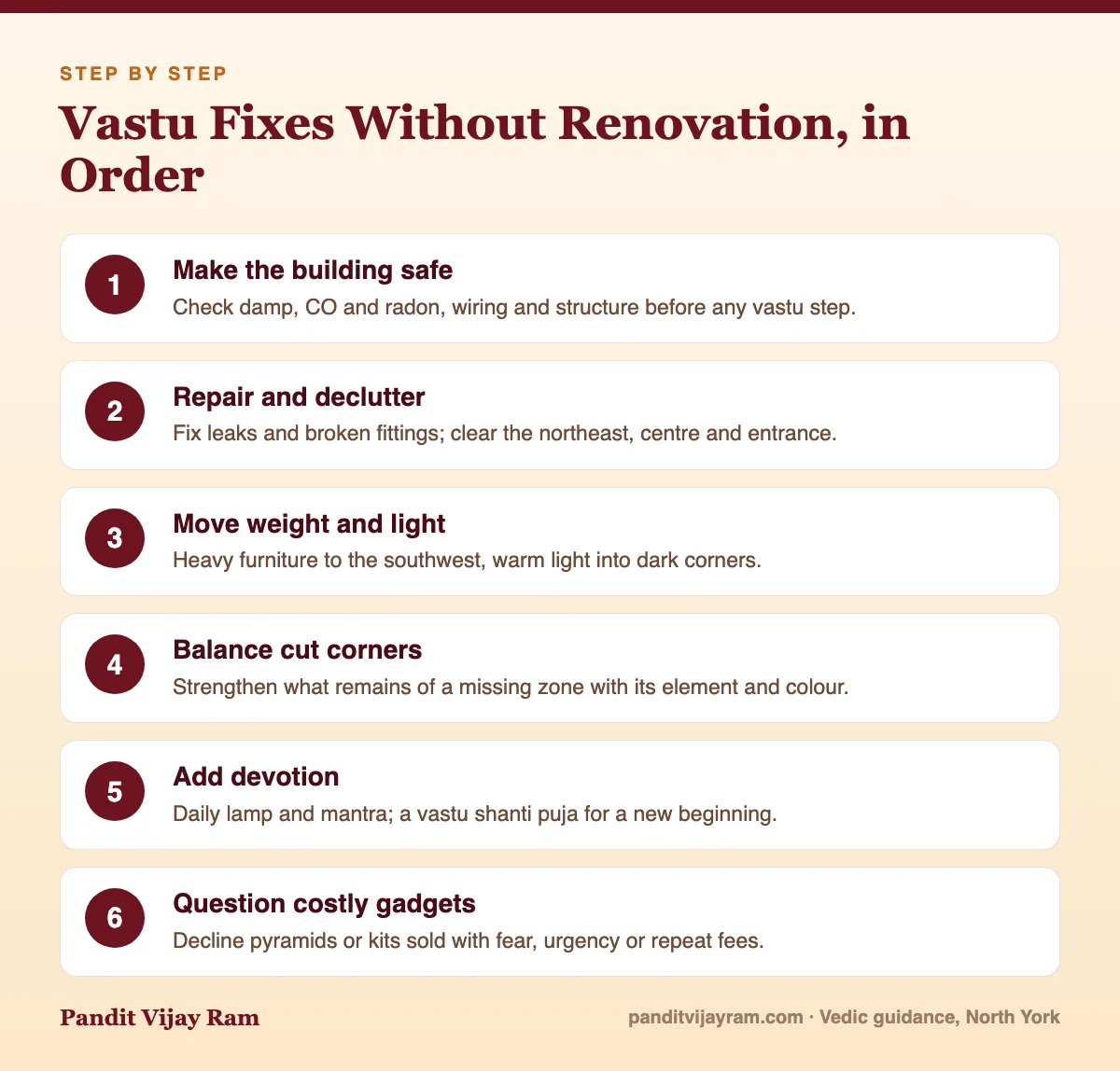
Here is a ranked list, from the steps I suggest first to the ones that come later:
- Repair what is broken. Dripping taps, cracked glass, stopped clocks, flickering bulbs and doors that stick are all seen as draining in vastu. They also make daily life harder.
- Clear clutter. Start with the northeast, the centre and the main entrance. Donate or recycle what you do not use.
- Move the weight. Wardrobes, bookcases and the master bed belong toward the southwest and south.
- Add light. A warm lamp in a dark northeast corner, a working porch light and clean windows.
- Adjust colour. Use textiles, rugs and cushions in direction colours before repainting.
- Place plants and water. Tulsi or other healthy plants in the north and east; a clean bowl of water in the northeast, changed daily.
- Reassign rooms. Swap a study and a bedroom if that brings each into a better zone.
Many people stop after the first three steps because the home already feels different. That is not magic; it is the effect of attention, light and order. For kitchen-specific fixes, see the guide to vastu for the kitchen, and for renters the apartment and condo guide lists what you can change without permission.
How do you fix a missing or cut corner in vastu?
A missing corner, where an L-shaped plan cuts away part of a zone, is balanced by strengthening what remains of that zone. Add light and life to a cut northeast, weight and earth tones to a cut southwest, and warm light to a cut southeast. Some practitioners also use a mirror on the adjacent wall to visually extend the space.
Irregular shapes are common in GTA homes: garages that cut into a corner, condos with notches for corridors, and additions that extend one side. Vastu prefers squares and rectangles, so these cuts are often flagged. A zone-by-zone approach:
- Cut northeast. Keep the remaining northeast area very clean and bright. Place a water bowl, a small prayer shelf or a healthy plant there. This is the cut most often treated with care.
- Cut southwest. Add weight: a heavy bookcase, stone planters or a solid piece of furniture. Earth tones such as beige, brown and terracotta help.
- Cut southeast. A warm lamp or a red or orange accent supports the fire element.
- Cut northwest. Light, moving elements such as a wind chime or curtains that catch the breeze suit the air zone.
On mirrors: some practitioners place a mirror on a wall facing the missing area to suggest that the space continues. Use this with care. Mirrors are usually kept off the south and west walls, and a mirror facing a bed or the main door is advised against.
An extension, such as a bay window or a porch, is treated differently from a cut. A small extension in the northeast is often welcomed; a large one in the southwest is more often questioned. Either way, the remedy is still arrangement rather than demolition.
Do vastu pyramids, copper strips and gadgets really work?
There is no evidence that pyramids, copper or brass strips, crystals or branded energy devices change a home's vastu. Some practitioners use them, and some people find them meaningful, but they are not part of classical texts. Be wary of kits sold with fear, urgency or high prices. Visible repairs and arrangement come first.
I want to be fair here. A small brass or copper yantra installed with prayer has a real place in Hindu devotional life, and many families value one in the puja room. My concern is with the market that has grown around "vastu correction" products.
Some warning signs when a gadget is recommended:
- You are told the house is dangerous and only this product can protect it.
- The price is high, and the seller is also the adviser who diagnosed the problem.
- Dozens of pyramids or strips are required, often with a recurring "energising" fee.
- The product claims to cure illness, fix finances or save a marriage.
- Removing it is said to bring bad luck.
Questions worth asking before you buy anything:
- Which text or tradition does this come from?
- What happens if I simply fix the clutter and light first?
- Can I see the cost in writing, with no future charges?
If a remedy cannot be explained plainly, it is fair to decline it. The guide to Kuber mantra and yantra claims covers wealth yantras in particular, and the article asking whether vastu is scientific looks at evidence more broadly.
What prayers and pujas are used to remove vastu dosh?
The traditional devotional remedy is the vastu shanti puja, which honours Vastu Purusha and the deities of the directions and is often done at griha pravesh or after major changes. Daily lamp-lighting, Ganesha worship before any new start and the Vastoshpati hymn from the Rigveda are simpler household practices that bless the home without altering it.
In Hindu understanding a house is more than a structure. It is a space where the deities of the directions are invited to dwell. Devotional remedies work at that level, as an act of respect and intention, not as a mechanical fix.
Common practices, from simple to formal:
- A daily lamp. A ghee or sesame-oil diya in the northeast or at the home altar each evening, lit safely and never left unattended.
- Ganesha first. A short Ganesha prayer before rearranging rooms or starting any change.
- Mantra. Some families recite Om Vastu Purushaya Namah; others use the Vastoshpati verses of the Rigveda, addressed to the lord of the dwelling.
- Navagraha prayer. Where a chart shows a difficult period, prayer to the nine planets accompanies home remedies.
- Vastu shanti puja. A formal ritual with kalash, havan and offerings to Vastu Purusha and the directional deities, usually led by a priest.
For apartment dwellers, a vastu shanti can be adapted to a smoke-free form with lamps replaced by LED diyas and the havan done elsewhere, in line with building rules. The puja and anushthan page explains how formal rituals are arranged. Choose the scale that fits your faith and your home; a simple daily practice offered sincerely is never second best.
When is a home problem not about vastu at all?
If a home feels heavy, causes headaches or brings constant illness, check the physical building first. Damp and mould, poor ventilation, faulty wiring, a failing furnace, carbon monoxide and radon are real hazards. Structural cracks, roof leaks and drainage problems need a qualified contractor or inspector. Vastu remedies should never delay those repairs.
People sometimes reach for vastu when the real cause is something a professional can find and fix. Before attributing trouble to a direction, consider these ordinary causes:
- Moisture. Musty smells, peeling paint and dark patches in basements and bathrooms suggest mould, which affects breathing and sleep.
- Air quality. A blocked furnace filter or a range hood that recirculates rather than vents can leave rooms stuffy.
- Carbon monoxide. Every home with fuel-burning appliances needs working CO alarms near sleeping areas.
- Radon. This invisible gas is found in many Canadian basements, and Health Canada advises homeowners to test for it.
- Electrical issues. Flickering lights or warm outlets need a licensed electrician.
- Structure. Widening cracks, sloping floors and water entering the basement need an inspector or contractor.
- People. Tension, grief, loneliness or overwork can make any house feel wrong.
If anyone in the home is unwell, see your family doctor. For a broader triage of uneasy homes, the guide asking whether a house can be cursed walks through ordinary causes before spiritual ones.
Once the building is safe, vastu can then do what it does best: help a sound home feel ordered, bright and blessed.
The bottom line
Vastu remedies without demolition rest on use, arrangement and devotion rather than construction. Repairs, decluttering, moving weight, adding light and reassigning rooms address most concerns, and a missing corner can be balanced by strengthening what remains of its zone. Pyramids and gadgets have no proven effect and should never be bought under fear. Make the home safe first, then let simple care and prayer do the rest.
Key takeaways
- Most vastu concerns can be addressed through how rooms are used and arranged.
- Repairs and decluttering are the first and cheapest remedies.
- A cut corner is balanced by strengthening the remaining part of that zone.
- No evidence supports pyramids, strips or branded energy devices.
- Check damp, CO, radon, wiring and structure before blaming vastu.