
Cleansing a Condo or Rental Without Fire or Smoke

Many people in high-rise buildings want to cleanse an apartment without smoke, and they are right to think twice before lighting camphor under a ceiling alarm. A condo tower in North York or a basement rental in Scarborough is a shared building, and one cloud of dhoop can set off an alarm, bring firefighters and upset a neighbour with asthma. The good news is that Vedic tradition never depended on smoke alone. Sound, water, salt, mantra and living plants are all old cleansing tools. Over four decades of advising families, I have seen these quieter methods work well in small spaces when they are done with steady attention. This article explains why smoke is a problem in GTA condos and rentals, which smokeless methods to use, how to do a full sound-and-water cleansing room by room, what landlords and condo boards usually care about, and when a bigger ritual should happen somewhere else.
Why shouldn't you burn sage, camphor or dhoop in a condo?
Condo and apartment smoke alarms are sensitive and often linked to the building system, so incense or camphor smoke can trigger a full alarm. Many leases and condo rules also forbid open flame or smoke, and smoke travels through shared ventilation into neighbours' units, which matters for anyone with asthma or allergies.
In a detached house, a little camphor near an open window is usually manageable. A condo is different for several reasons.
- Alarms are close and sensitive. Unit smoke alarms often sit a few metres from the kitchen and living room. Photoelectric sensors react to visible smoke particles, which is exactly what dhoop and sage produce.
- Building systems escalate. In many towers, corridor detectors and the fire panel can call the fire service. A false alarm disturbs hundreds of people and may lead to a charge from management.
- Air is shared. Bathroom and kitchen exhausts and corridor pressurisation move smoke into other units. Your neighbour may have a newborn or a lung condition.
- Rules exist. Condo declarations and rental leases frequently prohibit smoking, open flames or candles. Balconies are often included.
Never cover, unplug or disable a smoke alarm to allow a ritual. Ontario's Fire Code requires working alarms, and tampering is an offence. More importantly, the alarm is there for your family.
If you live in a house and want to use flame safely, the guides to camphor cleansing and guggul dhoop cover ventilation and alarm safety in detail. This page is for everyone who needs another way.

What can I use instead of smoke to cleanse my apartment?
The main smokeless tools are a brass bell or ghanta, mantra and chanting, clean water or Ganga jal sprinkled with a tulsi sprig, bowls of rock salt in corners, an electric or LED diya, and living plants such as tulsi. Each one carries the same intention of clearing and inviting good energy.
Here is how each smokeless tool maps to the role smoke normally plays:
- Sound replaces the moving smoke. A small brass ghanta rung in each corner is described in tradition as scattering heaviness. A conch works too, but it is loud, so keep it for daytime.
- Mantra replaces the fire offering. Repeating Om, the Gayatri mantra or the Mahamrityunjaya mantra while walking the space carries the prayer itself.
- Water purifies surfaces. Mix a few drops of Ganga jal, or simply clean water with a pinch of turmeric, in a small bowl. Dip a tulsi sprig or a flower and sprinkle lightly.
- Salt absorbs. Small bowls of rock salt, sendha namak, placed in corners are left for a week, then flushed away.
- Light without flame. An LED diya keeps the evening lamp custom alive without a smoke risk. Tradition values the intention behind the lamp.
- Plants hold the space. A tulsi pot on a sunny south-facing window is a daily act of care. Money plants and peace lilies suit lower light.
Fragrance can come from fresh flowers, a dab of sandalwood paste on the altar, or a few drops of natural ittar on cotton. None of these produce smoke.
The salt water mopping guide explains which floors tolerate salt, which matters on condo hardwood and laminate.
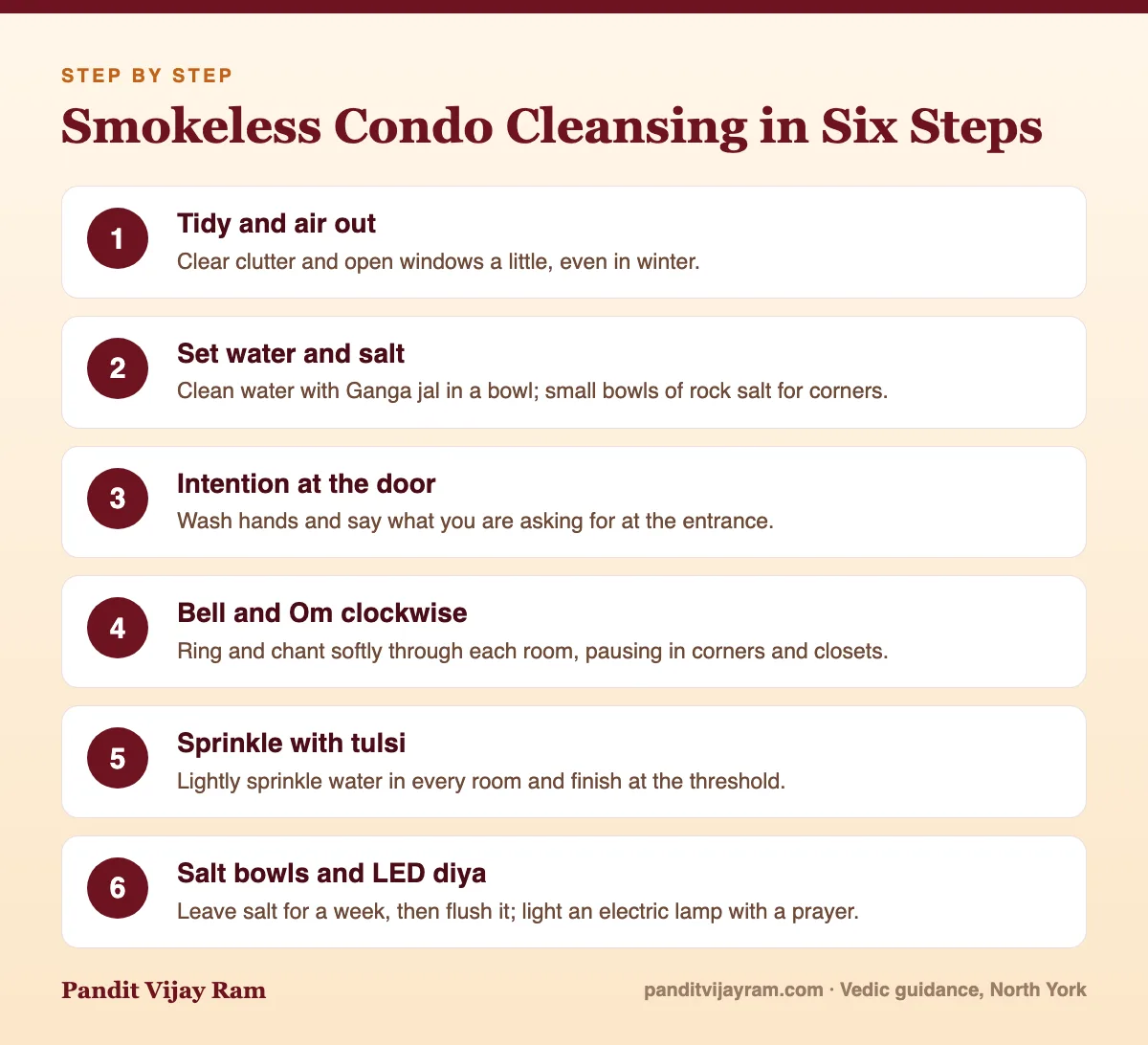
How do you do a sound cleansing with a bell in a small space?
Start at the main door, ring a bell steadily while chanting softly, and move clockwise through every room, pausing in corners, closets and behind doors. Finish at the entrance, sprinkle water at the threshold and sit quietly for a minute. Keep the volume considerate and stay within building quiet hours.
Sound cleansing works best when it is unhurried. Plan around twenty minutes for a one-bedroom unit.
- Prepare. Tidy first. Open the windows a little, even in winter, so the space feels fresh. Wash your hands and feet.
- Set the intention. Stand at the entrance and say in your own words what you want: peace, protection, a fresh start.
- Begin at the door. Ring the bell three times at the threshold, then walk clockwise into the unit.
- Pause where air sits still. Corners, closets, behind doors and under the bed are where tradition says heaviness settles. Ring a few times in each.
- Chant as you go. A soft, steady Om or the Gayatri mantra keeps the mind on the prayer rather than on the task.
- Return to the entrance. Sprinkle a little water at the door and on the step outside if the corridor allows.
A note on neighbours: most GTA buildings have quiet hours in their rules, and Toronto has a noise by-law. Morning or early evening is kind. Rest a hand on the bell to soften it in shared walls.
For the doorway itself, the article on threshold rituals at the main door includes condo-friendly options for toran and rangoli.
Can I do a spiritual cleansing in a rental without breaking my lease?
Yes. Choose practices that leave no marks and break no rules: no open flame, no nails, no turmeric on grout or carpet, and removable hooks for a toran. If you want a havan or larger puja, ask the landlord in writing or hold it at a temple or community hall instead.
Tenants and condo owners face slightly different rules, but the same courtesy works for both. Think about what the next occupant or the property manager will find.
- Stains. Turmeric, kumkum and sindoor stain grout, stone counters and pale carpet. Use a tray or a cloth under the altar.
- Salt. Salt water can dull some hardwood finishes and laminate. Wring the mop nearly dry, or limit salt to tile.
- Walls and doors. Hang a toran with removable adhesive hooks. Use rangoli stickers or a washable mat rather than powder on a corridor carpet.
- Shared spaces. Hallways, elevators and lobbies belong to everyone. Keep your practice inside the unit.
Many families also cleanse twice in a rental: once at move-in to make the space theirs, and again at move-out as a respectful handover. The new-home cleansing sequence can be adapted to a smokeless version easily.
When a reading genuinely calls for a fire ritual, it does not have to happen in your unit. A temple, a community hall or a relative's house with a proper hearth works. Vijay Ram ji arranges this through the puja and havan service when needed.
When is smokeless cleansing not enough?
Smokeless cleansing handles everyday heaviness well. If problems continue after several weeks of steady practice, first check practical causes such as damp, noise from neighbours, sleep and stress. If those are clear, ask for a reading, which may suggest a havan held elsewhere or another targeted remedy.
Small apartments concentrate problems. Thin walls carry a neighbour's arguments. Poor ventilation lets damp build in bathrooms without windows. Long Canadian winters keep people indoors, and a small space starts to feel heavy simply because it is used for everything.
Before deciding the cleansing failed, ask:
- Is there mould behind the bathroom caulking or under the sink?
- Is sleep being broken by noise, light or screens?
- Has the household been under money, job or relationship stress?
- Are you practising steadily, or only once when things felt bad?
If those questions do not explain it, a consultation is reasonable. The aura cleansing service looks at the person as well as the place, because sometimes the heaviness travels with someone rather than living in the walls. The cleansing and protection hub lists other methods to read about first.
And if someone in the home is struggling with low mood that does not lift, please see a family doctor. For anyone in crisis, Canada's 9-8-8 line is open by call or text at any hour.
The bottom line
You can cleanse an apartment without smoke by using the bell, mantra, water, salt and plants that tradition has always offered. Respect the building's alarms, the lease and the neighbours on the other side of the wall. Choose stain-free, mark-free methods and move any fire ritual to a temple or hall. If heaviness persists, check practical causes first, then seek a reading.
Key takeaways
- Condo smoke alarms react to dhoop and camphor, and many buildings forbid open flame.
- A bell, mantra, water, rock salt and tulsi carry the same cleansing intention.
- Walk clockwise from the door and pause in corners, closets and behind doors.
- Protect floors and grout from salt and turmeric, and use removable hooks.
- A havan, if needed, can be held at a temple or hall instead of the unit.