
Diwali, Navratri and Holi in Richmond Hill: Local Celebrations and Practical Rules

Every autumn I hear the same question from families: can we light fireworks for Diwali in Richmond Hill, or will a neighbour call the City? It is a fair worry. Rules differ between neighbouring cities, and what a cousin in Brampton or Mississauga is allowed to do may not apply on your street. I meet families in person in North York and by video across the GTA, and in more than forty years of Vedic practice I have seen that festivals feel most joyful when nobody is anxious about a fine or a fire. This guide gathers what the City of Richmond Hill actually says about consumer fireworks, open-air burning, fire pits and sky lanterns, and where those rules touch Diwali, Navratri and Holi. It also describes how the festivals are usually marked locally, without dates, and offers safe ways to keep each one meaningful indoors, in a condo or in a backyard.
Can you set off fireworks for Diwali in Richmond Hill?
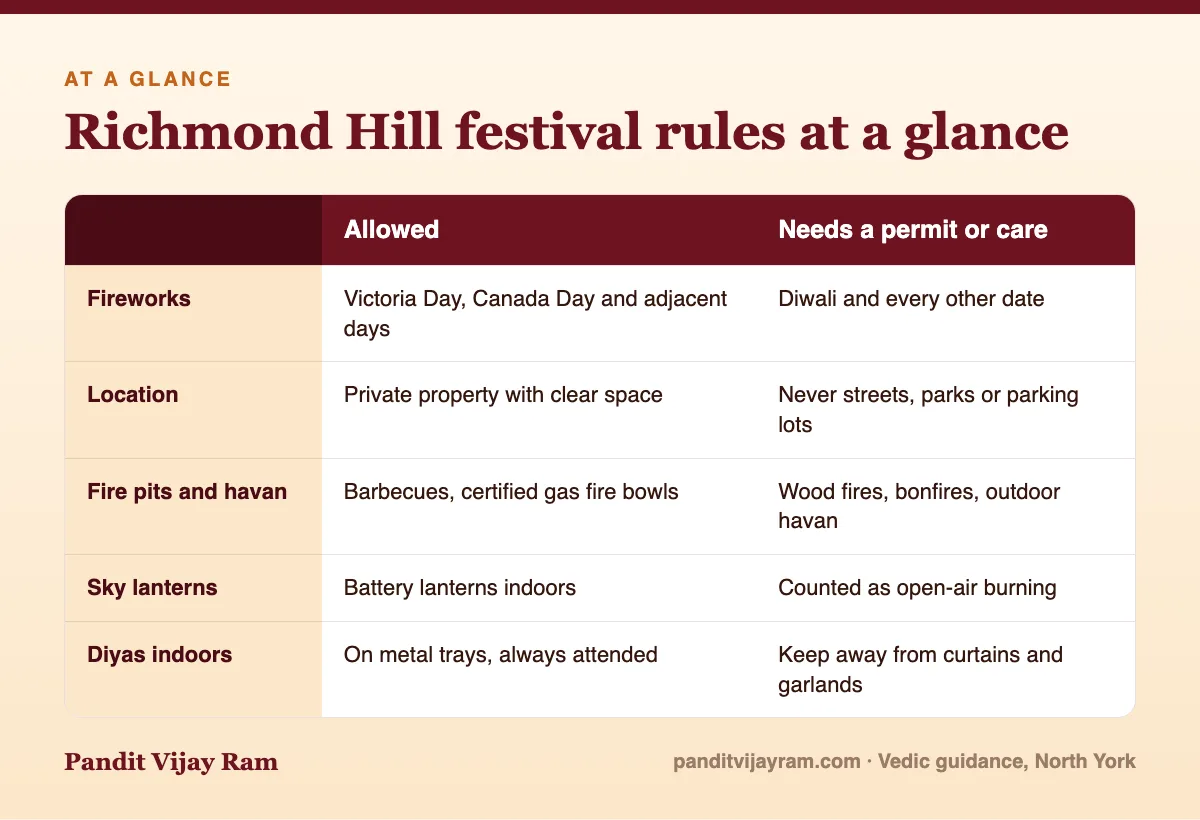
Only with a permit. Richmond Hill's fireworks rules allow consumer fireworks without a permit on Victoria Day and Canada Day and the day immediately before and after each. Diwali is not one of those days, so a household that wants fireworks for Diwali must apply for a permit through the City's online form beforehand.
This surprises families who have moved from cities that treat Diwali as a permit-free day. In Richmond Hill it is not. The City's fireworks page sets out the position plainly:
- Permit-free days: Victoria Day and Canada Day, plus the day before and after each, from sunset until late evening.
- Any other date: a permit is required for your own display, applied for online.
- Age: vendors may not sell to anyone under eighteen, and the City says an adult should light fireworks, never a child.
- Questions: the City directs them to Richmond Hill Fire and Emergency Services' Fire Prevention Division.
Apply well ahead of the festival and keep the permit handy on the night. If your neighbours are new to Diwali, a friendly note and a box of sweets beforehand does more for community harmony than any rule. For a comparison with other cities, see our GTA Diwali fireworks rules guide, and for the city next door, the Vaughan festivals guide. Rules can change, so always confirm on the City's own page before buying anything.

Where can fireworks legally be set off in Richmond Hill?
On private property, with the owner's permission, in a wide and clear space. The City says fireworks are not allowed on public property, including streets, City parks, community centres and parking lots. It recommends an area of at least thirty by thirty metres, free of trees and power lines, with spectators kept well back.
Many Richmond Hill homes have compact backyards, and townhouse lots are smaller still. Honest advice: if your yard cannot give you that open space, fireworks are not safe there, permit or no permit. The City's safety tips include:
- Choose a site at least thirty metres by thirty metres, with no trees or power lines overhead.
- Check the wind and do not light anything in strong gusts.
- Keep a pail of water or a hose ready.
- Bury the base of longer fireworks halfway in sand or soil.
- Stand an arm's length away when lighting, and keep spectators at least twenty metres back.
- Never relight a dud, never hold or throw a lit firework, and keep pets indoors.
- Wear eye protection and closed shoes.
After the celebration, the City says spent fireworks should soak in water overnight before going in the garbage. Unused live fireworks do not belong in any bin; the City asks residents to call York Regional Police on its non-emergency line to arrange disposal. Condo residents should assume balconies are off limits entirely; our guide to Diwali diyas and condo fire safety explains safer options.
Do fire pits, havan and sky lanterns need a permit in Richmond Hill?
Yes, in most cases. Richmond Hill defines open-air burning to include bonfires, fire pits, outdoor fireplaces and sky lanterns, and a permit from Fire and Emergency Services is required. Barbecues and certified propane or natural gas fire bowls are exempt. An outdoor havan with wood or samagri should be treated as open-air burning.
This rule matters for festivals more than people expect. A backyard havan for Navratri, a Holika Dahan bonfire, or releasing sky lanterns for Diwali all fall under the City's open-air burning by-law. The City's page notes several points:
- Permit first. A permit is required for any open-air burning, and the applicant must own the property or have the owner's signed permission.
- Exemptions. Cooking on a barbecue, and certified propane or natural gas appliances installed to the manufacturer's instructions.
- Buying is not permission. The City warns that being able to buy a chiminea or fire bowl in a store does not mean you may use it.
- Burn bans. During dry conditions the City can suspend all permits.
Most suburban lots will not meet the conditions for a permitted open fire. The practical answer is to hold the havan indoors at a small scale, at a temple, or with a professional priest in a suitable setting. Our guide to Holika Dahan and bonfire rules in the GTA suggests symbolic alternatives, and the puja and havan page explains a contained homa.
How is Diwali usually celebrated in Richmond Hill?
Diwali in Richmond Hill is marked at temples with special pujas, in banquet halls and community rooms with cultural evenings, and at home with diyas, rangoli, sweets and Lakshmi Ganesh puja. Vishnu Mandir on Yonge Street, for example, lists morning and evening Diwali pujas and a Diwali gala among its observances.
Diwali is the festival of lights, celebrated by Hindus, Jains and Sikhs, each with their own stories and emphasis. In Richmond Hill the celebrations tend to fall into three layers.
- Temple. Special pujas and darshan, with large crowds on the main evening. Arrive early and carpool where you can. Our guide to Hindu temples in Richmond Hill covers etiquette for busy days.
- Community. Cultural associations hold dinners, dance performances and family evenings in rented halls and community centres.
- Home. Cleaning the house, rangoli at the entrance, diyas at doors and windows, sweets for neighbours, and Lakshmi Ganesh puja in the evening.
Home practice is the heart of it. A clean, bright, peaceful home is the true invitation to Lakshmi, far more than noise or spectacle. For a step-by-step evening puja, read Diwali Lakshmi Ganesh puja at home. Battery diyas near curtains and real diyas on metal trays away from children keep the glow without the risk.
How can families mark Navratri and Holi safely in Richmond Hill?
Navratri centres on nine nights of Devi worship, fasting and, for many communities, garba and dandiya. Holi is a spring festival of colour. In Richmond Hill, most families combine home puja with community events in rented halls, use dry or natural colours outdoors on private property, and keep any fire within the City's open-air burning rules.
Navratri. Many households set up a ghatasthapana kalash, light an akhand jyot or a daily lamp, and observe fasts. Garba nights are usually held in large halls that can handle the crowd and the music. Practical points:
- An akhand jyot burning for nine days must sit on a stable metal tray, away from curtains, and never be left with no one home. A sealed electric lamp is an acceptable devotional alternative.
- Fasting should suit your health. Diabetics, pregnant women and anyone on medication should speak with their doctor first. Our Navratri in the GTA guide covers gentle fasting options, and Kanya Pujan explains the closing rite.
Holi. The colour play is joyful but messy.
- Play on your own property or at an organised event, not in a City park without asking the City first.
- Use skin-safe, dry colours and keep them out of eyes and drains.
- Holika Dahan, the bonfire the night before, falls under open-air burning, so most families mark it with a lamp and prayer instead.
For a Devi puja performed on the family's behalf, the Durga puja service describes what is involved.
What fire safety basics matter most during Richmond Hill festivals?
Working smoke alarms, attended flames and a clear plan. Ontario law requires a working smoke alarm on every storey and outside sleeping areas. During festivals, test alarms, never leave diyas or the jyot unattended, keep water nearby, and keep flames away from curtains, garlands and children's clothing, especially in busy homes full of guests.
Festivals bring guests, food and flames into the same rooms at the same time. A few habits prevent most problems.
- Test smoke alarms before the festival week. Never remove a battery to stop it chirping during puja; open a window or use less camphor instead.
- Count your flames. Know how many diyas are lit and who is responsible for each room.
- Use metal trays under every diya and incense holder.
- Keep paths clear of rangoli lamps where guests walk in saris and dupattas.
- Kitchen care. Deep frying for sweets is a common source of fires. Keep a lid nearby to smother oil flames and never use water on them.
- Last walk-through. Before bed, check every room and put out every flame.
If a festival season keeps bringing arguments, illness or heaviness to the house, and ordinary causes have been ruled out, a calm consultation may help; the Richmond Hill astrologer page explains how that works for local families.
The bottom line
Diwali in Richmond Hill can be joyful and fully within the rules. Remember that consumer fireworks need a City permit outside the Victoria Day and Canada Day windows, and only ever on private property with enough clear space. Treat fire pits, outdoor havan and sky lanterns as open-air burning that needs a permit. Keep diyas and the Navratri jyot attended, test smoke alarms, and let home puja remain the heart of every festival.
Key takeaways
- Richmond Hill allows permit-free fireworks only around Victoria Day and Canada Day.
- Diwali fireworks in Richmond Hill need a permit applied for in advance.
- Fireworks are banned in streets, City parks, community centres and parking lots.
- Fire pits and sky lanterns count as open-air burning and need a permit.
- Attended diyas and working smoke alarms prevent most festival fires.