
Manglik and Non-Manglik Marriage: Myths and Real Options

Few words cause as much quiet panic in South-Asian families as manglik. A proposal is going well, then someone compares charts and announces that one partner has mangal dosh and the other does not. Suddenly a manglik and non manglik marriage is spoken of as a danger. Couples in North York and across the GTA bring me these worries regularly, often after being told frightening things about illness, separation or worse. This guide is written for those mixed couples and their parents. It explains how the placement is counted, which cancellation rules most traditions accept, what the partner's chart contributes, and why the widely repeated idea that the dosha ends at age twenty-eight does not hold up as a rule. It also covers the remedies I actually suggest, and the warning signs of fear-selling. Over forty years of reading charts for marriage, I have seen far more marriages strained by the fear of mangal dosh than by Mars itself. My aim here is to replace that fear with clear information and a sensible next step.
Can a manglik marry a non-manglik?
Yes. Nothing in the Vedic tradition forbids the marriage. Astrologers first check whether the dosha is present by the stricter definitions, whether it is cancelled, and whether the non-manglik partner's chart carries balancing placements. When concern remains, prayer-based remedies are offered alongside practical preparation, and the couple still makes the decision.
Mangal dosh, also called kuja dosha, describes Mars in certain houses of the birth chart. Most North Indian practice counts the first, fourth, seventh, eighth and twelfth houses from the ascendant. South Indian practice usually adds the second. Some astrologers also check the same houses from the Moon and from Venus.
Because five or six of twelve houses qualify, a large share of people meet the simplest definition. That alone should tell families the label cannot mean what the frightening stories claim. If it did, a very large part of every community would be unable to marry.
The traditional concern is that a strong, unmodified Mars in these houses brings heat into the relationship: impatience, sharp words, competitiveness, or a restless need for independence. Matching a manglik with a manglik was historically thought to balance that heat. A mixed match asks a further question: how does the other partner's chart meet that energy?
Before any judgement, I confirm the birth time, because a difference of an hour can move Mars across a house line. I then work through the cancellations described below. Only after that do I talk about remedies. Couples who want this done carefully can book a relationship compatibility reading, and those who have already chosen each other may find the guide to kundli matching for a love marriage helpful.

What cancels mangal dosh in a kundli?
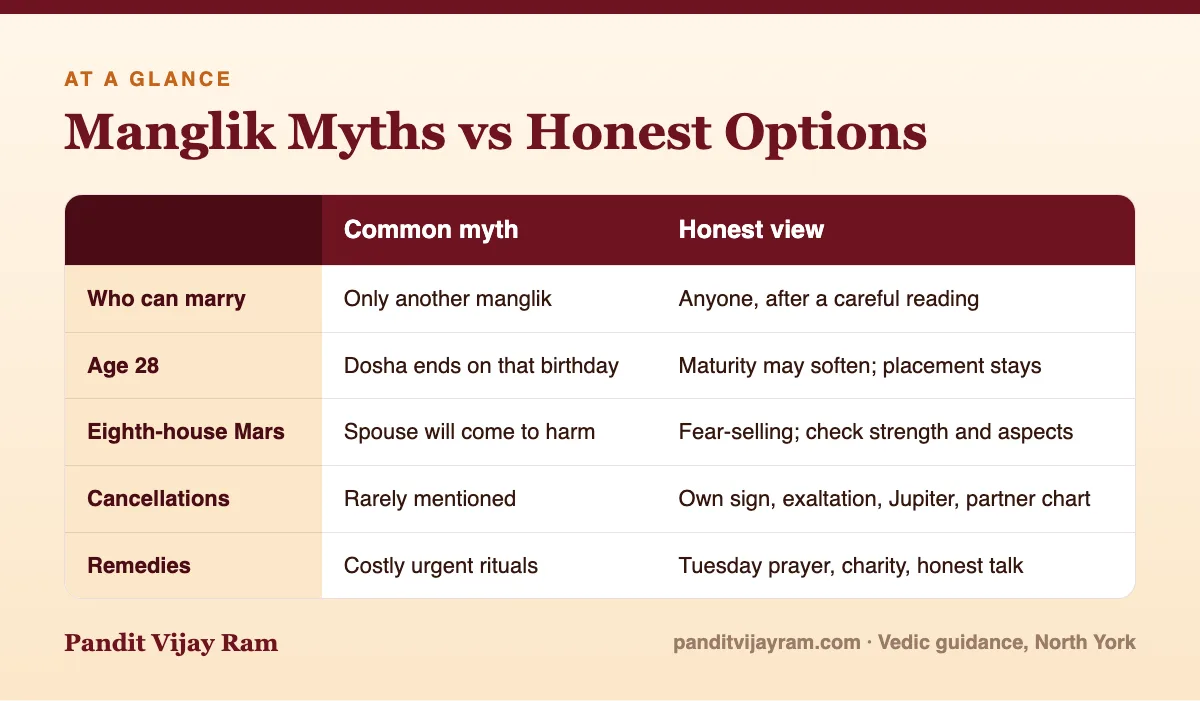
Common cancellations include Mars in its own signs Aries or Scorpio, Mars exalted in Capricorn, Mars joined or aspected by Jupiter, and sign-specific exceptions for particular houses. Many traditions also treat the dosha as balanced when the partner has Mars, Saturn or Rahu in the same set of houses.
Mangal dosh cancellation, or mangal dosh parihara, is where much of the confusion clears. Software often marks a person manglik without running these checks. A traditional reader works through them one at a time.
- Dignity of Mars. Mars in Aries or Scorpio, its own signs, or exalted in Capricorn, is widely held to act constructively rather than harmfully.
- Jupiter's influence. Jupiter conjunct Mars, or casting its aspect on Mars or on the seventh house, is a classic softening factor.
- House and sign exceptions. Classical lists name particular sign placements in particular houses as exempt. The lists vary between texts, so I tell families which one I am using.
- Strength of the seventh house. A well-placed seventh lord and a strong Venus change how a Mars placement plays out.
- Balancing in the partner's chart. Mars, Saturn or Rahu in the same houses in the other partner's chart is traditionally said to equalise the match, sometimes called dosha samya.
Where one or more of these apply, many astrologers describe the dosha as mild or cancelled. Where none apply, it still does not mean the marriage will fail. It means Mars deserves attention in how the couple handles anger, independence and decisions.
I also look at the other kootas. A pair with strong matching elsewhere stands on firmer ground. For one such factor, see bhakoot dosha explained.
Does mangal dosh end after age 28?
The belief that mangal dosh disappears at twenty-eight is a popular saying, not a consistent classical rule. Some astrologers link it to an idea that Mars matures around that age. Maturity may soften how a person expresses Mars energy, but a birth placement does not vanish on a birthday.
The age twenty-eight idea spreads because it is comforting and easy to repeat. Families hear it from relatives, matrimonial sites and online astrologers. It sometimes leads to a couple waiting years for no reason, or to an older manglik person being told the problem has gone when the real question was never answered.
Here is a fair way to understand it. Several traditions describe ages at which each planet is said to mature and give its fuller results, and twenty-eight is often cited for Mars. Life experience also matters. By the late twenties, many people have learned to channel drive and temper better than they could at twenty-two.
That is a statement about character growth, not about the chart changing. A careful reading still looks at where Mars sits, its strength, and the dasha periods each partner will run. If someone tells you to delay a marriage until twenty-eight purely because of Mars, ask what in the chart supports that advice.
Other versions of the myth say the dosha ends after thirty-two, or after the first child. None of these is a uniform rule. I would rather families know that clearly than plan their lives around a slogan.
Where a family has delayed marriage for other reasons and is now worried, our article on marriage delay and its real causes looks at the chart factors that usually matter more.
How do you spot fear-selling around mangal dosh?
Fear-selling sounds like predictions of a spouse's death or illness, pressure to pay for an urgent ritual, claims that only one practitioner can remove the dosha, and refusal to explain cancellations. An honest astrologer explains the placement, the cancellations and simple remedies, then leaves the choice with the family.
The eighth-house placement is the one most often used to frighten people, because the eighth house is traditionally linked with longevity. Telling a young woman that her chart will harm her husband is cruel, and it has led to real suffering, including women being rejected or blamed for misfortune that had nothing to do with them.
Watch for these signs:
- Catastrophic predictions. Statements about death, accidents or certain divorce are not a responsible reading of any single placement.
- Urgency and escalating costs. A ritual that must happen this week, followed by a second and third one.
- Secrecy. Being told not to discuss the reading with family or another astrologer.
- No explanation. If nobody can tell you which houses, signs and cancellations were checked, the reading is incomplete.
Mangal dosh is also a cultural belief that has caused harm, and I think it is right to say so. Families can respect tradition and still refuse to let a label decide someone's worth. A manglik woman or man is not a risk to anyone.
If someone has taken money from you through fear, the guide to fake spell casters online explains the patterns and how to report them to the Canadian Anti-Fraud Centre.
What are the real remedies for a manglik and non-manglik couple?
Practical remedies include Tuesday Hanuman prayer, recitation of the Mangal stotra or Hanuman Chalisa, Shiva-Parvati worship before the wedding, and charity such as donating red lentils. Kumbh vivah is used in some families but is optional. Equally important is honest premarital talk about anger, decisions and independence.
The remedies I suggest are modest and personal. They are meant to steady the person, honour the tradition the family values and bring the couple into the marriage with a shared intention.
- Tuesday practice. A lamp, the Hanuman Chalisa and a few minutes of quiet. Hanuman is traditionally the deity who steadies Mars energy. The Hanuman puja and havan page describes a fuller observance for families who want one.
- Mangal stotra or the Mars beej mantra. Recited by the manglik partner, ideally with the meaning understood.
- Shiva-Parvati worship. A shared Monday prayer before the wedding asks for harmony as a couple, not for one person to be fixed.
- Charity. Red lentils, jaggery or service to people in need on Tuesdays, given quietly.
- Symbolic marriage rites. Kumbh, peepal or Vishnu vivah are used by some families; they are not required. Our separate post on kumbh vivah and other mangal dosh remedies explains when they are used.
The practical side matters as much. Mars is about energy, assertion and anger. A mixed couple does well to agree how they will pause a heated argument, how big decisions get made, and how much independence each person needs. Couples counselling before marriage is a sensible step for anyone, and especially for a pair who have been told their charts clash.
No remedy can promise a particular outcome. What prayer and preparation can do is turn fear into attention, and attention into care.
The bottom line
A manglik and non manglik marriage is not forbidden; the real work is confirming the placement, checking cancellations and reading the partner's chart for balance. The age twenty-eight rule is a popular saying rather than a reliable principle, and predictions of harm to a spouse are fear-selling. Modest remedies such as Tuesday Hanuman prayer and Shiva-Parvati worship, paired with honest conversations about anger and decisions, give a mixed couple a steady start.
Key takeaways
- Mangal dosh is common and does not forbid any marriage.
- Own-sign, exalted or Jupiter-aspected Mars is widely treated as cancelled.
- The partner's chart can balance the placement through similar houses.
- The age twenty-eight idea is a folk saying, not a rule.
- Predictions of a spouse's death are fear-selling, not astrology.