
Planning a Hindu Wedding in Etobicoke: Licences, Venues and Rituals
A Hindu wedding Etobicoke families will remember starts long before the mandap is built. There is a licence to arrange, a priest whose registration you should confirm, a banquet hall that wants to know exactly how big the sacred fire will be, and a muhurat that has to work in Toronto time rather than Delhi or Georgetown time. Couples from Etobicoke regularly sit with me in North York to sort these questions out, often with one parent on speakerphone from abroad. This guide walks through the legal steps that make the marriage valid in Ontario, the questions to ask a venue about the havan kund, how a wedding muhurat is chosen and what the central rites actually mean. In more than forty years of guiding families, I have seen that the calmest weddings are the ones where the paperwork and the fire plan were settled months ahead, leaving the day itself for prayer and joy. The details below come from official City of Toronto and Ontario pages; confirm them again close to your date, because procedures change.
Where do Etobicoke couples get an Ontario marriage licence?
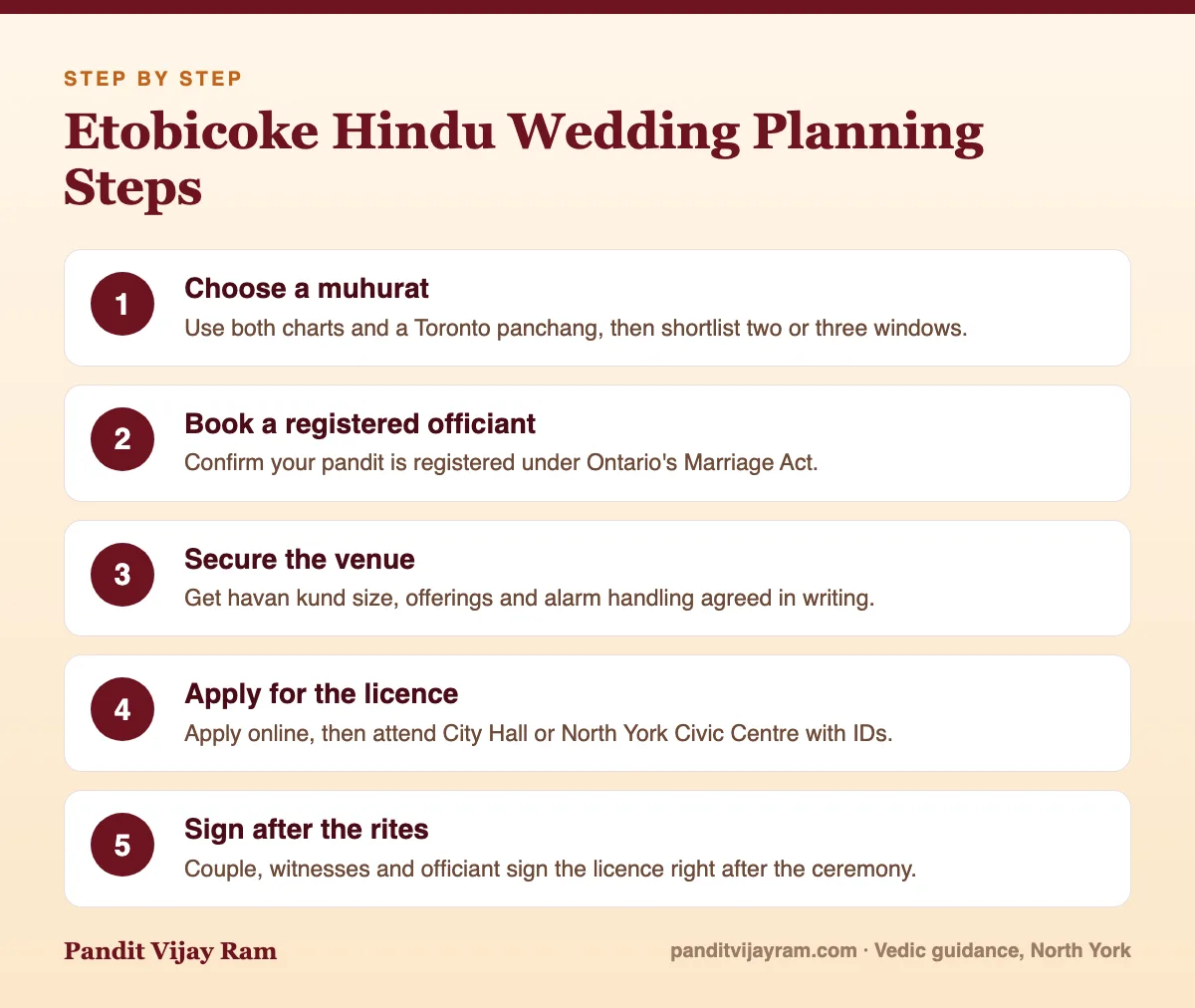
Etobicoke is part of Toronto, so couples can use the City of Toronto service. The City's licence page lists two counters, Toronto City Hall and North York Civic Centre. You apply online first, then book an in-person appointment where both partners bring two original government-issued IDs each. Any Ontario municipality's licence is valid province-wide.
Many Etobicoke couples expect to collect a licence close to home, but the City of Toronto currently lists only two counters: Toronto City Hall on Queen Street West and North York Civic Centre on Yonge Street. Service is by appointment only.
The process runs in a set order:
- Complete the City's online application and note the application number.
- Print the form and have both partners sign it in original ink; digital signatures are not accepted.
- Book the in-person appointment when prompted.
- Bring two valid, original, government-issued IDs for each partner. Health cards and SIN cards are not accepted, and documents not in English need a certified translation.
Toronto asks couples to apply within ninety days of the wedding, and Ontario states that a licence is valid for three months from the date it is issued. Because an Ontario licence works anywhere in the province, some west-end couples find an appointment in a neighbouring municipality more convenient. Our GTA marriage licence guide compares the options across the region.
Sort the licence before printing invitations. A missing ID or a name spelled differently on two documents is the most common reason couples leave without one.
Who can legally perform a Hindu wedding in Ontario?
Under Ontario's Marriage Act, a religious marriage must be performed by an officiant who is recognised by their religious body and registered with the province. Ask your pandit directly whether he is registered. The couple, their witnesses and the officiant sign the licence immediately after the ceremony.
Ontario allows religious officiants to solemnise marriages, but only if they are duly recognised by their religious body as entitled to perform marriages and are registered under the Marriage Act. A priest may be deeply learned and still not be registered, especially if he has recently arrived or usually serves in another province.
Families handle this in one of two ways:
- One registered officiant performs the Hindu ceremony and signs the licence, making the religious and legal marriage the same event.
- A separate civil ceremony takes place first, for example at a City wedding chamber, and the Hindu rites follow as a religious celebration. The City of Toronto lists civil weddings at North York Civic Centre and Old City Hall.
Either route is valid. What matters is clarity, so that no one assumes the temple priest is handling the legal side when he is not. Ontario also allows banns as an alternative to a licence in limited cases; your officiant can tell you whether that applies.
Our article on questions to ask when finding a pandit in the GTA includes registration, the length of the ceremony and which regional tradition he follows. Families planning a love marriage across communities may also want our love marriage guidance for the conversations that come before any of this.
What should you ask an Etobicoke venue before booking a havan kund?
Ask whether open flame is allowed indoors, what size of kund and how much ghee and samagri are permitted, whether smoke detectors can be managed by the venue's own staff, and what the venue's fire safety plan requires. Get the answers in writing before you sign the contract.
Banquet halls in Etobicoke host Hindu, Sikh, Christian and secular weddings in the same week, and each venue sets its own rules for flame. Some allow a small copper kund on a metal tray; others allow only a symbolic lamp. Outdoors, Toronto's rule is that open air burning is not permitted without a permit, although the City offers a cultural fire authorisation, with no user fee, for outdoor fires connected with a specific cultural or religious practice.
A short checklist to take to every venue viewing:
- Is an indoor havan kund allowed, and what size?
- How much ghee, wood and samagri can be offered?
- Will venue staff manage the smoke detectors, and who is responsible if an alarm sounds?
- Must a fire extinguisher and a staff member stand near the mandap?
- For outdoor ceremonies, has the venue worked with Toronto Fire Services on a cultural fire authorisation before?
- How long is the ceremony slot, and can the mandap be set up early?
A smaller fire does not make the marriage less sacred. Agni is the witness whether the flame is large or modest. If the venue limits the fire, ask your priest to keep the full mantras while reducing the offerings. Our puja and havan page explains how a havan can be scaled without losing its meaning.
How do you choose a wedding muhurat from Toronto?
A muhurat is an auspicious window chosen from the couple's charts and the panchang. For an Etobicoke wedding, the calculation must use Toronto's time zone and local sunrise, not the time in India. Check a current Toronto panchang, then match a few suitable windows against venue availability.
Muhurat selection usually considers the tithi, nakshatra, yoga and the lagna rising at the moment of the main rites, along with the couple's moon signs. Many traditions avoid certain months and periods for weddings, and different regional schools disagree on some of them. That is normal and worth discussing with your family's own priest.
Two practical points matter in Canada:
- Local time. Sunrise in Toronto differs from sunrise in Punjab or Gujarat, and the lagna changes roughly every two hours. A muhurat copied from an Indian calendar may fall at the wrong moment here.
- Venue windows. Halls often book in fixed slots. Find two or three acceptable muhurats, then see which one the venue can accommodate.
Our full guide to choosing a wedding muhurat in Canada explains each factor in more depth. Couples who are still at the matching stage can read about kundli matching for love marriage, which treats compatibility as guidance rather than a verdict.
A muhurat helps a family begin with intention and calm. It does not decide whether a marriage succeeds; that rests on the two people and their families.
What do the main Hindu wedding rituals mean?
The rites mark a passage from two households into one. Ganesh puja asks for an unobstructed start, kanyadaan entrusts the bride with blessings, the sacred fire stands as divine witness, and saptapadi, seven steps with seven vows, seals the marriage in many traditions. Regional customs add their own beautiful variations.
Etobicoke weddings bring together families with roots in Punjab, Gujarat, Tamil Nadu, Kerala, Guyana and Trinidad, among many others. The order and names of the rites differ, but most share a common spine:
- Ganesh puja, so that the day begins free of obstacles.
- Jaimala, the exchange of garlands, showing mutual acceptance.
- Kanyadaan, in which the bride's parents place her hand in the groom's with prayers; some modern couples reinterpret it as both families giving their blessings.
- Vivah homa, the offering into the sacred fire.
- Pheras or saptapadi, the circling of the fire or the seven steps, each tied to a vow of nourishment, strength, prosperity, family, children, health and lifelong friendship.
- Sindoor and mangalsutra, marks of the new marriage in many communities.
Ask your priest to explain each step in English for guests who did not grow up with the ceremony. Families worried about envy on the day may find our guide to nazar at weddings reassuring, and you can learn about local mandirs in our guide to Hindu temples in Etobicoke. For personal chart guidance before the wedding, see the Etobicoke astrologer page.
The bottom line
Planning a Hindu wedding in Etobicoke goes smoothly when three things are settled early. Get the Ontario marriage licence through an appointment at Toronto City Hall or North York Civic Centre and confirm your officiant is registered. Agree the havan kund rules with your venue in writing, and choose a muhurat calculated for Toronto time so the rites carry their full meaning.
Key takeaways
- Toronto issues marriage licences by appointment at City Hall and North York Civic Centre.
- Each partner needs two original government-issued IDs; health and SIN cards are not accepted.
- Only a registered officiant can make a religious wedding legally valid in Ontario.
- Agree the size and handling of the havan kund with the venue in writing.
- Calculate the muhurat for Toronto's local time, not an Indian calendar.