
Diwali, Navratri and Holi in Etobicoke: Local Celebrations and Practical Rules
Diwali in Etobicoke spans very different homes. Along the lakeshore, families in Humber Bay and Mimico condominiums light electric diyas behind glass; in north Etobicoke, households with backyards wonder whether a few fireworks are allowed this year; and Sikh and Jain neighbours mark the same season with observances of their own. Navratri brings garba nights and Kanya pujan, Holi brings colours in spring, and relatives drive over from North York to join in. Because Etobicoke has been part of the City of Toronto since amalgamation, every one of these celebrations falls under Toronto's rules on fireworks, open fires and parks. Families who move here from Brampton or Mississauga are often surprised by how those rules differ. This guide explains them in plain terms, describes how festivals are usually kept in Etobicoke without naming dates, and suggests safe ways to celebrate at home and in the community. In more than forty years of guiding families through these festivals, I have found that a well-planned, rule-abiding celebration leaves room for what matters: the prayer and the people.
What are the fireworks rules for Diwali in Etobicoke?
Toronto allows consumer fireworks without a permit only on Victoria Day and Canada Day, on your own private property, until eleven at night. Diwali is not a permit-free day. To set off fireworks at home for Diwali in Etobicoke, request a permit from Toronto Fire Services at least ten business days ahead.
Rules in neighbouring municipalities are set by their own councils, so what a relative in Peel Region tells you may not apply on your street. In Etobicoke, the City of Toronto's fireworks page is the reference.
The essentials, as Toronto states them:
- Two permit-free days only. Victoria Day and Canada Day, on property you own, finished by eleven at night.
- A permit for everything else. Toronto Fire Services handles requests, which must arrive at least ten business days before the date.
- No late finishes. A permit does not extend the eleven o'clock limit.
- Adults only. Toronto does not permit anyone under eighteen to set off fireworks, and an adult must supervise the whole time.
- Safe disposal. Soak used and unused fireworks fully in water overnight, put no more than ten in a garbage bin per collection, and never place them in the Blue Bin.
Many Etobicoke families have shifted the focus of Diwali to lamps and lights, which suits the festival's name and avoids the permit process. For a comparison with rules in Brampton, Mississauga and York Region, see our GTA Diwali fireworks rules. Families celebrating in the east end can read the Scarborough festival guide, which covers the same City rules from a different angle.

Can you celebrate festivals in Centennial Park, James Gardens or Humber Bay Park?
Yes, within City park rules. Fireworks and bonfires are not allowed in any Toronto park. A gathering of fewer than twenty-five people without its own barbecue generally needs no booking; larger picnics need one. Amplified sound, tents, stages, food served to the public or generators make it a special event needing a separate application.
Etobicoke's large parks, including Centennial Park, James Gardens on the Humber River and Humber Bay Park on the lake, draw families for festival picnics, Holi colours and photographs in traditional dress. A little planning keeps those outings within the rules.
- Small family Holi. Under twenty-five people and no barbecue: usually no booking. Keep colours well away from the Humber River and the lake, and leave the grass as you found it.
- Community picnic. Over twenty-five people, or bringing your own barbecue: book a picnic area through the City. Toronto's picnic booking page lists picnic sites, shelters, outdoor ovens and designated firepits that can be booked.
- Garba or bhangra with speakers. Amplified sound makes it a special event, whatever the size.
- Festival fair with food stalls or a stage. A special event application, made well in advance by an eligible organisation with insurance.
A designated firepit booked for a picnic is not the same as a ceremonial bonfire, so ask the City before planning any ritual use of one.
For a quieter festival evening, a home puja followed by a walk in the park keeps everyone within the rules. Our guide to Diwali Lakshmi Ganesh puja at home gives a simple order of worship.
How do Etobicoke condos and houses change festival plans?
Lakeshore and other high-rise condominiums usually ban open flame and fireworks on balconies and in hallways, so electric diyas and indoor puja suit them best. Detached and semi-detached houses in north and central Etobicoke can use real diyas indoors with care, and backyard fireworks only with a permit. In every home, working smoke alarms come first.
Toronto's fireworks rules name balconies among the places fireworks are never allowed. Condominium declarations and rental agreements often go further, limiting candles, incense and even rangoli in shared corridors. Read your building's rules before the festival week, and ask management if anything is unclear.
Practical adjustments by home type:
- High-rise condo. Electric diyas on window sills, a single real lamp at the shrine only if your rules allow, rangoli inside your own door, and no sparklers anywhere on the property.
- Townhouse. Check the condominium corporation's rules for front steps and shared gardens. A small rangoli at your own door is usually welcome.
- House with a yard. Real diyas on non-flammable trays away from curtains, and fireworks only with a Toronto Fire Services permit on your own property.
- Basement or rented unit. Agree any lamps with the landlord, keep them far from the smoke alarm, and never leave them unattended.
Toronto advises that smoke alarms be on every level and near each sleeping area, and tested monthly. A quick test before Diwali takes seconds. Our guide to Diwali diyas and condo fire safety goes deeper into sprinklers, hallway rules and lamp placement in towers.
How do Hindu, Sikh and Jain families in Etobicoke mark the Diwali season?
Hindu families usually clean the home, draw rangoli, light lamps and perform Lakshmi Ganesh puja in the evening. Sikh families observe Bandi Chhor Divas at the same season, often with prayers and lights at the gurdwara. Jain families mark Diwali as the anniversary of Mahavira's nirvana. Many households share sweets across these traditions.
Etobicoke has a large South Asian population and a sizeable Punjabi-speaking community, so the Diwali season here is shared by several faiths. Each observance has its own meaning, and neighbours who understand the differences celebrate with more warmth.
- Hindu Diwali. Preparations begin days ahead with cleaning and shopping. On the main evening, families light diyas, worship Lakshmi and Ganesha, and visit friends with sweets.
- Bandi Chhor Divas. Sikhs remember the release of Guru Hargobind from imprisonment. Gurdwaras are lit, and families join prayers and langar.
- Jain Diwali. Jains honour Mahavira's attainment of nirvana with prayer, fasting and reflection rather than fireworks.
- Navratri. Nine nights of devotion to the Goddess, with garba and dandiya in halls, fasting, and Kanya pujan on the eighth or ninth day in many North Indian homes. Our guide to Kanya pujan during Navratri explains the rite.
- Holi. The spring festival of colours, preceded in many families by Holika Dahan.
Etobicoke's temples mark the major festivals with special pujas and gatherings. Check each temple's own calendar for times; our guide to Hindu temples in Etobicoke describes the two landmark temples in the area. For the Punjabi harvest and new-year festivals, see Vaisakhi and Lohri in the GTA.
Is a Holika Dahan bonfire possible in Etobicoke?
Only with approval. Toronto does not permit open-air burning, which includes bonfires and fire pits, unless Toronto Fire Services authorises it. A fire connected with a specific cultural or religious practice can be considered through a Cultural Fire Authorization, which carries no user fee but requires a ceremonial fire information form and a site inspection.
Holika Dahan recalls the devotion of Prahlad, who was protected while the demoness Holika burned. The bonfire is a powerful image, and many families in Etobicoke wish to keep it. The safest route is to join a temple or community organisation that has arranged the authorization properly, rather than lighting a fire in a backyard or park.
If your group wants to apply, contact the Toronto Fire Services Fire Prevention office for your area well before the festival.
Meaningful alternatives when a bonfire is not possible:
- A lamp of Prahlad. Light a single diya at the home shrine and narrate the story to children.
- Symbolic offering. Place a few grains, a coconut and roli before the lamp and pray for the burning away of ego and fear.
- Parikrama at home. Walk around the lamp seven times with family, chanting the Narasimha or Vishnu name.
Never burn old puja items, dried garlands or samagri in the yard to stand in for the bonfire; that is also open-air burning. Our guide to Holika Dahan and GTA bonfire rules explains the ritual's meaning and more alternatives. For a full havan performed safely in the Vedic tradition, see the puja and anushthan page.
What should Etobicoke families check in festival week?
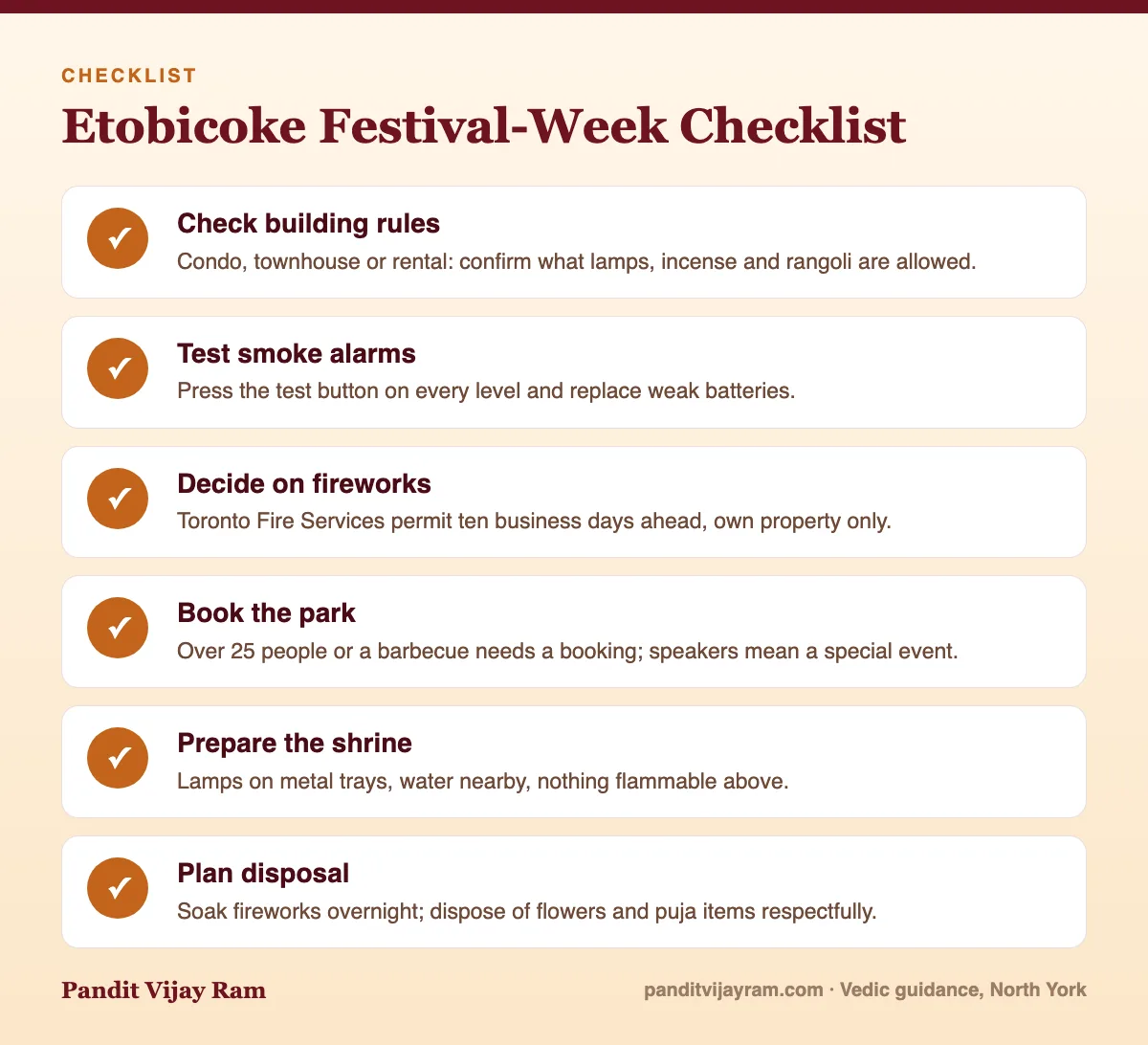
Run through a short checklist a few days before each festival: confirm your building's flame rules, test smoke alarms, decide whether fireworks are worth a permit, book any park picnic over twenty-five people, check temple times, prepare a lamp-safe shrine and plan disposal of fireworks and puja items. Preparation leaves the festival itself calm.
Use this as a household routine for Diwali, Navratri and Holi alike.
- Building rules. Condo, townhouse or rental: what does management allow for lamps, incense and rangoli?
- Alarms. Press the test button on every smoke alarm and replace weak batteries.
- Fireworks decision. If you want them at home, apply to Toronto Fire Services ten business days ahead; otherwise focus on lights.
- Park plans. More than twenty-five people or a barbecue means booking. Speakers, stalls or a stage mean a special event application.
- Temple timings. Check the temple's own calendar and allow for festival parking.
- The shrine. Clean it, set lamps on metal trays, keep water nearby.
- Afterwards. Soak fireworks overnight before the garbage, and dispose of flowers and puja items respectfully.
Families who would like their festival puja timed to the panchang, or matched to a kundli for a particular blessing, can consult through the Etobicoke astrologer page. For Navratri, the Durga puja and havan page explains how the Goddess is honoured in a full rite. A festival kept within the rules, with lamps lit and family gathered, carries its full blessing.
The bottom line
Diwali in Etobicoke, along with Navratri and Holi, is governed by City of Toronto rules on fireworks, open fires and parks. Fireworks at home need a Toronto Fire Services permit except on Victoria Day and Canada Day, and are never allowed in parks or on balconies. Bonfires such as Holika Dahan need a cultural fire authorization, and larger park gatherings need a booking or special event application. Prepare in festival week, honour your neighbours' traditions, and let the lamp and the prayer lead.
Key takeaways
- Etobicoke follows City of Toronto rules for festival fireworks, fires and parks.
- Diwali fireworks at home need a Toronto Fire Services permit requested ten business days ahead.
- Park picnics above twenty-five people or with a barbecue need a City booking.
- Condos usually ban balcony flames; electric diyas suit high-rise homes.
- Holika Dahan bonfires need a cultural fire authorization with a site inspection.