
Home Cleansing for Etobicoke Homes: A Practical Guide for Local Housing

Home cleansing in Etobicoke rarely looks the same from one street to the next. A family in a glass tower near Humber Bay has sealed windows and a sensitive smoke alarm. A couple renting in a Rexdale high-rise shares hallways and ventilation with dozens of neighbours. Grandparents in a postwar bungalow in Islington have a damp basement and decades of memories in the walls. Families from across Etobicoke, and from North York where I am based, ask me how to bring peace back into the home without breaking building rules. This guide shows you how to adapt a traditional cleansing to the housing you actually live in, which fire and tenancy rules to respect, and how to tell a spiritual heaviness from a plain maintenance problem. In more than forty years of practice I have found that the simplest method, done with steady attention, settles a home better than an elaborate one done in a hurry. You will also find links to the fuller cleansing guides on this site if you want to go deeper into any single step.
What does home cleansing in Etobicoke involve?
It combines physical cleaning with prayer. You declutter, wash floors and thresholds with salt water, open windows where possible, light a lamp or use a flameless one, and chant a protective mantra in each room. The core never changes; what changes is how much smoke, flame and noise your building allows.
Etobicoke is a former city that became part of Toronto through amalgamation, and its housing reflects that long history. The district is mostly single-family homes, with condo towers along the waterfront and the Humber River and apartment complexes across the central and northern areas. Older lakeshore communities such as Mimico sit a short drive from the newer towers of Humber Bay.
That variety is why I never hand out one fixed routine. A Vedic cleansing has a few essential parts, and each can be scaled up or down:
- Sankalpa: a short, sincere statement of what you want for the home, such as calm sleep or fewer quarrels.
- Shuddhi: physical cleaning, from clearing clutter to washing the floor with a little sea salt in water.
- Prakash: light, whether a ghee diya, a single candle under watch or an electric lamp.
- Mantra: the Gayatri mantra, the Hanuman Chalisa or simply a name of God repeated with attention.
The general method is laid out step by step in our guide on how to cleanse negative energy from your home. The rest of this page is about fitting it to Etobicoke buildings. If you want personal guidance first, the Etobicoke consultation page explains how families in the area reach me for an in-person sitting in North York or a phone or video call.

How do you cleanse a Humber Bay or lakeshore condo without setting off alarms?
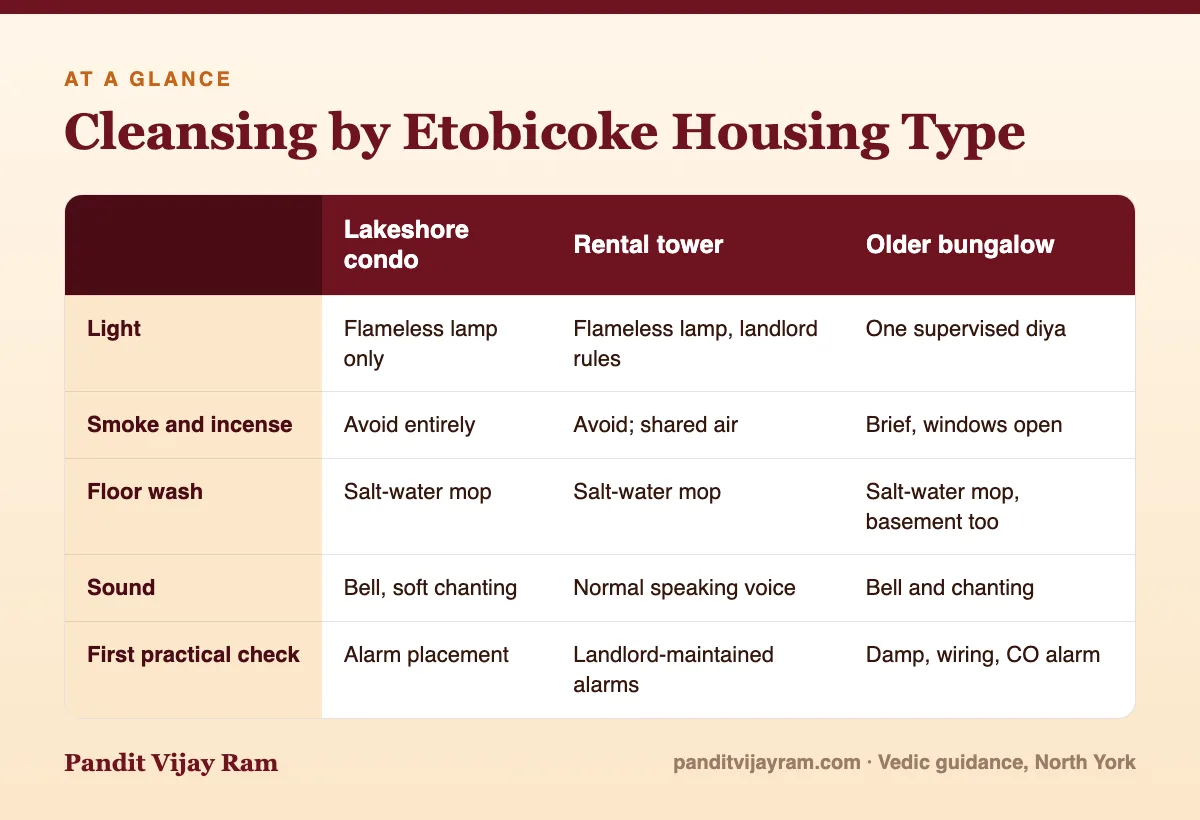
Skip loose smoke entirely. Use salt-water mopping, a flameless lamp or one supervised diya well away from the alarm, sound from a bell or recorded chanting, and fresh air from the balcony door. Tell your concierge nothing is burning, and keep camphor and dhoop for a temple visit instead.
Condo towers along the Etobicoke waterfront are built for fire safety first. Units are compact, and a single alarm can bring the fire service to the whole building. Toronto Fire Services asks residents to keep a working smoke alarm on every level of a home and outside all sleeping areas, and tenants must never disable one. Taping over a detector for a havan is not an option.
A smoke-free condo cleansing still carries the full intention of the ritual:
- Mop the floor from the farthest room toward the front door with water and a pinch of sea salt, then wipe the door frame.
- Place a flameless diya in the kitchen or living area facing east or north-east if your layout allows.
- Ring a small bell in each corner while chanting, which moves stale feeling as surely as smoke.
- Open the balcony door for a few minutes, wind permitting, to let air move through the unit.
For a fuller list of smoke-free methods, see the guide to cleansing a condo or rental without smoke. Our vastu guide for apartments and condos covers placing the puja shelf when every wall seems taken. Condo owners with a dispute over noise or odours under their declaration can find guides and an online dispute tribunal through the Condominium Authority of Ontario.
What changes for a Rexdale apartment tower or a rented unit?
In a rental, the landlord owns the walls and the alarms, so keep every step reversible. Avoid nails, permanent yantras and open flame, keep chanting at a volume your neighbours can live with, and ask the landlord before anything unusual. A calm, quiet cleansing respects both your faith and the people next door.
North Etobicoke, including Rexdale, has many apartment towers, and many residents are renters. Renting changes who decides what. Under the Ontario Fire Code, landlords must install smoke alarms and keep them working, and tenants must report any alarm that stops working. If a landlord fails to provide working alarms, Toronto residents can call 311 for a referral to Toronto Fire Services.
For a tenant, the most useful cleansing is often the most modest. I suggest:
- Clean thoroughly first, including vents, behind the fridge and the shoe area by the door, because neglected corners carry the heaviest feeling.
- Use a removable adhesive hook rather than a nail for a small Ganesha image above the entrance.
- Keep a covered bowl of rock salt in a bathroom corner and replace it weekly.
- Recite prayers at a normal speaking voice, especially early morning or late evening when walls carry sound.
Shared air matters too. Incense smoke travels through older ventilation into neighbouring units, and a neighbour may have asthma or a newborn. Being considerate is itself part of dharma. If a disagreement with a landlord does arise over the unit, the Landlord and Tenant Board is the provincial body that hears it, not a priest.
How can an older Etobicoke bungalow be cleansed room by room?
Work in a fixed order: entrance first, then kitchen, bedrooms, bathrooms and finally the basement. Clean, salt-mop and chant in each space before moving on. Older bungalows often have a finished basement and an enclosed porch, both of which deserve the same attention as the main floor.
Many Etobicoke streets are lined with brick bungalows and side-splits from the decades after the war. These homes often pass from parents to children, and with them pass stored furniture, old letters and sometimes old griefs. A room-by-room order keeps the work calm and complete.
- Threshold. Wash the front step and door frame. A rangoli or a string of mango leaves can follow; our guide on salt-water mopping, or namak pocha, explains the floor wash in detail.
- Kitchen. In vastu the south-east suits the cooking fire. Where the stove sits elsewhere, keep it spotless and light a lamp nearby during prayer.
- Bedrooms. Clear under the beds. Many people store unused items there, and sleep often improves once that space is open.
- Bathrooms. Keep lids closed and doors shut when not in use; place a small bowl of salt.
- Basement. Sort old boxes, ventilate and clean before praying here. Let go of broken items rather than storing them out of guilt.
- North-east corner. End with a short prayer where your home altar sits, ideally in the north-east of the main floor.
Vastu adjustments in an older home should be small and practical. Moving a mirror or a heavy cabinet is reasonable; knocking out walls is not. The vastu consultation page explains how a fuller assessment works from a floor plan.
When is a problem in the home not spiritual at all?
Rule out ordinary causes first. Musty smells, headaches, constant fatigue, flickering lights and cold rooms often point to damp, mould, ventilation, wiring or carbon monoxide. Fix those with a qualified tradesperson or your doctor, then cleanse. Seek spiritual help when the heaviness remains after the practical causes are dealt with.
I always ask families what the house has been through before I discuss anything spiritual. A basement that floods in spring will smell stale whatever mantra is recited. A furnace that needs servicing can cause headaches, and a carbon monoxide alarm is the only way to detect that gas. Old wiring in a postwar home can make lights dim and flicker. None of this is a curse, and treating it as one wastes time and money.
A simple decision rule helps:
- If the symptom is physical and has a likely physical cause, call the tradesperson first.
- If someone feels low, anxious or unable to sleep for weeks, see your family doctor. For a crisis, call or text 9-8-8.
- If the house is sound and the people are healthy, yet arguments, bad dreams or a sense of unease keep returning, a deeper cleansing or a reading may help.
When that last point applies, a negative energy assessment starts with questions, not rituals. Families who also want to reconnect with a local temple community can read our guide to Hindu temples in Etobicoke, and readers across the border in Peel may find our Mississauga home cleansing guide closer to their own housing.
The bottom line
Home cleansing in Etobicoke works best when the method fits the building. Condo owners can rely on salt water, light and sound instead of smoke, renters should keep every step reversible and respect their landlord's alarms, and bungalow families can move room by room from the threshold to the basement. In every home, practical causes such as damp, wiring or health come first, and prayer follows with a settled mind.
Key takeaways
- Fit the cleansing to your building: smoke-free in condos, reversible in rentals, room by room in older houses.
- Toronto Fire Services asks for a working smoke alarm on every level and outside sleeping areas.
- Salt-water mopping, a lamp and steady mantra carry the full intention of a cleansing.
- Check for damp, mould, wiring and carbon monoxide before assuming a spiritual cause.
- Seek a reading only when the heaviness remains after practical problems are fixed.