
Hindu Temples and Community Centres in Etobicoke: A Respectful Visitor's Guide

Many families first hear about Hindu temples in Etobicoke because a relative visiting from India or the Caribbean wants to see the carved stone mandir near Highway 427. Others discover the Sringeri temple on Brydon Drive when a child begins school and the family wants a blessing from Saraswati. Both are major places of worship, a reasonable drive from North York, and both welcome visitors who arrive with respect. This guide describes temples in Etobicoke whose details we could confirm, points to City community centres that suit cultural gatherings, explains the etiquette that matters at a large mandir and at a South Indian temple, and suggests how a visit can carry into prayer at home. Families from Mississauga and Brampton also travel here for festivals, so it helps to know what to expect before the drive. In more than forty years as a Vedic astrologer I have often suggested a temple visit before any private remedy, because darshan in a place built for prayer settles the mind. I am not affiliated with any temple named here.
Which Hindu temples are in Etobicoke?
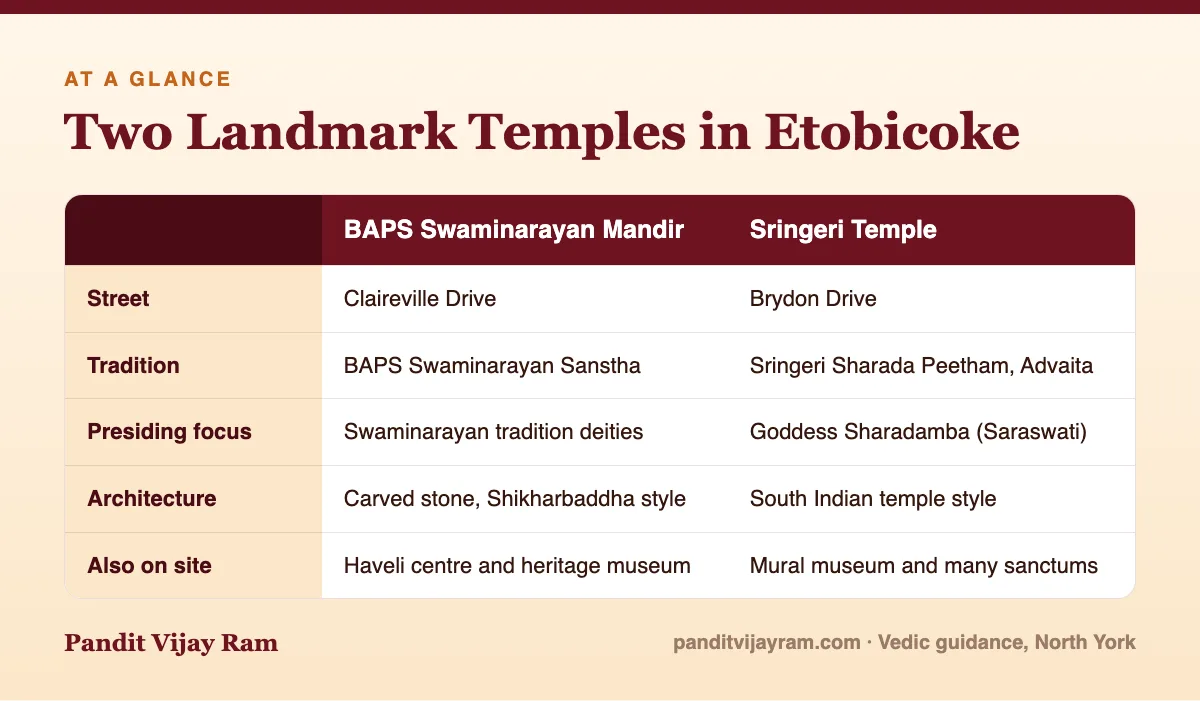
Two large Hindu temples stand in north Etobicoke. BAPS Shri Swaminarayan Mandir on Claireville Drive was built by the BAPS Swaminarayan Sanstha and is open daily to worshippers and visitors. The Sringeri Temple of Toronto on Brydon Drive is run by the Sringeri Vidya Bharati Foundation Canada and honours Goddess Sharadamba, a form of Saraswati.
Both temples sit in the industrial and residential belt between Highway 427, Highway 409 and Kipling Avenue, a part of Etobicoke well known to families travelling from Brampton and Mississauga as well as from the west end of Toronto.
- BAPS Shri Swaminarayan Mandir. A traditional stone mandir in the Shikharbaddha style, built from hand-carved Italian marble, Turkish limestone and Indian pink stone. The site also includes a cultural centre called the Haveli and a heritage museum.
- Sringeri Temple of Toronto. An affiliate of Sri Sharada Peetham, Sringeri, the monastic seat founded in the lineage of Adi Shankaracharya. Its main deity is Sharadamba, with further shrines for deities including Ganesha, Shiva as Chandramouli, Adi Shankara, Radha Krishna, Rama, Durga, Hanuman, Kartikeya, Venkateswara and the Navagraha.
Etobicoke also has smaller mandirs and satsang groups that serve particular communities. We have not named those we could not verify on an official source. Our directory of Hindu temples across the GTA includes neighbouring areas, and the companion guide to Hindu temples in Scarborough covers the east end. Always check a temple's own website or phone line for current darshan times.
What can visitors expect at BAPS Shri Swaminarayan Mandir in Etobicoke?
Visitors find a carved stone mandir built to traditional Shilpa Shastra principles, with shrines for Swaminarayan tradition deities, alongside the Haveli cultural centre and a heritage museum exhibition called Understanding Hindu Dharma. Dress modestly, follow staff directions, keep silence in the mandir and check the posted rules on photography before taking any pictures.
The mandir is one of the largest traditional Hindu temples in Canada, and its scale can surprise first-time visitors. A calm visit usually follows this pattern.
- Arrive and prepare. Remove shoes where indicated. Cover shoulders and knees; staff may offer a wrap if needed.
- Enter the mandir quietly. The carved interior invites conversation, but the space is for prayer. Speak softly or not at all.
- Offer darshan. Stand before each shrine with folded hands. There is no need to know a mantra; a sincere silent prayer is enough.
- Visit the Haveli and museum. The Haveli houses an assembly hall, classrooms and gymnasium, and the heritage museum introduces Hindu Dharma and Indo-Canadian contributions.
- Leave gently. Accept prasad if offered, and make a donation only if you wish.
School groups and interfaith visitors come often, so the mandir is used to explaining itself. Families bringing a child who struggles with crowds may prefer a quieter weekday visit. If the visit inspires you to begin a Ganesha or family puja at home, our guide to Ganesh puja at home is a gentle first step, and the Ganesha puja and havan page describes a fuller rite.
What makes the Sringeri temple in Etobicoke distinctive?
The Sringeri Temple of Toronto follows the tradition of the Sringeri Sharada Peetham in Karnataka, a seat of Advaita Vedanta in the lineage of Adi Shankaracharya. Its presiding goddess is Sharadamba, worshipped as Saraswati, goddess of learning. The complex includes a museum of marble murals depicting Shankaracharya's teachings, and many sanctums for other deities.
The temple is modelled on the Sringeri Sharadamba temple in India. Its architecture follows South Indian temple style, and Doors Open Toronto has featured it as a heritage site with a museum of specially made marble murals carved in India.
For families, three things stand out:
- Saraswati and learning. Parents often bring children before exams, at the start of school or before music and dance lessons. Our guide to Saraswati remedies for students explains simple home practices that complement a temple visit.
- The Navagraha shrine. Devotees concerned about planetary periods circle the nine planetary deities. A shrine visit is a prayer, not a prescription; if a difficult dasha is troubling you, a reading of the whole chart is more useful than guessing which planet to appease.
- Advaita philosophy. The murals introduce Shankaracharya's teaching that the self and the ultimate reality are one. Visitors interested in philosophy as well as worship find much to reflect on.
As at any South Indian temple, priests conduct the rituals inside the sanctums, and devotees receive kumkum, flowers or tirtha with the right hand. Ask at the office about archanai in your family's name.
Which community centres in Etobicoke suit cultural gatherings?
The City of Toronto runs several recreation facilities in Etobicoke that community groups use for classes and events, including Thistletown Community Centre on Albion Road, Elmbank Community Centre on Rampart Road and the Etobicoke Olympium on Rathburn Road. Bookings go through the City, and rituals with flame or amplified sound need the relevant approvals.
Temple halls fill quickly at festival time, and some satsang groups, music schools and seniors' circles prefer a neutral, accessible space. City recreation centres serve that need.
- Thistletown Community Centre. In the Thistletown area of north Etobicoke, on Albion Road.
- Elmbank Community Centre. Another north Etobicoke facility on the City's gymnasium listings.
- Etobicoke Olympium. A larger sports facility in central Etobicoke, better suited to sport than to prayer gatherings, but useful for youth programmes.
Before booking a City room for a bhajan evening or a festival celebration, ask about these points:
- Whether diyas, camphor or incense are allowed. In most City rooms they are not; plan an electric diya.
- Whether amplified sound is permitted, and until when.
- Food rules, since serving food to the public can change the booking type.
- Accessibility for elders, including elevators and seating.
Etobicoke is home to a large South Asian population and a sizeable Punjabi-speaking community, so many groups organise their own cultural programmes. For newcomers looking for more than worship, our companion guide to family and newcomer support in Etobicoke names services that help.
What etiquette matters most at Etobicoke's large temples?
At a large temple the main courtesies are quiet, modest dress, patience in queues and respect for staff instructions. Keep shoes in the racks provided, never point your feet towards a shrine when seated, supervise children closely, avoid food and drink outside designated areas, and check the photography rules, which often differ between the prayer hall and the grounds.
Large temples receive many visitors at once, and small habits keep the atmosphere prayerful for everyone.
- Queues and crowds. On festival days, darshan lines can be long. Let elders and people with disabilities go first where staff allow.
- Seating. If you sit on the floor during an aarti or discourse, tuck your feet beneath you or to the side rather than towards the deity.
- Children. Temples welcome children, but carved stone and lamps are not playthings. Keep little ones close.
- Food. Eat prasad and snacks only where indicated. Most temples do not allow outside food inside the prayer hall, and everything served is vegetarian.
- Mobile phones. Switch to silent. Step outside for any call.
- Photography. Many temples restrict photos inside the shrine areas. Follow the signs.
- Offerings and donations. Welcome but optional. A sincere prayer is the essential offering.
Visitors from other faiths are generally welcome and often find staff glad to explain what they see. If you have questions about a private puja, a samskara or a festival rite, ask at the temple office. For timing questions that depend on your birth chart, the Etobicoke astrologer page explains how families here consult in person in North York or by phone and video.
How can a temple visit in Etobicoke carry into prayer at home?
Bring something of the temple home: a flower, a little prasad, a photograph of the deity where permitted, or simply the memory of the aarti. Place it at your home shrine, light a lamp the same evening and repeat one prayer you heard. Small, regular home worship keeps the temple's peace alive between visits.
A temple visit can feel uplifting for a day and then fade. A few steps help it last.
- Choose one practice. If the Saraswati shrine moved you, recite a short Saraswati vandana each morning before study or work. If the Swaminarayan aarti stayed with you, sing it softly at the evening lamp.
- Keep the altar clean. Fresh water, a fresh flower and a clean cloth matter more than elaborate decoration.
- Respect what you bring home. Dried flowers and prasad wrappings from the temple should be disposed of thoughtfully; our guide to disposing of puja items in Toronto explains respectful options within City rules.
- Return on a rhythm. Weekly, monthly or on festival days, whatever your family can sustain.
When a family cannot travel because of illness, age or work, home worship is fully valid. A remote puja can also be arranged; our explainer on how online puja works describes what to expect. For those who want a temple-quality rite performed in the Vedic tradition for their family, the puja and anushthan page describes how that is done.
The bottom line
Hindu temples in Etobicoke include two of the GTA's landmark places of worship: BAPS Shri Swaminarayan Mandir on Claireville Drive and the Sringeri Sharada temple on Brydon Drive. City facilities such as Thistletown and Elmbank community centres suit gatherings that temple halls cannot host, within the City's rules on flame and sound. At large temples, quiet, modest dress, patience and attention to posted rules are the main courtesies. Carry one practice home from each visit, and the temple's peace will stay with your family.
Key takeaways
- BAPS Shri Swaminarayan Mandir and the Sringeri temple are major Etobicoke places of worship.
- The Sringeri temple honours Sharadamba, a form of Saraswati, and the Shankaracharya lineage.
- City community centres in Etobicoke can host cultural events within flame and sound rules.
- Quiet, modest dress, patience in queues and attention to photo rules matter most.
- One small daily practice at home keeps a temple visit alive.