
Online Puja: How Remote Pujas Work and What to Ask

Online puja has gone from a novelty to a normal part of devotional life for many families. A son in Calgary wants a Mahamrityunjaya jaap for a father in hospital in Punjab. A couple in Vancouver wants a Satyanarayan katha but has no priest nearby. Even families living close to me in North York sometimes join by video because an elder cannot travel in winter. The question I hear most is simple: does it really count if I am not in the room? In more than forty years of Vedic practice, I have performed pujas on behalf of families in many places, and I take that question seriously. This article explains how a remote sankalp works, what traditional reasoning stands behind it, what you can do at home during the puja, the questions worth asking any priest before you book, and the warning signs that an online offer is more about money than devotion.
How does an online puja actually work?
You first discuss your need with the priest, who suggests a suitable puja and a muhurat. You share the names, gotra, place and intention for the sankalp. On the day, the priest performs the ritual while you watch live by video or receive photos and a recording. Guidance, and sometimes dry prasad, follow afterwards.
The steps look much the same whichever deity or ritual is chosen.
- Consultation. A phone or video conversation about what is happening and what you hope for. A good priest may suggest a simpler option, or none, if a puja is not what you need.
- Choice of ritual and timing. The deity, the form of worship, any mantra count, and a date from the panchang that suits both locations.
- Details for the sankalp. Full names of the people the puja is for, gotra if known, the city where each lives, and a one-line intention.
- The ritual. Ganesh puja, kalash, the main worship, japa or havan as agreed, then aarti. You join by video or receive a recording.
- Closing. The priest explains any simple home practice to continue, and may post a sacred thread, vibhuti or other dry prasad.
Sending food prasad across a border can run into customs rules, so dry items are usual. Vijay Ram ji follows this sequence in his puja, havan and anushthan service, with the family joining by video where they wish. For a sense of what a full home ritual involves, our Satyanarayan puja guide walks through one in detail.

How is the sankalp done with your name and gotra remotely?
The sankalp is a formal Sanskrit resolve in which the priest states the time, the place, the name and gotra of the person for whom the puja is done, and its purpose. Done remotely, he names you and your city. If you join live, he may pause so you can repeat it or hold water at home.
A sankalp places the ritual in time and space. It names the cosmic era, the lunar month and day, the place of worship, then the person: I, on behalf of so-and-so, of such-and-such gotra, perform this puja for this purpose. That naming is what makes a puja yours.
Tradition has long accepted worship by a priest on someone else's behalf. Temple archanas are offered daily in the names of people who are not present, and family priests have performed rites for travellers and the sick for generations. The yajamana, the person who sponsors the rite, is honoured through the sankalp whether or not they sit by the fire.
Practical points for a remote sankalp:
- Gotra unknown? Many families who do not know their gotra are traditionally given Kashyap, after the sage regarded as a common ancestor. Ask your priest what he follows.
- Several people? List each name clearly, with spellings, and say which person the main intention concerns.
- Your part at home. Sit facing the screen, light a small lamp if safe, hold a little water and rice in your right hand during the sankalp, and release it into a bowl when told.
Joining live is not required for the puja to be complete, but most people find it moving to hear their own name in the mantra.
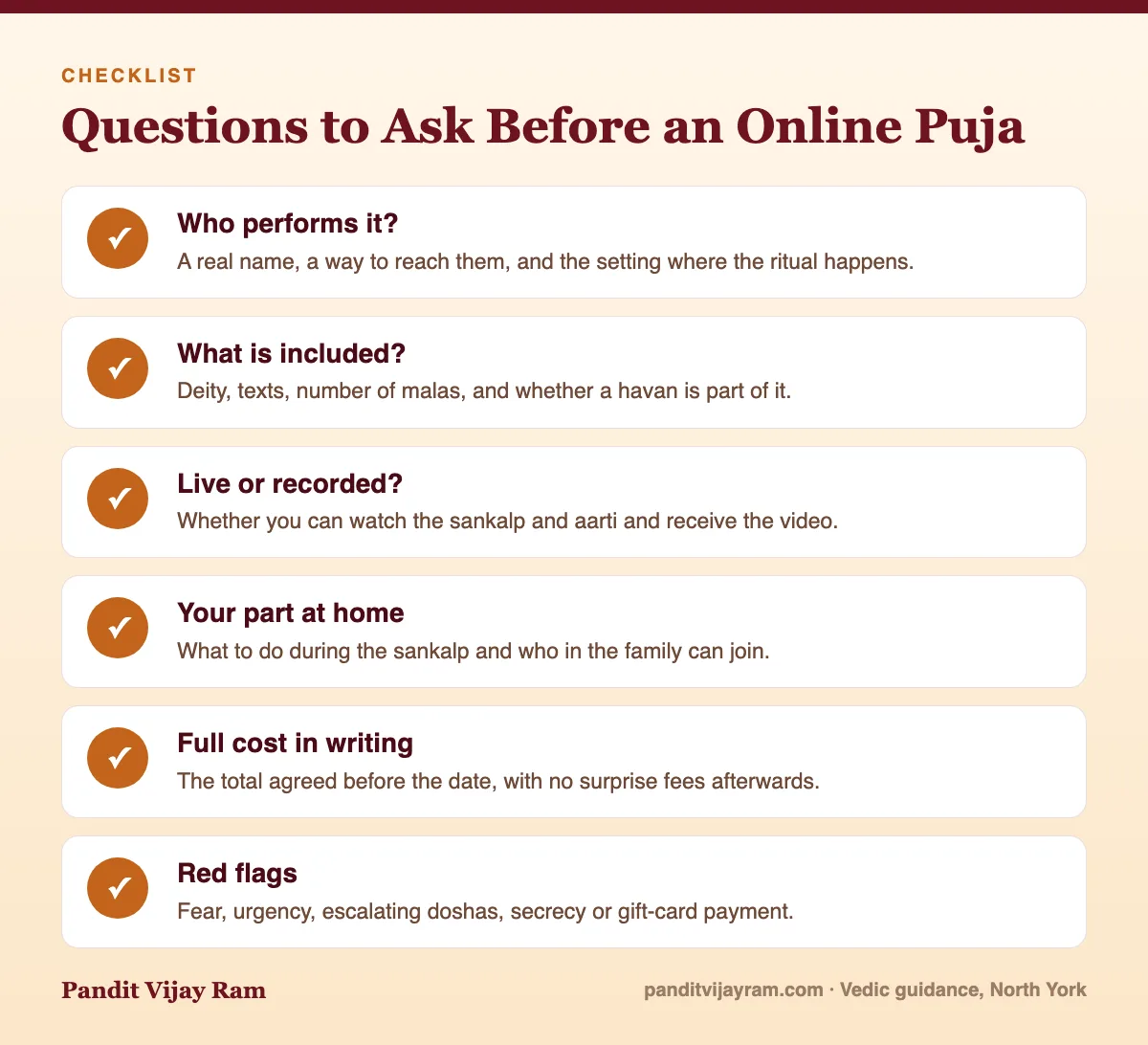
What should you ask before booking an online puja?
Ask who will perform the puja and where, which mantras and how many repetitions are included, whether it will be live or recorded, how you can take part, how long it lasts, what happens if the connection fails, what guidance follows, and what the full cost is in writing before anything is paid.
Clear answers to these questions are a sign of an honest practice.
- Who performs it? The person you spoke with, or someone else? A real name and a way to reach them matter.
- Where? A home temple, a hired hall, a temple? You do not need an address, but you should know the setting.
- What exactly is done? Which deity, which texts, how many malas of japa, and whether a havan is included.
- Live or recorded? Can you watch the sankalp and aarti, and will you receive the video?
- Your role. What to do at home, and whether family members in other cities can join the call.
- Contingencies. If your internet drops, is the sankalp repeated or the recording sent?
- Afterwards. What home practice is advised, and is prasad posted?
- Money. The total cost and payment method agreed in writing before the date, with no surprises later.
A priest who welcomes these questions is usually one worth trusting. Our checklist of questions to ask when choosing a pandit covers in-person bookings too.
How can you spot an online puja scam?
Warning signs include urgent fear-based messages, claims that you are cursed or in danger, promises of certain results, fees that rise after each puja, payment demanded by gift card, cryptocurrency or wire transfer, refusal to show any part of the ritual, and pressure to keep the arrangement secret from family. Stop and verify before paying.
Online devotion attracts honest priests and also people who exploit grief and worry. The patterns are familiar:
- Fear as a sales tool. A stranger on social media says a curse is on your family and must be removed tonight.
- Escalation. One puja leads to a newly discovered dosh, then a second, larger fee, then a third.
- Impossible promises. A spouse returned, a visa approved or an illness ended by a fixed day.
- Untraceable payment. Gift cards, crypto, wire transfers to personal accounts abroad.
- No visibility. No live link, no recording, only a stock photo of a havan.
- Secrecy. Being told not to tell your spouse or parents, which isolates you from people who might question it.
- Borrowed names. Pages that imitate famous temples or use photos of well-known priests.
If you think you have been targeted, stop payments and keep screenshots. Compare what happened with the warning signs we list for removal scams, then contact the Canadian Anti-Fraud Centre and your bank. Speaking to a trusted family member also helps break the pressure.
Is an online puja as effective as attending in person?
Within the tradition, a puja done correctly with your sankalp is complete whether you sit beside the priest or join from another city. Many people still feel more connected in person. What matters most is that the ritual is performed sincerely and that you take part with attention, rather than treating it as a purchase.
I would be dishonest if I said distance makes no difference to how a puja feels. Sitting near the fire, smelling the ghee and tying the thread yourself is a different experience from watching a screen. Some families, especially elders, will always prefer that.
Yet there are good reasons to choose a remote puja:
- No local priest knows the ritual your family needs.
- The person it is for cannot travel because of illness, age or weather.
- Relatives in several countries want to share one sankalp.
- A rented home or condo does not allow a havan. Our article on puja and havan in rented homes discusses that situation.
To make it meaningful, prepare as if you were attending. Bathe, sit in a clean spot, switch off notifications, and keep a lamp or picture of the deity nearby. Afterwards, continue the small daily practice the priest suggests, because that is where much of the value lies.
No puja, online or in person, should be presented as a guaranteed fix. It is prayer, offered with care, and it sits alongside medical, legal and practical help, never instead of it.
The bottom line
An online puja is a ritual a priest performs on your behalf, made yours by a sankalp naming you, your gotra, your city and your purpose. Ask clear questions about who performs it, what is included, how you take part and what it costs before you book. Treat fear, escalating fees and untraceable payments as warning signs, and remember that a remote puja is prayer, not a promise.
Key takeaways
- An online puja is performed by a priest on your behalf, live or recorded.
- The sankalp names you, your gotra, your city and the intention.
- Kashyap gotra is traditionally used when a family does not know its own.
- Ask who performs it, what is included and the full cost in writing first.
- Fear, urgency and gift-card payments are signs of a scam.