
Negative Energy and Students: Focus, Exam Stress and Saraswati Remedies

A student who used to top the class now stares at the same page for an hour. Another freezes in every exam despite knowing the material. Parents start to wonder whether someone's envy has landed on their child, and grandparents begin tying black threads. Questions about negative energy and students reach me most often from families in North York, Markham, Brampton and other GTA neighbourhoods during exam season and university application time. My answer always begins with sleep, screens and stress, because those explain most falling grades. Then I share the traditional supports that genuinely help a young mind settle: Saraswati worship, a properly placed study desk, Mercury and Jupiter remedies from the chart, and the gentle nazar customs many families already know. This article is written for parents and for students themselves, including international students studying far from home. In forty years of practice I have seen many bright young people regain their footing, and the turning point was usually a better bedtime and a calmer home rather than any dramatic ritual. Prayer added confidence once those were in place.
Why can't my child concentrate on studies?
The most common reasons a student cannot concentrate are too little sleep, phones and gaming late at night, energy drinks, skipped meals, heavy pressure at home and anxiety about results. Learning differences such as ADHD or dyslexia also show up as poor focus. Address these first; spiritual remedies then work on a steadier base.
Before I discuss any remedy with a family, I ask the student, not the parent, a few direct questions. When do you go to sleep? Where is your phone at night? What do you drink while studying? How do you feel the night before a test?
The answers usually point to one of these:
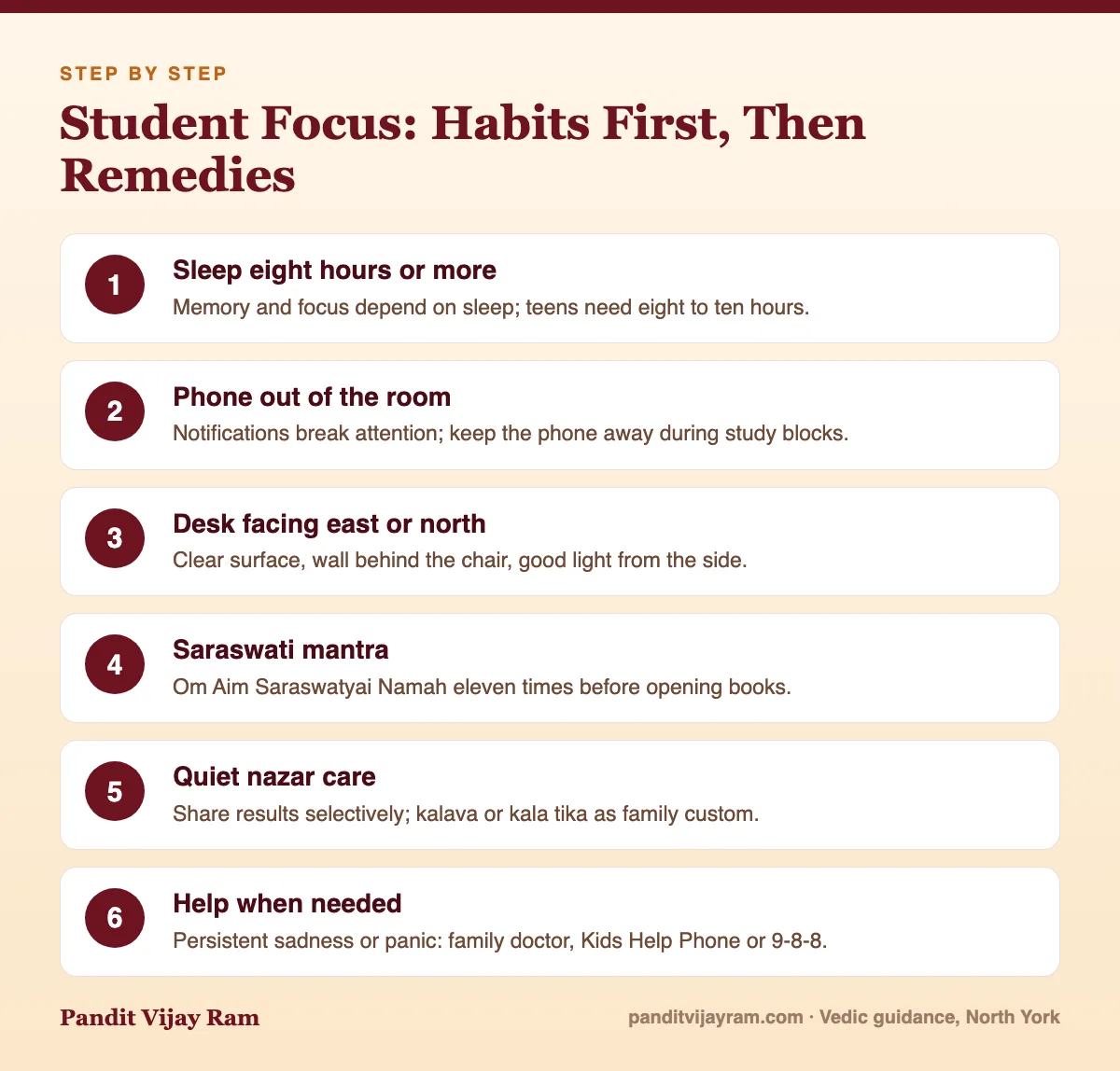
- Sleep debt. Teenagers generally need eight to ten hours. Many in the GTA get six, between school, commute, tutoring and part-time jobs. Memory consolidation depends on sleep.
- Screens. Notifications break attention every few minutes. A phone in the bedroom is the single biggest focus thief I see.
- Caffeine. Energy drinks and late coffee cause jitteriness and broken sleep, then a crash.
- Pressure. Constant comparison with cousins or siblings makes many students freeze.
- Possible learning or attention differences. If focus problems have been present since childhood, ask the school about an assessment and speak with your family doctor.
If a student seems persistently sad, withdrawn, or talks about being a burden, please treat it as a health concern. Speak with your family doctor, and know that Kids Help Phone and the 9-8-8 Suicide Crisis Helpline are available by call or text at any hour. The article on negative energy or depression explains the warning signs in more detail.

Which Saraswati mantra is best for students?
The simplest and most widely used is the beej mantra Om Aim Saraswatyai Namah, recited eleven or one hundred and eight times before study. Many families also teach the Saraswati vandana beginning Ya Kundendu Tushara Hara Dhavala. Saraswati is the goddess of knowledge, music and speech, honoured especially on Vasant Panchami.
Saraswati is depicted in white, seated on a white lotus or with a swan, holding a veena, a book and a mala. White symbolises clarity; the veena, harmony of mind; the book, learning; the mala, steady practice. Students often find that image itself calming.
Three forms of Saraswati prayer suit different students:
- Beej mantra: Om Aim Saraswatyai Namah. Short, easy to remember, good for eleven repetitions before opening a textbook. "Aim" is the seed syllable associated with the goddess.
- Saraswati vandana: the verse beginning Ya kundendu tushara hara dhavala, ya shubhra vastravrita, praising the goddess as white as jasmine, the moon and snow. Many Indian schools sing it at assembly, so parents may already know it.
- Gayatri Mantra: for older students who want a prayer for clarity of understanding. It is explained in our guide to mantras for negative energy.
Vasant Panchami, in late winter, is the traditional day for Saraswati puja. Families place books, pens and instruments before the goddess, wear yellow and offer yellow sweets. Young children sometimes write their first letters that day. In the GTA, many mandirs hold Saraswati puja for students, which also gives young people a sense of community around their studies.
Which direction should a study table face according to vastu?
Vastu recommends that a student sit facing east or north while studying, with the desk in the east, north or north-east of the room. Keep a solid wall behind the chair, avoid sitting under a beam or facing a blank wall too closely, and keep the desk uncluttered. Good light matters as much as direction.
East is associated with the rising Sun and new knowledge; north with Mercury and opportunity; north-east with clarity and Jupiter's wisdom. That is why vastu favours these directions for study. In shared bedrooms or small condos, perfect placement is rarely possible, so focus on the changes that are easy:
- Face east or north if you can turn the desk. If not, a small Saraswati image on the east wall can be an anchor.
- Back to a wall, not to a door or window. This is also basic ergonomics: you feel less distracted when nobody walks behind you.
- Clear the desk. Only the books for today's subject. Old papers and broken pens are traditionally removed.
- No mirror facing the desk, as tradition links it with scattered attention.
- Light from the left for right-handed students, so the hand does not shadow the page.
- Phone outside the room or in a drawer across the room during study blocks.
- Soft colours: light green, cream or pale yellow are traditional for study spaces.
For a wider look at the home, see vastu cleansing by room and direction, or book a vastu consultation if the whole home layout feels wrong.
Can nazar affect a student's exam results?
Many families believe high achievers attract nazar, especially after results are praised publicly. Tradition suggests keeping marks and admissions quiet until settled, a small black tika for younger children, a kalava on the wrist, and nazar utarna with salt after big celebrations. Low results also have ordinary causes, which should always be checked first.
In South-Asian homes, praise and protection go together. A grandmother who says "how well she's doing" may also quietly tap wood or add "nazar na lage". Families are especially careful around board exam results, scholarships and university offers.
Gentle customs that many households use:
- Share results selectively. Tell close family first, and post on social media later, if at all.
- Kala tika: a small dot of kajal behind the ear or on the forehead for younger children. Use a safe, child-appropriate product.
- Kalava or black thread: tied on the wrist before exams, after a short prayer. Check school rules on accessories during exams.
- Nazar utarna: a parent circles a pinch of rock salt over the child's head seven times and dissolves it in running water. Our post on removing nazar at home describes the steps.
Please do not let nazar become the explanation for every bad mark. If a usually strong student's grades drop sharply, ask about sleep, friendships, bullying, online pressure and health. A student who senses their parents think they are "cursed" may stop talking about what is really wrong. The chart, not the neighbours, is where I look next; see the following section.
What does astrology say about education and exam stress?
In Jyotish, the 4th house relates to basic education, the 5th to intelligence and exams, and the 9th to higher learning. Mercury governs analysis and memory; Jupiter, wisdom and teachers. Difficult periods for these planets can coincide with exam stress. Remedies are devotional: Wednesday Ganesha prayer for Mercury, Thursday offerings for Jupiter.
When parents bring a student's chart, I look at the 5th house and its lord, Mercury's strength, Jupiter's position and the current dasha. A student starting a Rahu period may become restless and attracted to distraction; a Saturn period can make results come slowly despite hard work. This helps families set patient expectations rather than blaming the child.
Remedies I suggest for students are deliberately light:
- For Mercury: a Ganesha prayer on Wednesdays, feeding green moong or offering durva grass. Wearing a touch of green is a gentle custom.
- For Jupiter: on Thursdays, offer yellow flowers or chana dal, respect teachers and help younger students. Jupiter is the planet of the guru.
- For the Moon and anxiety: water offered to a Shiva lingam on Mondays, and an earlier bedtime.
- Gemstones: I rarely recommend stones for children. For adults, any stone should follow a careful chart reading; see gemstone and numerology guidance.
International students studying in Toronto, Waterloo or Ottawa often carry family expectations and money worries together. Campus counselling services exist for exactly this, and using them is a sign of maturity. Newcomer students may also find the post on negative energy after moving to Canada useful. More protective guides are on the cleansing and protection hub.
The bottom line
Negative energy and students is usually a story of sleep, screens and pressure before it is anything spiritual, so fix those first. Saraswati vandana or the Om Aim Saraswatyai Namah mantra, an east or north-facing desk and quiet nazar care then help a young mind settle. Persistent sadness or anxiety needs a family doctor and, in crisis, Kids Help Phone or 9-8-8.
Key takeaways
- Sleep, phones and caffeine explain most lost focus.
- Om Aim Saraswatyai Namah before study is simple and steady.
- Face east or north with a wall behind the chair.
- Share results quietly and avoid blaming every bad mark on nazar.
- Persistent low mood in a student needs medical care.