
Ganesh Puja at Home: Simple Steps for Any New Beginning

Lord Ganesh is worshipped first in almost every Hindu ritual, and many homes keep a small Ganpati on the altar for daily prayer. Yet when families want to do a proper Ganesh puja at home themselves, they often feel stuck between a two-line prayer and a priest-led ceremony lasting hours. There is a comfortable middle path. Families in North York ask me for it when moving into a new flat, starting a business, welcoming a baby or simply wanting a fresh start after a hard year. In more than forty years of Vedic practice, I have seen that a clear, simple method done with devotion is exactly what Ganesh asks for. This guide covers a general method suitable for any day. You will learn what to gather, how to choose and place a murti, what the five-offering method involves, why durva and modak matter, which aarti to sing, and how to keep the lamp and camphor safe. A separate guide covers the short blessing before a single exam or interview.
Why is Lord Ganesh worshipped first before any puja?
Ganesh is called Pratham Pujya, the one worshipped first, and Vighnaharta, remover of obstacles. Puranic stories say the gods granted him first worship, often linked to the tale where he circled his parents Shiva and Parvati instead of the world. Honouring him first asks that the work ahead proceed without hindrance.
The best-known story has Ganesh and his brother Kartikeya competing to circle the world. Kartikeya set off on his peacock. Ganesh walked around his parents, Shiva and Parvati, explaining that they were his whole world. The gods were delighted by his wisdom, and he was granted the honour of first worship.
Ganesh also carries meanings that make him a natural start for any undertaking:
- Lord of beginnings. Weddings, housewarmings, new ventures and even the first page of an account book open with his name.
- Remover and placer of obstacles. Tradition says he removes hindrances from right efforts and can place them before careless ones, which is a gentle reminder to prepare well.
- Lord of intellect. He is linked with buddhi, wisdom, and with learning and writing; the Mahabharata tradition says he wrote it down as Vyasa dictated.
- Ganapati. Leader of the ganas, Shiva's attendants, and so a protector of the household.
That is why even a puja to another deity often begins with a short Ganesh invocation. If you are preparing for one specific event, our article on a blessing before an interview, wedding or exam gives a shorter routine. This guide is the fuller home puja.

What samagri is needed for Ganesh puja at home?
You need a Ganesh murti or picture, a clean cloth and platform, a lamp, incense, kumkum or sandal paste, akshat (unbroken rice), red flowers, durva grass, a small water vessel, a sweet such as modak or laddoo, a banana or coconut, and camphor for aarti. A betel nut can stand in for a murti.
Here is a home-friendly list. Most items are available at Indian grocers across the GTA.
- Murti or picture. Clay, brass, marble or a framed image. A supari, betel nut, placed on a heap of rice can represent Ganesh when no murti is available; this supari Ganesh is used in many priest-led rituals.
- Platform and cloth. A small wooden chowki with a red or yellow cloth.
- Kumkum, haldi and sandal paste for tilak.
- Akshat. Unbroken rice, often mixed with a little turmeric.
- Red flowers. Hibiscus is a traditional favourite.
- Durva grass. Offered in bunches of three or five blades, or twenty-one on special days.
- Naivedya. Modak, motichoor laddoo, jaggery, bananas or a coconut.
- Lamp, incense and camphor. Ghee lamp preferred.
- Water vessel with a spoon for achamana and offering.
One item most traditions avoid offering to Ganesh is tulsi. A Puranic story describes a quarrel between Ganesh and Tulsi, and tulsi is usually kept for Vishnu and Krishna. A few traditions allow it on Ganesh Chaturthi alone.
For substitutes and a wider list for other pujas, see our puja samagri list.
Where should a Ganesh murti be placed at home, and which trunk direction is best?
Place Ganesh in a clean puja corner, ideally in the northeast, facing east or west so the devotee faces east or north while praying. Many households choose a murti with the trunk curving to his left, considered gentle for home worship. A right-curving trunk is often associated with stricter rules of worship.
Placement guidance comes partly from vastu and partly from family custom. Use it as a guide, not a source of worry.
- Direction. The northeast, ishanya, is the preferred zone for worship. If your apartment layout makes that impossible, any clean, quiet spot at a comfortable height is fine.
- Not in the bathroom area. Avoid placing the altar on a wall shared with a toilet, or under a staircase.
- Height. At or above chest level when you stand, or on a raised platform if you sit on the floor.
- Trunk. A left-turning trunk, vamamukhi, is the common household choice. A right-turning one, dakshinamukhi or siddhi vinayak, is a powerful temple form that many families believe needs more exacting daily worship.
- Posture. A seated Ganesh is often preferred at home for steadiness; a standing or dancing form suits a shop or office entrance.
- Number. Many families keep one main Ganesh on the altar rather than several facing each other.
For a permanent murti, some families arrange a formal sthapana with prana pratishtha by a priest. For a daily puja, a sincere invitation, avahana, is enough. Our guides to caring for a home mandir and vastu consultations go further.
What is panchopachara puja, and how is it different from the sixteen-step method?
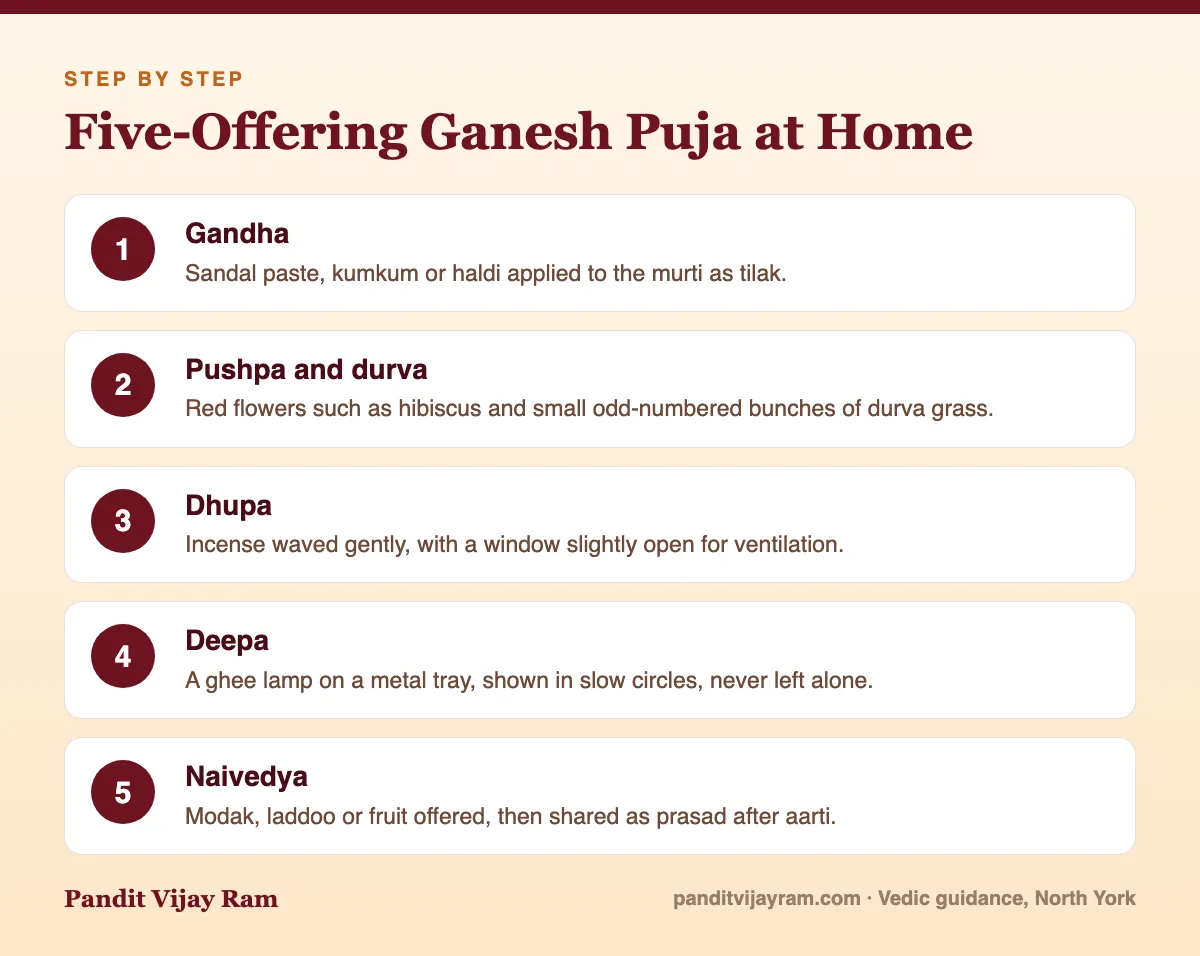
Panchopachara means five offerings: gandha (sandal paste or kumkum), pushpa (flowers), dhupa (incense), deepa (lamp) and naivedya (food). It is the standard short home puja. Shodashopachara has sixteen steps, adding invocation, seat, foot-washing water, bath, clothing, sacred thread and others, and is used for festivals and formal pujas.
Both methods treat the deity as an honoured guest. The sixteen-step version simply welcomes the guest more elaborately.
Panchopachara, the five-step home method:
- Gandha. Apply sandal paste, kumkum or haldi to the murti.
- Pushpa. Offer red flowers and durva.
- Dhupa. Wave incense gently.
- Deepa. Show the lamp.
- Naivedya. Offer modak or another sweet, sprinkling water around it.
Shodashopachara adds, in most lists, dhyana (meditation), avahana (invitation), asana (seat), padya (water for the feet), arghya (water for the hands), achamana (sipping water), snana (bath), vastra (cloth), yajnopavita (sacred thread), then the five above, and finally pradakshina and namaskara (circling and bowing). Lists vary a little between texts and regions.
A practical rule: use panchopachara daily or weekly, and shodashopachara on Ganesh Chaturthi, a housewarming or a family milestone. For Diwali, when Ganesh is worshipped with Lakshmi, see our Diwali Lakshmi Ganesh home puja guide.
Wednesdays are traditionally associated with Ganesh, and the monthly Vinayaka Chaturthi in the bright fortnight and Sankashti Chaturthi in the dark fortnight are popular days for a fuller puja.
Why are durva grass and modak offered to Ganesh?
Durva grass is said to have cooled Ganesh after he swallowed the fiery demon Analasura, so it became his favourite offering. Modak, a sweet dumpling of rice flour with coconut and jaggery, is his beloved food and symbolises the sweetness of spiritual knowledge. Both carry stories families enjoy telling children.
Durva. In the story, the demon Analasura, made of fire, terrorised the gods. Ganesh swallowed him whole, but the burning inside him would not settle. Sages offered him bundles of durva grass, and the heat subsided. Since then durva has been offered in odd-numbered bunches, often three or five blades, and twenty-one on festival days. Pick fresh blades with three leaves at the tip if you can, rinse them, and tie small bunches with a thread.
Modak. Steamed ukadiche modak, with a rice-flour shell and a filling of fresh coconut and jaggery, is the Maharashtrian classic. Fried modaks, mawa modaks and chocolate modaks are modern variations seen in GTA sweet shops. Tradition often offers twenty-one on Ganesh Chaturthi. The shape is read symbolically as a closed vessel of sweetness, the reward of patient effort.
Other regional favourites include kozhukattai in Tamil Nadu, kudumu in Andhra, and motichoor laddoo in North India.
Close with aarti. North Indian homes usually sing Jai Ganesh, Jai Ganesh, Jai Ganesh Deva; Marathi homes sing Sukhakarta Dukhaharta, traditionally attributed to Samarth Ramdas. Wave camphor on a dedicated plate, keep it short and away from smoke detectors, and never leave the flame alone. For short mantras to recite during the puja, read our guide to Ganesh mantras and their meanings. For a family milestone puja performed by a pandit, see Vijay Ram ji's Ganesha puja and havan service.
The bottom line
Ganesh puja at home needs no special skill, only a clean space and a sincere heart. Gather simple samagri, place the murti in a quiet, preferably northeast corner, and follow the five-offering method with durva and modak. Save the sixteen-step method for festivals and milestones. Keep the lamp and camphor safe, and let your ganesh puja at home mark each new beginning with calm.
Key takeaways
- Ganesh is worshipped first as the remover of obstacles and lord of beginnings.
- Panchopachara uses five offerings and suits daily or weekly home puja.
- Durva grass and modak are his traditional favourites; tulsi is usually avoided.
- A left-trunk seated murti in a northeast corner is the common household choice.
- Keep lamps on a tray and camphor brief, and never leave a flame unattended.