
Kanya Pujan in Navratri: Meaning and How to Do It
On the eighth or ninth morning of Navratri, many homes fill with small girls in bright clothes, giggling on a row of cushions while the adults bow before them. This is kanya pujan, also called kanjak in Punjabi homes, and for many families it is the emotional heart of the festival. Parents in North York tell me they treasure it, and they also have new questions. What if a child does not want her feet touched? What about nut allergies in the halwa? How do we find nine girls when the family is small and spread across the GTA? In more than forty years of Vedic practice, I have seen the ritual adapt gracefully without losing its meaning. This guide explains why girls are honoured as the goddess, how Ashtami and Navami customs differ, the traditional step-by-step method, the regional forms such as Bengali Kumari Puja, and the modern sensitivities that make the day joyful for every child. For the wider nine-night plan, see our separate Navratri guide.
What is the meaning of kanya pujan in Navratri?
Kanya pujan honours young girls as embodiments of Shakti, the divine feminine power that Durga represents. During Navratri the goddess is worshipped in nine forms, and many families invite nine girls to reflect them. The ritual teaches that the divine is present in every girl, and it ends the festival's fast with a shared meal.
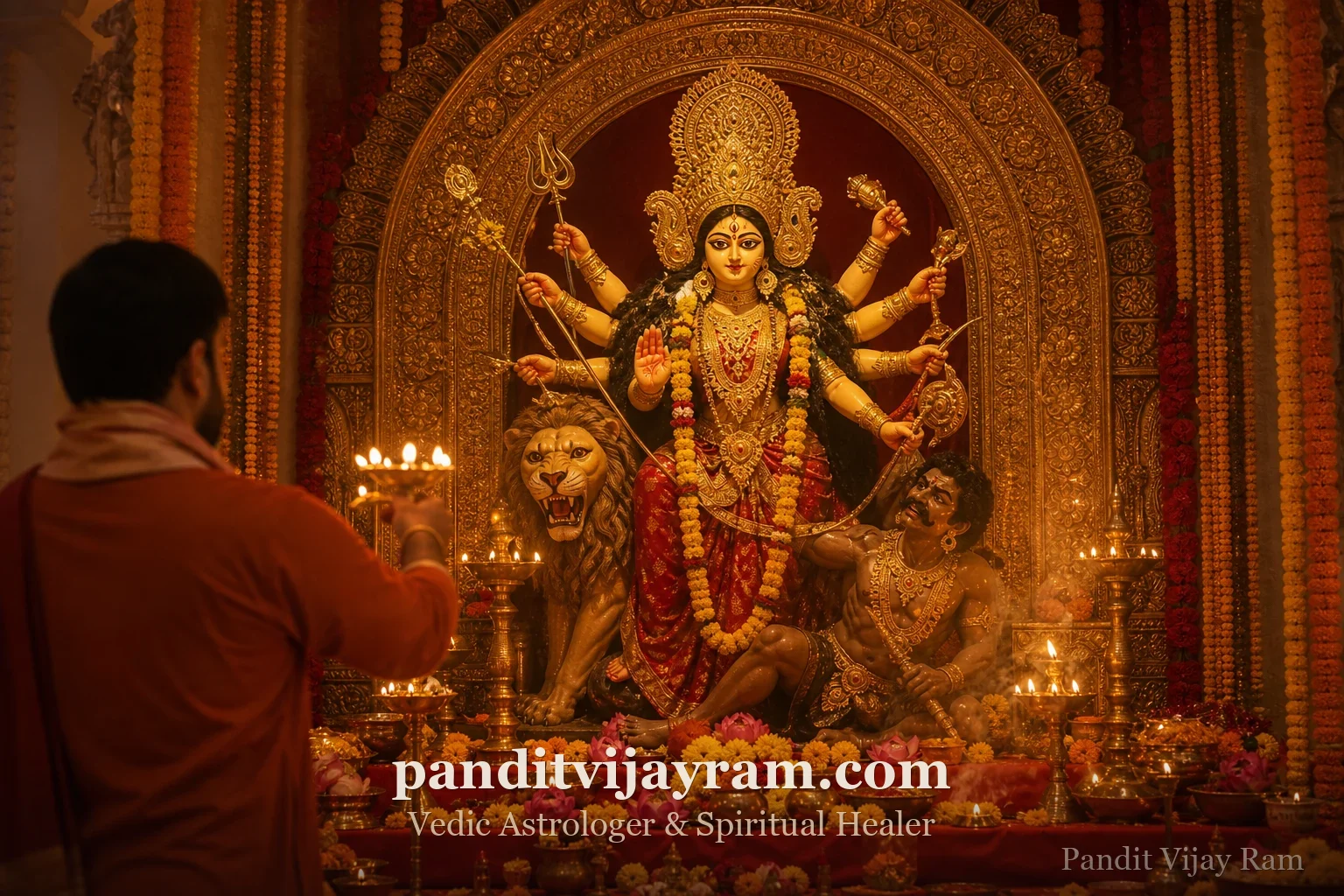
Navratri celebrates Durga's victory over the buffalo demon Mahishasura and honours her nine forms, the Navadurga. Kanya pujan brings that worship out of the image on the altar and into living children.
Several layers of meaning sit together:
- Shakti in every girl. Devi texts describe the goddess as dwelling in all beings. Honouring girls is a reminder to see that divinity in daughters, sisters and every girl in the community.
- Purity and innocence. Young children are seen as free from ego and calculation, closest to the goddess in spirit.
- Completion of the vow. Many families who fast through Navratri break the fast after feeding the girls, so the meal becomes prasad shared with the goddess herself.
- Community. In practice, kanjak brings neighbours, cousins and friends' children into the home, renewing ties at the end of the festival.
A boy is often invited too, called the langur or langoora in North Indian custom, and seen by many families as a form of Bhairav or Hanuman, the goddess's guardian.
There is also a challenge in the ritual. Honouring girls for one morning means little if they are treated as lesser for the rest of the year. Many teachers today speak of kanya pujan as a promise to support girls' education, safety and dignity. Our guide to Navratri in the GTA places kanya pujan within the wider festival.

Should kanya pujan be done on Ashtami or Navami?
Both are traditional. Many North Indian families perform kanya pujan on Ashtami, the eighth day, often called Durga Ashtami; others keep it on Navami, the ninth, as the close of the festival. Follow your family custom. Where the tithi overlaps two calendar days, check a panchang for your own city to choose the morning.
Custom varies by family, region and lineage, and both choices are equally respected.
- Ashtami. Common in many Punjabi, Haryanvi and Delhi families. It aligns with Maha Ashtami, a high point of Durga worship in many traditions.
- Navami. Preferred by families who break their nine-day fast on the last day. In Chaitra Navratri, Navami is also Rama Navami, which adds a second celebration.
- Both Navratris. Many homes hold kanya pujan in both the spring Chaitra and autumn Sharad Navratri; others keep it only in Sharad.
Tithis do not follow the clock. A lunar day can start in the afternoon of one date and end the next. Families who want the ritual within the Ashtami or Navami tithi should use a panchang set for Toronto or their own city rather than one calculated for India. Our guide to reading the panchang explains how.
In practice, many GTA families also shift to the nearest weekend morning so the girls are not pulled out of school. Tradition generally treats that as a sincere and acceptable adjustment. What matters is the respect shown to the children and the devotion of the household.

How many girls are needed for kanya pujan, and what age should they be?
Nine girls are traditional, one for each form of Durga, usually between about two and ten years old, along with one boy as the langur. Families who cannot gather nine invite as many as they can, even one. The spirit of welcome matters far more than the exact number or ages.
Many families repeat the rule of nine girls between two and ten. The reasoning is simple: nine for the Navadurga, and the age range for childhood before puberty. Some texts give each age its own goddess name, but families rarely follow those details today.
Practical realities in the GTA make flexibility important:
- Small families. One or two girls are enough. Many families also honour a small murti or image of the goddess beside them to complete the nine.
- Combining households. Neighbours and friends often agree on a rotation, so girls visit several homes in one morning. Keep portions small so no child is overfed.
- Temple and community events. Some mandirs hold group kanya pujan where families sponsor the meal together.
- No girls available. Offer the prasad at a temple, feed children through a community kitchen, or donate to a charity supporting girls' education.
Inclusion is part of the ritual's meaning. Invite girls without regard to caste, community or income. Children with disabilities or sensory sensitivities are equally welcome; simply adapt the steps so they are comfortable.
For families who would like a full Durga puja or havan alongside, Vijay Ram ji's Durga puja and havan service can be arranged for the Ashtami or Navami morning.
What food is served at kanya pujan, and how do you handle allergies?
The classic kanjak plate is sooji halwa, puri and dry black chana, sometimes with kheer, fruit or coconut. Before the day, ask every parent about allergies and dietary needs: wheat, dairy, ghee, nuts and sesame are common concerns. Cut chana and fruit for toddlers, serve food warm rather than hot, and never pressure a child to finish.
The food is offered first to the goddess as bhog, then served to the girls as prasad. The menu has deep roots, and it can be adapted without losing meaning.
Allergy and diet checklist to send parents in advance:
- Nuts. Halwa is often garnished with almonds, cashews or pistachios. Make a nut-free batch or skip the garnish entirely.
- Wheat and gluten. Puri is wheat. Rice, kuttu or rajgira flour, or simply extra fruit, can replace it, but check that the flours are not cross-contaminated.
- Dairy and ghee. Some children avoid milk products. A halwa cooked in oil, or fruit and chana alone, works well.
- Sesame and other allergens. Ask, do not assume.
- Faith-based diets. Some families avoid onion and garlic during Navratri; most kanjak food is already free of both.
Kitchen safety. Fry puris before the children arrive and keep the stove off while they are in the kitchen. Hot oil and curious toddlers do not mix. Whole chana and grapes can be a choking risk for very young children; serve them mashed or cut.
If a parent tells you about a serious allergy, keep their child's plate separate and labelled. Ask whether the child carries an epinephrine auto-injector and where it is kept. A child's safety is the first offering of the day.
How do you respect consent and comfort during kanya pujan?
Ask parents ahead, explain each step, and let every girl choose. If a child does not want her feet washed, touched or photographed, skip that part with a smile. Keep adults' bowing gentle, limit the time the girls sit still, and give age-appropriate gifts. Honour means the child feels safe and happy, not just ceremonially worshipped.
Kanya pujan places children at the centre of adult ritual. A few habits keep it respectful.
- Invite through parents. Ask the parent first, share the time and plan, and tell them what the girls will do. Let parents stay if they wish.
- Explain to the girls. Older girls enjoy knowing why they are being honoured. A simple sentence such as today we see the goddess in you helps them feel proud rather than confused.
- Feet are optional. Washing or touching feet is traditional, but some children feel ticklish, shy or uneasy. A respectful namaste or offering a flower can replace it.
- Ask before photos. Ask parents before taking pictures and before posting anything online. Many prefer images that do not show children's faces publicly.
- Keep it short. Twenty to thirty minutes on the cushions is plenty for small children.
- Thoughtful gifts. Bangles, a red chunri, books, stationery or a small coin in an envelope are common. Avoid anything with small parts for toddlers.
Tying a kalava thread on the wrist is common; ask first, and use a loose knot. Our guide to the kalava protective thread explains its meaning and how it is later removed respectfully.
Bengali families may know the related Kumari Puja, revived on a grand scale by the Ramakrishna Mission, in which a single girl is worshipped as the goddess during Durga Puja. Our article on the Durga Saptashati path covers another Navratri practice many families keep.
The bottom line
Kanya pujan honours young girls as living forms of Durga on Ashtami or Navami, ending the Navratri vow with a shared meal. Follow your family's day and custom, and be flexible about numbers and timing in a busy GTA week. Ask parents about allergies, cook safely and let each girl choose what she is comfortable with. A kanya pujan that leaves every child happy, safe and respected carries the real meaning of the festival.
Key takeaways
- Kanya pujan honours young girls as embodiments of Shakti during Navratri.
- Ashtami and Navami are both traditional; follow your family custom.
- Nine girls are customary, but any number offered sincerely is enough.
- Ask every parent about allergies and adapt halwa, puri and chana.
- Consent comes first: feet-washing, photos and threads are always optional.