
Emergency and Non-Emergency Numbers Every GTA Family Should Know

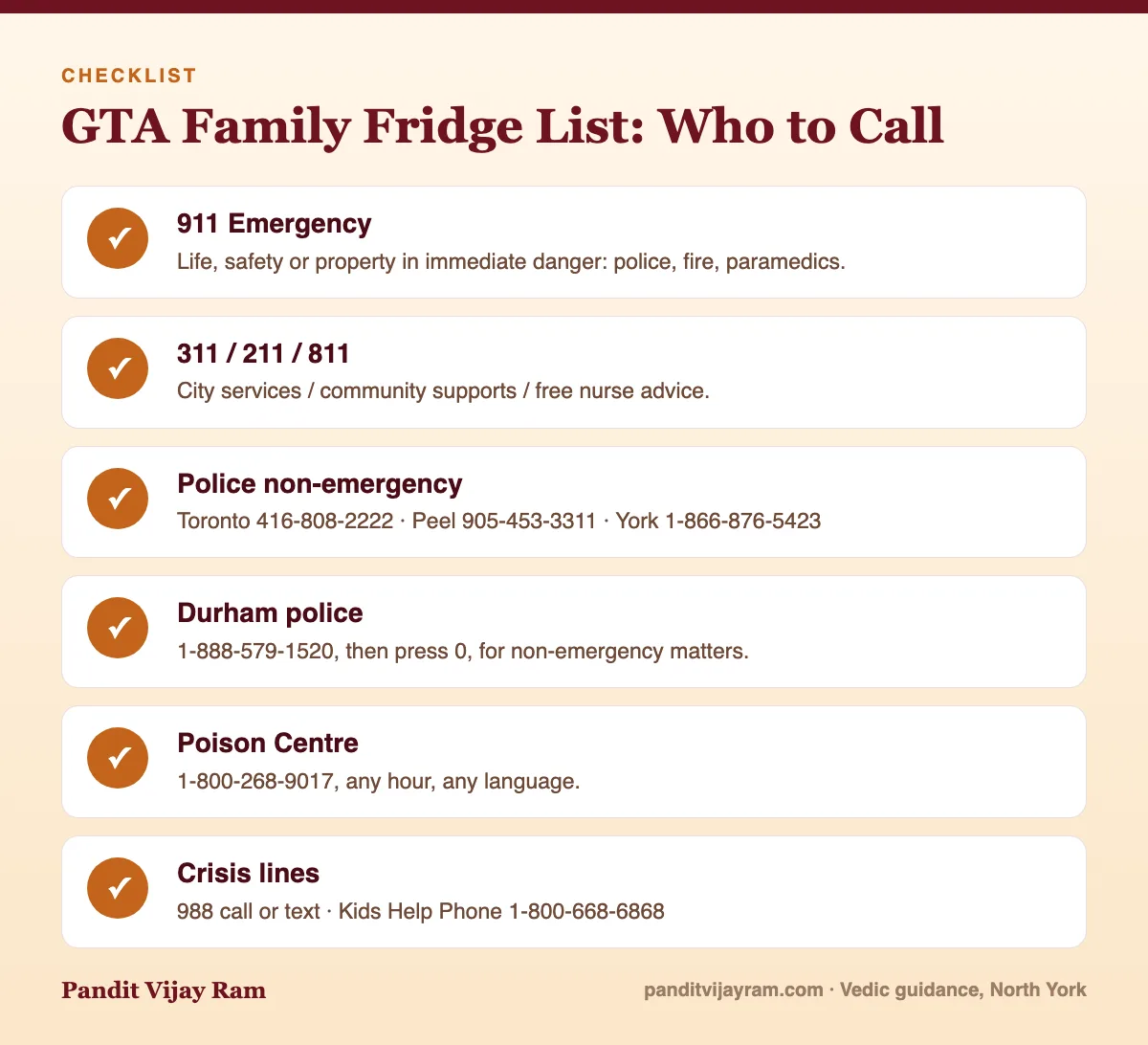
When something goes wrong at home, panic makes even simple choices hard. Should you call 911 for a noisy neighbour, a confused grandparent or a child who swallowed a pill? Many families search for non emergency numbers GTA services use only after the moment has passed, when the stress has already done its damage. Clients in North York, Brampton and Markham have told me about nights when they called the wrong line, or no one at all, because they were unsure. In more than forty years of guiding families through crises, I have found that preparation calms fear better than any amulet. This guide lists verified numbers across the GTA: 911, Toronto's 311, 211 Ontario, Health811, the 988 crisis line, police non-emergency lines for Toronto, Peel, York and Durham, and the Ontario Poison Centre. It explains when to use each one and offers a fridge checklist you can print, translate for elders and keep where everyone can see it.
When should you call 911 in the GTA?
Call 911 when someone's life, health, safety or property is in immediate danger and you need police, firefighters or paramedics right now. Examples include a fire, a serious injury, chest pain, someone not breathing, a crime in progress or a person threatening harm. If unsure whether it is urgent, it is safer to call.
The City of Toronto's Make the Right Call page describes 911 as the number for emergencies that need immediate police, firefighter or paramedic response. Police services across the GTA say the same thing.
Call 911 for:
- Fire, smoke or the smell of gas inside a building.
- Chest pain, stroke signs, severe bleeding, unconsciousness or trouble breathing.
- A crime happening now, or a suspect still nearby.
- Someone threatening suicide or violence with a means at hand.
- A serious collision with injuries.
Do not call 911 for noise complaints, a theft discovered hours later, or general questions. Those calls tie up lines needed by people in danger. The police non-emergency numbers below handle them.
Teach children their home address, the nearest major intersection and how to dial 911 from a locked mobile phone. Practise once in a calm moment. Elders who are more comfortable in Punjabi, Tamil, Gujarati or Urdu should practise saying the address and intersection in English, and keep them written by the phone.
Diwali and other festivals bring extra fire risk at home; our guide to Diwali diyas in condos and apartments covers safe lamps, and Diwali fireworks rules across GTA cities explains local bylaws.

What are 311, 211 and 811 used for?
311 connects Toronto residents with non-emergency City services, available at all hours; Brampton and other GTA municipalities run their own 311 lines. 211 links anyone in Ontario to social services and community supports in more than 150 languages. 811 reaches Health811, where a registered nurse gives free, confidential health advice.
These three short numbers solve many problems that are not emergencies:
- 311 (City services). In Toronto, 311 handles non-emergency City services and programmes, around the clock, and also helps with emergency shelter and outdoor-living concerns. Brampton's 311 serves callers within city limits. Use it for missed garbage collection, potholes, bylaw questions, tree damage and similar issues.
- 211 (community and social services). Dial or text 2-1-1, or call toll-free 1-877-330-3213. 211 Ontario says its helpline is answered by real people at all hours, in more than 150 languages. Ask about food banks, housing, seniors programmes, newcomer help, mental health and substance use resources.
- 811 (Health811). Ontario says Health811 lets you talk to a registered nurse, day or night, for free, secure and confidential health advice. TTY users dial 711. There is also an online chat option.
For a confused grandparent with a mild fever at night, 811 is often the right first call; the nurse will tell you if you need emergency care. For an elder who feels lonely or needs services, 211 helps. Our guide to services for South Asian seniors in the GTA lists more supports.
What are the police non-emergency numbers across the GTA?
Toronto Police: 416-808-2222 from any phone, or *TPS (*877) from a mobile. Peel Regional Police: 905-453-3311. York Regional Police: 1-866-876-5423. Durham Regional Police: 1-888-579-1520, then press 0. Halton residents should use the non-emergency reporting options on Halton Regional Police's website.
Use these for police matters that are not happening right now and where no one is in danger, such as a theft discovered later, a minor collision without injuries, ongoing noise or a past incident you want on record.
- Toronto Police Service: 416-808-2222 from any phone, at any hour, or *TPS (*877) from a mobile phone, as listed on the City of Toronto's Make the Right Call page.
- Peel Regional Police (Brampton and Mississauga): 905-453-3311, with TTY at 905-451-1196.
- York Regional Police (Markham, Vaughan, Richmond Hill and the rest of York Region): toll-free 1-866-876-5423, with TTY at 1-800-668-0398.
- Durham Regional Police (Pickering, Ajax, Whitby, Oshawa and more): 1-888-579-1520, then press 0.
- Halton Regional Police (Oakville, Burlington, Milton, Halton Hills): use the Report a Non-Emergency option on the service's website.
A simple decision rule: is anyone in danger, or is the person still there? If yes, call 911. If no, use the non-emergency line.
Some families hesitate to call police at all, especially newcomers who distrusted police in their home country. If worries about status or past experiences hold you back, our guide to legal clinics and legal aid in the GTA lists free advice. For disputes with neighbours that have not become crimes, try the calmer steps in neighbour disputes in the GTA first.
What should you do in a poisoning emergency?
If the person is unconscious, having a seizure or struggling to breathe, call 911. Otherwise call the Ontario Poison Centre at 1-800-268-9017, which is available every hour of every day in any language. Have the container, the person's age and weight, and the time of exposure ready.
The Ontario Poison Centre is operated by The Hospital for Sick Children, and its contact page says it can help by phone 24 hours a day, every day of the year, in any language. The number is 1-800-268-9017.
Common poisoning risks in GTA homes:
- Medicines left on bedside tables, especially elders' blood pressure or diabetes tablets.
- Cleaning products decanted into unlabelled bottles.
- Camphor tablets used in puja and kept in reach of small children.
- Ayurvedic or imported remedies of unknown strength.
- Button batteries from toys, remotes and diya-style LED lamps.
- Carbon monoxide from blocked vents or indoor fuel use.
Store camphor, ghee lamps and incense high and out of reach, and never leave a burning lamp unattended. If your puja shelf is low, consider a lockable drawer for samagri. Our puja samagri list includes safer substitutes for some items.
Keep the Poison Centre number beside 911 on your fridge. In a panic, people often forget that a specialist line exists and either wait too long or crowd an emergency department unnecessarily.
Which crisis and support lines should be on every GTA fridge?
Add 988, Canada's Suicide Crisis Helpline, by call or text; Kids Help Phone at 1-800-668-6868 or text CONNECT to 686868; the Seniors Safety Line at 1-866-299-1011; and the Canadian Anti-Fraud Centre at 1-888-495-8501. Each helps a different family member in a different kind of trouble.
Not every crisis involves sirens. These lines cover the quieter emergencies that families in the GTA face:
- 988: call or text for anyone thinking about suicide or worried about someone else. It is a safe space to talk at any hour. If safety is at immediate risk, call 911.
- Kids Help Phone: 1-800-668-6868 or text CONNECT to 686868, for children, teens and young adults. Our guide to youth and student support in the GTA adds student lines.
- Seniors Safety Line: 1-866-299-1011, free and confidential for older adults experiencing or at risk of abuse.
- Canadian Anti-Fraud Centre: 1-888-495-8501 for scams, including fake spiritual healers who demand large payments. See reporting spiritual fraud in the GTA.
- Toronto Central Intake: 416-338-4766 for emergency shelter assistance in Toronto.
For family violence, our domestic violence help guide for the GTA lists shelters and helplines.
When someone tells me they feel attacked by black magic and cannot sleep or eat, I first make sure they have these numbers and a doctor. Spiritual work, such as our negative energy guidance, comes after safety, never instead of it.
The bottom line
Non emergency numbers in the GTA protect families as much as 911 does, because they send each problem to the right place. Keep 911 for immediate danger, use 311, 211 and 811 for city, community and health questions, and save your region's police non-emergency line. Add the Poison Centre, 988, Kids Help Phone, the Seniors Safety Line and the Anti-Fraud Centre to a fridge list that every family member can read.
Key takeaways
- Call 911 only when life, health, safety or property is in immediate danger.
- Toronto 311 handles City services; 211 connects to community supports in 150-plus languages.
- Health811 gives free nurse advice by dialling 811, with TTY at 711.
- Toronto Police non-emergency is 416-808-2222; Peel is 905-453-3311; York is 1-866-876-5423.
- The Ontario Poison Centre, 1-800-268-9017, helps in any language at any hour.