
Support Services for South Asian Seniors in the GTA

Many grandparents who came to Canada to help raise grandchildren now spend long days alone while everyone is at work or school. A search for seniors services GTA South Asian families can rely on often turns up scattered lists with no sense of where to begin. Clients in North York, Brampton and Scarborough tell me their parents feel lonely, unsure of the language at the doctor's office, or quietly worried about money and family pressure. In more than forty years of practice, I have learned that a peaceful old age needs both spiritual company and practical support. This guide gathers verified public services across the GTA: the Seniors Safety Line for abuse concerns, Seniors Active Living Centres, helplines for home care and loneliness, and the Brampton seniors clubs that celebrate South Asian festivals. It also explains how to spot elder abuse, how a temple or community seva role can restore purpose, and how adult children can help without taking over.
What support services exist for South Asian seniors in the GTA?
Across the GTA, older adults can use provincial services such as Health811, Ontario Health atHome and the Seniors Safety Line, city recreation and 55+ programmes, Seniors Active Living Centres, and 211 for local referrals. Many cultural seniors clubs, especially in Brampton, run activities in South Asian languages and celebrate familiar festivals.
Ontario publishes a Guide to Programs and Services for Seniors on ontario.ca. It is the best single starting point for families in any GTA city, because it covers health, money, housing, safety and caregiving in one place.
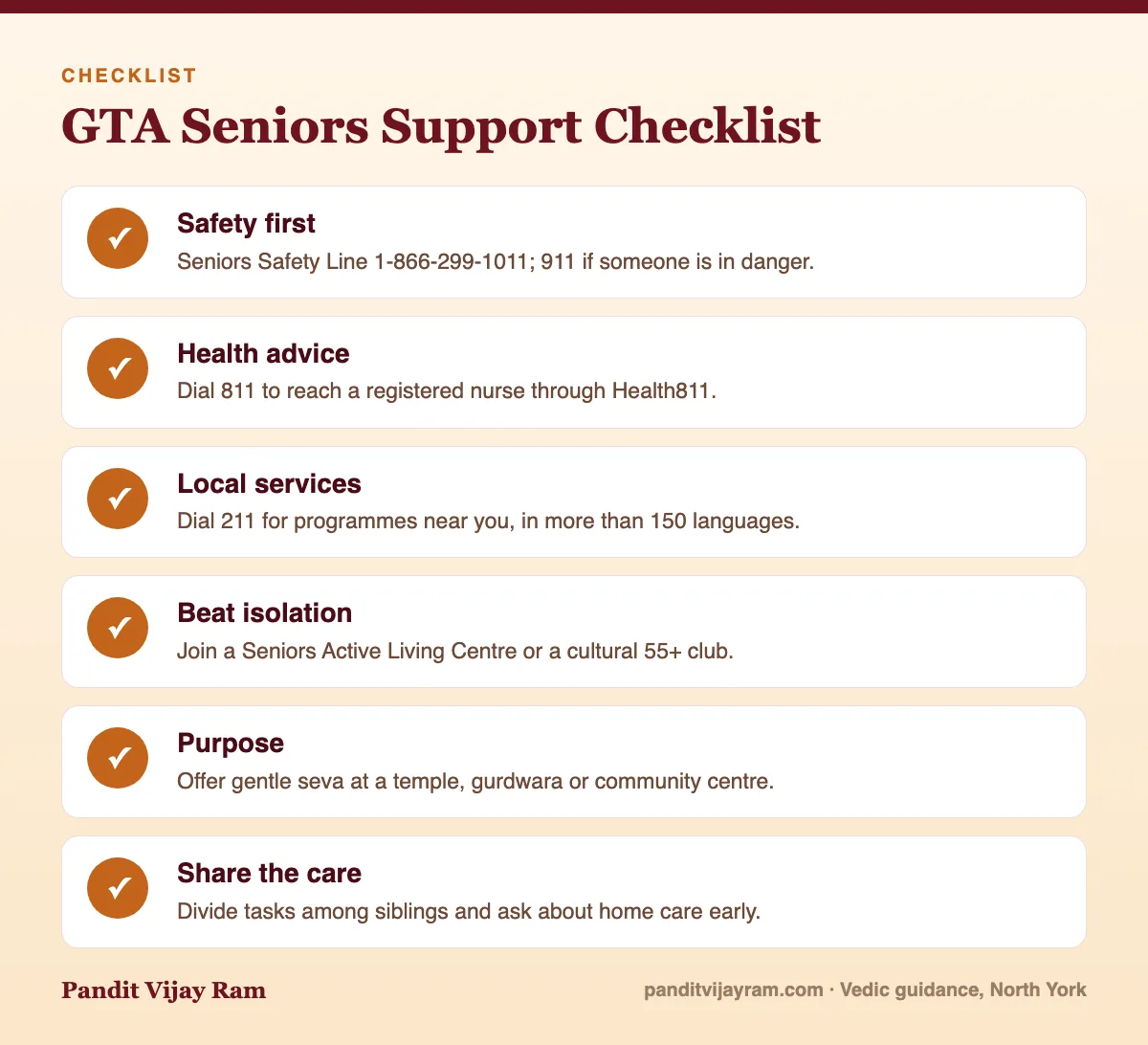
- Health advice: Health811 connects callers with a registered nurse by dialling 811.
- Care at home: Ontario Health atHome arranges home and community care; the provincial guide lists its toll-free line as 1-833-515-1234.
- Local referrals: 211 is answered by people around the clock and offers service in more than 150 languages, which matters for elders more comfortable in Punjabi, Tamil, Gujarati, Urdu or Hindi.
- Toronto: the Toronto Seniors Helpline connects older adults and their families with community supports, crisis help, in-home care and caregiver resources, with interpretation in many languages.
Settled families sometimes forget that these services are for them too, not only for newcomers. If your parents arrived recently, our guide to settlement services for new immigrants in the GTA explains where sponsored parents can find orientation help. If low mood or anxiety is part of the picture, read mental health support for South Asian families in the GTA before assuming the problem is spiritual.
Write the key numbers on a card by the phone, in your parent's own script if that helps. A senior who knows whom to call feels far less helpless.

How do Seniors Active Living Centres and Brampton seniors clubs reduce isolation?
Seniors Active Living Centre programmes offer in-person, online and telephone activities that Ontario describes as a way to reduce loneliness and stay active. Brampton lists dozens of volunteer-run 55+ community groups, including Tamil, Gujarati and Punjabi-speaking clubs that mark Diwali, Vaisakhi and other festivals together.
Isolation is one of the quiet hardships of elder life in the GTA. Winters are long, transit can feel daunting, and grandchildren grow busy. Ontario's active living chapter of its seniors guide points to three useful routes:
- Seniors Active Living Centres. Ontario says there are over 300 of these programmes in the province, with in-person, online and phone options. A finder tool on ontario.ca shows the nearest one.
- Seniors' Centre Without Walls. Group activities by telephone for older adults who cannot easily leave home.
- A Friendly Voice. A phone line for people 55 and over who want someone to talk to; the province lists it as 1-855-892-9992.
Brampton's city website lists Adults 55+ Community Groups, which are volunteer, not-for-profit clubs meeting at recreation centres. Among them are the Brampton Tamil Seniors Association, a Gujarati Seniors Group, and several clubs that celebrate Hindu and Sikh festivals, Vaisakhi and Diwali alongside Canadian holidays. Toronto, Mississauga and York Region cities also run 55+ recreation; check your own city's recreation pages.
When I meet an elder who has stopped eating well and sleeps through the afternoon, I ask how many conversations they had that week. Often the answer is almost none. Before any remedy, I suggest one group activity a week. Familiar food, a shared bhajan or a game of cards does more for the spirit than many rituals.
What is elder abuse and how can families recognise it?
Elder abuse is harm or neglect of an older person by someone they know or rely on. Ontario lists emotional, financial, physical and sexual abuse and neglect. Warning signs include sudden money problems, fearfulness around one relative, unexplained injuries, missed medicines and being cut off from friends or the temple.
Ontario's seniors guide states plainly that elder abuse is never acceptable. In close-knit families it can be hard to name, because it often comes from someone the elder loves. Respect for parents is central to our cultures, yet pressure, control and neglect still happen.
Use this simple check if something feels wrong:
- Money: pension or bank cards held by someone else without clear consent, pressure to sign property papers, or bills unpaid despite income.
- Emotion: shouting, threats to send the elder back, insults about being a burden, or silence enforced as punishment.
- Body: bruises with vague explanations, poor hygiene, or medicines not given.
- Isolation: phone taken away, visitors refused, or no longer allowed to attend the mandir, gurdwara or mosque.
Sponsored parents may fear that complaining will affect their status or the family's reputation. That fear keeps many people quiet. A confidential call is a safe first step, because it gives information without forcing any decision.
Fraud is another form of harm. Ontario warns about grandparent scams and urges people never to send money without independently confirming an emergency. Spiritual fraud targets elders too; our guide to reporting spiritual fraud in the GTA covers the Canadian Anti-Fraud Centre and police.
Who can a senior call about abuse or safety in Ontario?
In immediate danger, call 911. For abuse or the risk of it, Ontario's Seniors Safety Line at 1-866-299-1011 is free, confidential and open around the clock. Theft, fraud or assault can be reported to local police. Scams can also be reported to the Canadian Anti-Fraud Centre at 1-888-495-8501.
These numbers come from the safety and security chapter of Ontario's seniors guide:
- Seniors Safety Line: 1-866-299-1011, TTY 1-866-299-0008. Ontario describes it as free, confidential and available every hour of every day for seniors who are experiencing or at risk of abuse.
- Emergencies: 911 when someone is in danger.
- Police: contact local police if a senior has been a victim of theft, fraud or physical assault. Each GTA region's non-emergency line is in our guide to emergency and non-emergency numbers every GTA family should know.
- Canadian Anti-Fraud Centre: 1-888-495-8501 for scams.
When abuse happens between spouses or within a household, the shelters and helplines in our domestic violence help guide for the GTA also apply to older people. Age does not cancel anyone's right to safety.
If you are the adult child, do not confront the person you suspect in anger first. Call the line yourself, describe what you have seen, and ask what options exist. Then speak with your parent privately, in their own language, and let them lead. Spiritual practice can steady a frightened heart, but it never replaces safety planning or the police when a crime has been committed.
How can seniors find purpose through temple or community seva?
Seva, selfless service, gives many elders a reason to dress, travel and connect. Gentle roles include helping in a temple or gurdwara kitchen, reciting at a prayer gathering, teaching grandchildren's classes in a heritage language, or welcoming newcomers. Choose tasks that suit their health and keep the commitment small at first.
In our traditions, the later stage of life has long been linked with service, prayer and passing on wisdom. In the GTA, that stage often lands in a basement apartment with little to do. Seva can change the shape of the week.
Roles that suit most older adults:
- Kitchen help: chopping vegetables or rolling rotis while seated, often with a lively group.
- Path and kirtan: joining recitation of the Hanuman Chalisa, Sukhmani Sahib or other prayers.
- Teaching: sharing stories, festival meanings or a heritage language with children.
- Welcoming: greeting newcomers who also feel far from home.
Ask the place of worship how volunteers sign up and what physical demands are involved. Arrange transport and avoid long standing or icy walks in winter. Our list of Hindu temples across the GTA can help you find one close by.
At home, a short daily routine also anchors the day. A morning lamp and a few lines of prayer, like those in our guide to family peace prayers, give an elder a role in the household's spiritual life. When grandchildren join, the elder becomes a teacher again rather than a dependant.
How can adult children support ageing parents without burning out?
Share tasks among siblings, write down medicines and appointments, use Health811 and Ontario Health atHome early, and look after your own sleep and health. Caregiver burnout is common. Respect your parent's choices where it is safe, and ask for outside help before exhaustion turns into resentment.
Many of my clients carry a full job, children and the care of one or two parents. They feel guilty asking for help, as if a good son or daughter should manage alone. That belief wears families down.
A practical rhythm that works for many households:
- Hold a short monthly family meeting, including siblings abroad by video, to divide tasks.
- Keep one notebook or shared document listing medicines, doctors, health card details and emergency contacts.
- Call Ontario Health atHome early to ask what home care your parent may qualify for.
- Book one regular outing for your parent, such as a seniors club or temple programme, so you are not their only company.
- Protect one evening a week for your own rest.
Our longer article on spiritual support for caregivers of elderly parents covers prayer, patience and boundaries in more depth.
Sometimes families ask me for a health and wellbeing reading or a puja for an ageing parent. I am glad to offer prayer and chart insight, but I always ask first whether the family doctor has reviewed the medicines and whether memory has been checked. Spiritual care walks beside medical care; it never replaces it.
The bottom line
Seniors services across the GTA are broader than most South Asian families realise. Ontario's Seniors Safety Line and police protect elders from abuse, while Seniors Active Living Centres, Brampton's cultural 55+ clubs and helplines ease loneliness. Seva and a simple daily prayer routine restore purpose, and shared caregiving keeps adult children from burning out. Begin with one call and one weekly activity, and build from there.
Key takeaways
- Ontario's Seniors Safety Line, 1-866-299-1011, is free, confidential and open around the clock.
- Seniors Active Living Centres and Brampton's cultural 55+ clubs are practical answers to isolation.
- Elder abuse includes financial pressure and cutting someone off from friends or worship.
- Temple, gurdwara or community seva gives many elders purpose and company.
- Adult children should share caregiving and use home care services before burning out.