
Neighbour Disputes in the GTA: Calm Steps and Spiritual Patience

A neighbour dispute wears on you in a particular way. You cannot leave it at the office. It is there when you pull into the driveway, when the bass starts through the condo wall at midnight, when the fence line or the shared driveway becomes a weekly battle. Families in North York, Scarborough, Brampton and Vaughan describe the same tiredness: they no longer feel at ease in their own home. In more than forty years of Vedic practice, I have seen that the conflicts which settle are usually handled in a patient, documented order, while those that escalate often began with one angry knock on a door. This guide sets out that order for GTA households, from the first conversation to by-law officers, mediation and, when needed, police. It also offers patience practices from the Vedic tradition that help you keep your temper. It is general guidance only; for legal questions about property lines or tenancies, speak to a lawyer or the relevant tribunal.
How do you deal with a difficult neighbour without making it worse?
Start with one calm, private conversation at a good time, not in the middle of the problem. Describe the issue, not the person, and suggest a simple fix. Assume good faith at first; many neighbours do not realise the noise or the parking spot bothers you. Follow up with a short, friendly note.
The first conversation sets the tone for months. A few habits make it far more likely to go well.
- Pick the moment. Not at midnight during the party, and not the morning after when you are exhausted. A weekend afternoon works better.
- Use I-statements. Say that the music after eleven keeps your children awake, rather than that they are inconsiderate.
- Offer something. Your number to text if your own dog barks, or an offer to split the cost of trimming a shared hedge.
- Respect culture. Cooking smells, festival gatherings and prayer sounds are part of life in a diverse city. Ask about timing, not about changing who they are.
- Write it down after. Note the date and what was agreed. A friendly follow-up text keeps a record without sounding legal.
If there is a language barrier, a mutual friend or a building staff member can help translate. Avoid sending a teenager to deliver complaints; it puts them in an unfair spot.
Above all, do not retaliate. Loud music in return, blocking a driveway or leaving items on their property can turn a nuisance into a legal problem of your own. Our piece on negativity that comes from other people explains why boundaries work better than revenge.

Who do you call about a neighbour noise complaint in Toronto and the GTA?
In Toronto, non-emergency noise and property complaints go to 311, which passes them to by-law enforcement. Other GTA cities, such as Mississauga, Brampton, Vaughan and Markham, run their own by-law services, often also reached through 311 or the city website. Condo residents should report to management first. Tenants can contact their landlord.
Matching the problem to the right office saves weeks of frustration. A simple guide:
- Ongoing noise, garbage, long grass, property standards. Your city's by-law or municipal standards service. In Toronto, call 311 or use the online service request. Rules on quiet hours vary by municipality, so check your own city's noise by-law rather than relying on what a friend in another city says.
- Condo noise, odours, pets or parking. Report in writing to the property manager or board. Ontario's Condominium Authority Tribunal handles certain condo disputes if the building's own process fails.
- Rental issues with your own landlord. The landlord is responsible for many tenant complaints, and Ontario's Landlord and Tenant Board deals with tenancy disputes.
- Trees, fences and property lines. A survey and a real estate lawyer are the right first steps. City arborist rules may apply to large trees.
- Parking on your property or blocked driveways. Usually your city's parking enforcement, often through 311 or the police non-emergency line, depending on the municipality.
Keep a log of each call: the date, the reference number and what you were told. By-law officers can only act on what they can verify, and a clear record helps them. Our guide to puja and havan in a rented home also covers being a considerate neighbour yourself.
Can community mediation help resolve neighbour problems?
Yes, often. Community mediation services in many GTA areas offer trained, neutral volunteers who meet both neighbours, usually at low or no cost. Mediation is voluntary and confidential, and it focuses on practical agreements such as quiet hours or parking arrangements. It works best before relations have broken down completely.
Mediation sounds formal, but it is mostly a structured conversation with a neutral person keeping it fair. Here is what usually happens.
- Intake. You contact a community mediation or conflict resolution service. Your city, a community centre, a legal clinic or 211 can point you to one nearby.
- Separate calls. The mediator speaks to each side privately to understand the issue.
- Joint meeting. Both neighbours sit together, in person or online, and take turns speaking without interruption.
- Options. The mediator helps list possible fixes: a quieter time for the basketball net, a shared bin location, a heads-up text before parties.
- Written agreement. Whatever is agreed is written down in plain words. It is usually not a court order, but it gives both sides a clear reference.
Mediation does not suit every case. If there is violence, a serious power imbalance or ongoing harassment, mediators may decline and refer you elsewhere.
The Vedic tradition has long valued the neutral elder, the person both sides respect. Mediation is a modern form of that same wisdom. Our guide on family property disputes describes how a mediator helps relatives too.
When does a neighbour dispute become harassment that police should handle?
Call 911 if anyone threatens you, damages property while you watch, or you feel in immediate danger. Contact the police non-emergency line for repeated intimidation, vandalism, stalking or targeted abuse, including racist or religious slurs. Keep evidence such as photos and messages, and never confront an aggressive neighbour alone.
Most neighbour problems are nuisances. Some cross into something more serious, and knowing the difference protects your family.
Treat it as a police matter when:
- Someone threatens to hurt you, your children or your pets.
- Your car, fence or property is damaged deliberately.
- You are followed, watched or repeatedly confronted in a way that makes you fear for your safety.
- You receive slurs or abuse targeting your race, religion, caste or community.
- Items are left on your doorstep to frighten you.
Save everything. Photos with dates, doorbell camera clips, messages and the names of any witnesses. Write a short note after each incident while details are fresh.
Some families fear that an object left at the door, a lemon, a doll or ash, is black magic. Handle it calmly: photograph it, wear gloves, bag it and report it if it was meant to intimidate. Our guide to finding a suspicious object explains the full process.
Spiritual protection can ease the fear that follows, but it does not replace a police report. Vijay Ram ji's negative energy guidance always begins by asking whether you are safe.
Which spiritual practices help you stay patient with a neighbour?
Kshama, or forbearance, is a core Vedic virtue, and simple daily practices support it. A morning breath practice before leaving the house, a lamp at the entrance at dusk, a quiet prayer for the neighbour's wellbeing, and the Hanuman Chalisa on difficult days all help you respond rather than react.
Patience is not weakness. In the tradition, kshama is listed among the qualities of a person of steady wisdom. It means you choose your response rather than letting the neighbour choose it for you.
A short routine that families find useful:
- Before you leave home. Three rounds of slow breathing, counting four in and six out. Our pranayama guide has gentler and deeper options.
- At the threshold. Light a diya inside the entrance at dusk and ask that your home stay peaceful. Keep it on a metal tray, away from shoes and coats.
- A goodwill prayer. Once a day, say sarve bhavantu sukhinah, may all be happy, with the neighbour in mind. It is hard at first. Over time it loosens resentment.
- On bad days. Recite the Hanuman Chalisa once before replying to any message.
- Weekly reset. Clean and tidy your own entrance. A calm, well-kept doorway lifts your own mood.
None of this asks you to tolerate abuse or give up your rights. It keeps your mind clear while the practical steps, by-law, mediation or police, do their work.
The bottom line
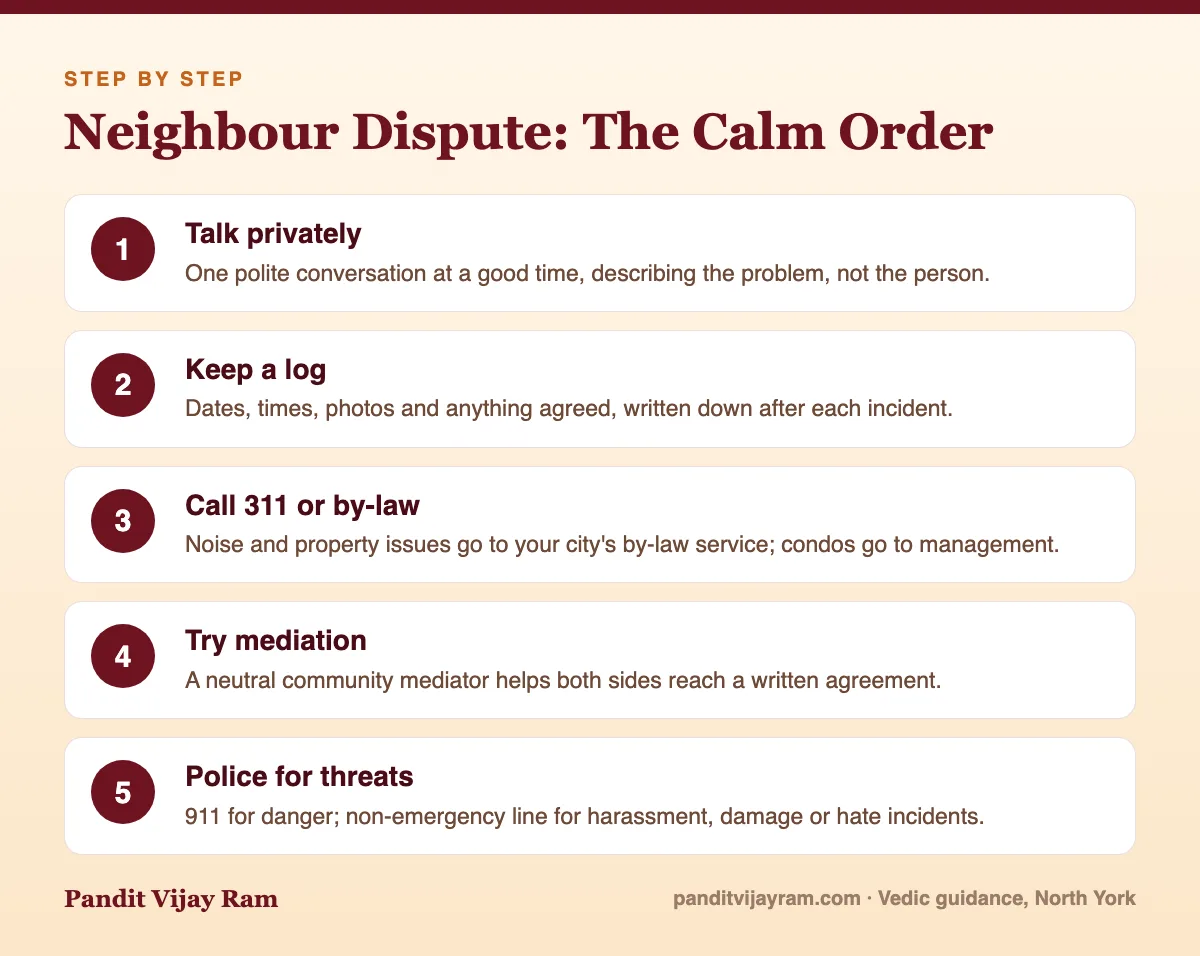
A neighbour dispute in the GTA settles most reliably when you follow a calm order. Begin with a polite private conversation and a written log, then use your city's by-law service through 311 and community mediation. Treat threats, damage and harassment as police matters. Throughout, patience practices such as a breath routine and a goodwill prayer keep your mind steady and your home peaceful.
Key takeaways
- Talk privately and politely before filing any complaint.
- Keep a dated log of incidents, calls and reference numbers.
- Use 311 or your city's by-law service for noise and property issues.
- Community mediation offers a neutral, low-cost path to agreement.
- Threats, damage and hate-motivated abuse are police matters.