
Latino Spiritual Traditions in Toronto, Respectfully Explained
Many of the people who write to me are Latino. Some grew up with a grandmother who swept an egg over them to lift mal de ojo; others set out photographs and marigolds for their dead every autumn. When readers look up Latino traditions Toronto families keep alive, they often want to know whether those practices have a place here, and how they relate to the Vedic remedies I teach in North York. In more than forty years I have learned to listen first and compare second. A Mexican limpia, a Peruvian procession and a Vedic nazar ritual come from different worlds, even when they rhyme. This guide offers a respectful overview for Latino readers across the GTA and for neighbours who want to understand them. It covers Día de Muertos, Catholic devotions, limpia and curanderismo, beliefs about mal de ojo, the diversity of Latin American spirituality, and community organisations that support Spanish-speaking families. I write as an outsider who respects these traditions, not as an authority on them.
How is Día de Muertos observed by Latino families in Toronto?
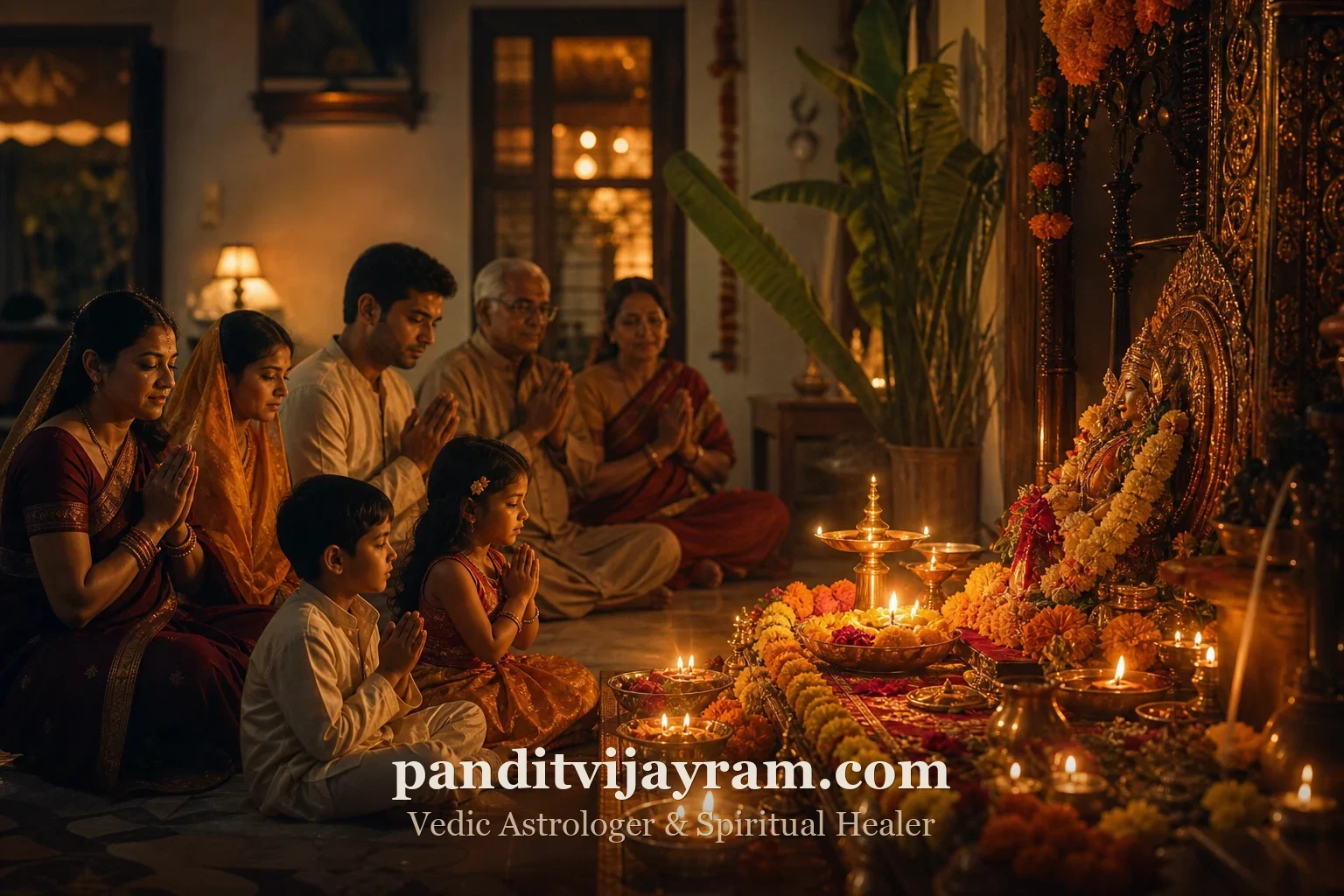
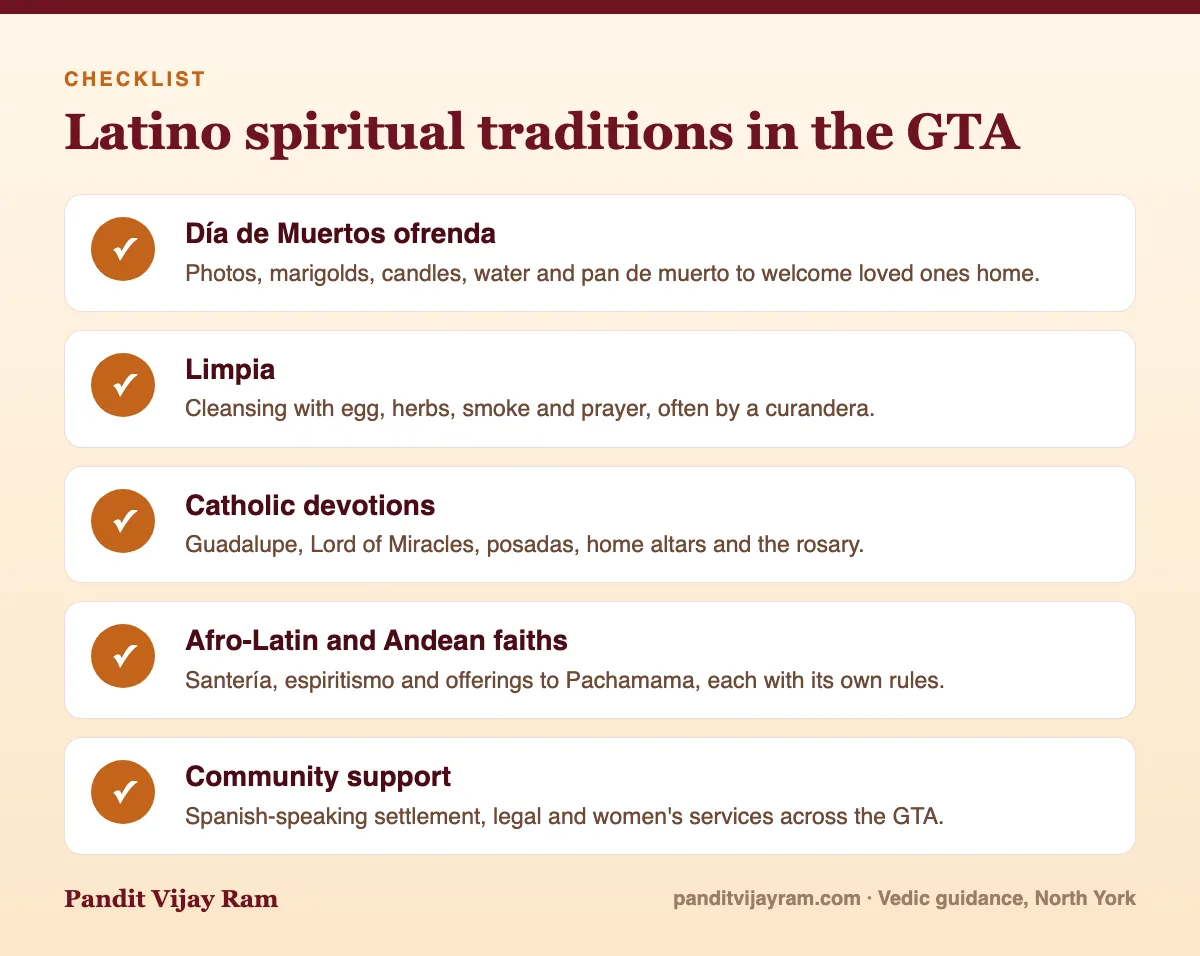
Día de Muertos, or Day of the Dead, is a Mexican tradition, now shared more widely, in which families welcome the spirits of loved ones home. They build an ofrenda, an altar with photographs, marigolds, candles, water, salt, pan de muerto and the person's favourite foods. In Toronto, families keep home altars and gather at community events.
Day of the Dead is a celebration of memory, not a Mexican version of Halloween. Its roots combine Indigenous Mesoamerican honouring of ancestors with the Catholic feasts of All Saints and All Souls.
An ofrenda usually includes:
- Photographs of those being remembered.
- Cempasúchil, orange marigolds, whose colour and scent are said to guide souls home.
- Candles to light the way, and water for thirst after the journey.
- Pan de muerto, a sweet bread, and favourite foods or drinks.
- Papel picado, cut paper banners, and sugar skulls with names written on them.
In GTA apartments, families adapt. A shelf becomes the altar, battery candles replace open flames in condos, and marigolds come from a local florist. Schools, libraries and cultural centres often hold public displays and workshops.
I find a gentle echo here with Hindu shraddh, when families offer food and water to ancestors. The beliefs differ, and I would never fold one into the other, but both say that love continues after death. Families mourning someone recently may find our guide on feeling the presence of a deceased relative comforting.
What is a limpia, and how does curanderismo approach healing?
A limpia is a spiritual cleansing, often performed by a curandero or curandera, using an egg, herbs such as rue or basil, flowers, smoke, prayer and sometimes water. Curanderismo is a Mexican and Mexican-American healing tradition that blends Indigenous medicine, Catholic prayer and herbal knowledge. Practitioners see body, soul and community as connected.
A limpia can be simple or elaborate. A grandmother may pass an egg over a child while praying, then crack it into a glass of water and read the shapes. A curandera may sweep the body with a bundle of herbs, use copal smoke and recite prayers to the saints.
Curanderismo addresses conditions with cultural names:
- Mal de ojo, the evil eye, believed to come from an envious or admiring gaze, especially on babies.
- Susto, soul loss after a fright, with symptoms such as poor sleep and low appetite.
- Empacho, a digestive blockage.
These are understood within a whole worldview, and many curanderos encourage people to see a doctor too. That matters. Symptoms such as fever, weight loss, a baby who will not feed, or long-lasting low mood need medical care first. See your family doctor, and in crisis call or text 9-8-8.
Our wave-one comparison of egg cleansing limpia and Vedic nazar removal looks at where the two practices meet and where they differ. I do not perform limpias, because that is not my tradition, and I respect those who carry it.
What role do Catholic devotions play in Latino spiritual life in the GTA?
For many Latino families, Catholic faith is the centre of spiritual life, expressed through Mass, saints, the Virgin Mary in national forms such as the Virgin of Guadalupe, home altars, rosaries and processions. Popular devotions mix official church practice with family customs, and Spanish-language parishes in the GTA keep them alive.
Latin America is diverse, and so is its Catholicism. Families in the GTA may honour:
- Our Lady of Guadalupe, patroness of Mexico and of the Americas, with mañanitas songs at dawn on her feast.
- El Señor de los Milagros, the Lord of Miracles, with purple-clad processions in Peruvian communities.
- Las Posadas, the nine nights before Christmas re-enacting Mary and Joseph's search for shelter.
- Día de Reyes, Three Kings Day, with rosca bread and gifts.
- National patronesses, such as Colombia's Virgin of Chiquinquirá or Cuba's Virgin of Charity.
Home altars often hold a crucifix, saints' statues, candles and photos of relatives. Prayer is daily and personal, and asking a saint's help for health, work or a journey is an act of trust.
Some readers worry that visiting a Hindu practitioner betrays their faith. I never ask anyone to give up their religion. If someone of Catholic faith consults me, I encourage them to keep their prayers and parish, and I offer only Vedic perspectives they can accept with a clear conscience.
Belief in the evil eye crosses all these cultures. Our article on the evil eye across cultures explores mal de ojo beside nazar.
Are Santería, brujería and Andean traditions part of Latino spirituality?
Yes, for some families. Afro-Cuban Santería, or Lucumí, is a religion with its own priests and initiations. Andean communities may honour Pachamama, Mother Earth, with offerings. Brujería is a broad, often misunderstood word for folk magic. Each deserves respect and accurate description, and none should be reduced to fear or stereotypes.
Latin American spirituality includes much more than one church. Respectful understanding means naming things carefully:
- Santería or Lucumí. An Afro-Cuban religion that honours the orishas, with initiated priests called santeros and babalawos. It is a faith, not a spell service. Our article on Santería and Candomblé, respectfully explained says more.
- Andean practice. Families from Peru, Bolivia and Ecuador may offer coca leaves, food or drink to Pachamama and to the apus, the mountain spirits, especially before journeys or at the start of the planting season.
- Espiritismo. In some Caribbean Latino communities, mediums contact spirits for guidance.
- Brujería. The word can mean anything from a grandmother's herbal charm to harmful magic. Using it as an insult for another person's faith causes real harm.
Our comparison of obeah, jadu and brujería traditions places these words side by side with care.
A caution applies in every tradition. Anyone, of any background, who demands large payments to remove a curse, frightens you about a relative or promises to control another person is not acting as a genuine healer. Vijay Ram ji does not perform rituals to override another person's will.
Where can Latino families in the GTA find community support?
Spanish-speaking families can turn to organisations such as the Centre for Spanish Speaking Peoples in North York, which offers settlement help, a legal clinic and support for women facing violence, and FCJ Refugee Centre, which helps people with immigration and refugee issues at no cost. Spanish-language parishes and cultural groups also offer belonging.
Spiritual life grows best on steady ground. These verified organisations are good starting points:
- Centre for Spanish Speaking Peoples (Centro para Gente de Habla Hispana). A long-established non-profit serving the Latinx and Hispanic community. Its site describes a settlement program, a legal clinic offering services to Spanish speakers, support for women who have experienced abuse, and programs for older adults.
- FCJ Refugee Centre. Supports refugees and people at risk because of immigration status, with settlement, youth education, anti-trafficking work and shelter for women and children. It states that it does not work with agents and that its services are free.
- Settlement agencies. Many have Spanish-speaking staff. Our guide to settlement services in the GTA explains how to find them.
- Parishes and cultural groups. Spanish-language Masses, folkloric dance groups and national associations keep language and faith alive for children.
Canada lists Latin American Heritage Month among its commemorative observances, and many GTA schools and libraries mark it with music, food and talks.
Latino readers who want a Vedic perspective can book through the Toronto consultation page, and the evil eye and nazar service explains Vijay Ram ji's approach. He is not affiliated with any organisation named here.
The bottom line
Latino traditions in Toronto are rich, varied and rooted in many countries, blending Indigenous, African and Catholic heritage. Día de Muertos honours the dead with love, limpia and curanderismo treat body and soul together, and Catholic devotions anchor daily faith. Respect means describing each tradition on its own terms, encouraging medical care alongside spiritual care, and supporting the community organisations that serve Spanish-speaking families across the GTA.
Key takeaways
- Día de Muertos is a celebration of memory with ofrendas, marigolds and favourite foods.
- Limpia and curanderismo combine prayer, herbs and Indigenous knowledge; see a doctor for physical symptoms.
- Catholic devotions, from Guadalupe to the Lord of Miracles, sit at the centre of many Latino homes.
- Santería is a religion and brujería a broad folk term; neither should be used to frighten.
- The Centre for Spanish Speaking Peoples and FCJ Refugee Centre support Spanish-speaking families in the GTA.