
Egg Cleansing (Limpia) and Vedic Nazar Rituals: An Honest Comparison

Toronto is one of the few cities where a Mexican grandmother and a Punjabi grandmother might live on the same street and do almost the same thing for a crying baby. One passes an egg over the child while praying the Our Father. The other circles a fist of salt and red chillies seven times and murmurs a prayer to Hanuman. Clients in North York, many in mixed Latino and South-Asian families, ask me how egg cleansing compares with nazar rituals, and whether it is right to use both. In more than forty years of Vedic practice, I have grown to respect how closely these customs mirror each other while staying distinct. This article explains what a limpia is, what nazar utarna involves, where they meet and differ, what can honestly be read from an egg or a burning chilli, how families can honour both traditions, and the safety points that matter for each.
What is an egg cleansing, or limpia, and how is it done?
A limpia con huevo is a cleansing ritual from curanderismo, the folk healing tradition of Mexico and Central America. A curandera or family elder passes a whole raw egg over the person from head to feet while praying, often with herbs such as rue or basil, then cracks the egg into a glass of water to read it.
Limpia means cleaning. Within curanderismo, it is one of the most familiar rituals, and it carries a blend of Indigenous and Catholic devotion. Variations appear in Mexico, Guatemala, Peru, Ecuador, and among Puerto Rican and Cuban families as well.
A typical egg limpia follows this pattern:
- Preparation. The healer prays, sometimes lights a candle before an image of the Virgin of Guadalupe or a saint, and may sprinkle holy water or agua florida.
- Passing the egg. A fresh, room-temperature egg is rubbed or rolled over the head, face, arms, chest, back and legs, often in the shape of a cross, while prayers such as the Our Father or the Hail Mary are said.
- Herbs. A bundle of ruda (rue), albahaca (basil) or romero (rosemary) may be brushed over the body too.
- Reading. The egg is cracked into a clear glass of water. The healer looks at bubbles, threads, cloudiness and the yolk's position to interpret what was drawn out.
- Disposal. The contents are flushed or buried away from the house, and the glass washed.
Limpias are sought for mal de ojo, the evil eye, for susto, a fright that is believed to unsettle the spirit, and for envidia, envy. The ritual belongs to its own tradition and deserves to be described on its own terms.

What is nazar utarna in South-Asian tradition?
Nazar utarna means taking off the evil eye. A parent or elder circles salt, dried red chillies, mustard seeds, a lemon or alum around the person seven times while praying, then discards the material outside or burns the chillies. It is a household custom found among Hindu, Sikh and many Muslim families.
Where a limpia is often performed by a recognised healer, nazar utarna is usually done by a mother or grandmother at home, especially for babies, brides, new homeowners or children who have done well at school.
Common materials and their customs:
- Salt and red chillies. Held in a closed fist and circled around the head and body. The chillies are often dropped into a fire or stove afterwards.
- Mustard seeds. Sometimes added to the salt, or circled alone.
- Lemon. Circled and then cut or discarded at a crossroads. The full method is in the guide to the lemon cleansing ritual.
- Alum, phitkari. Circled and then heated; the shape it melts into is sometimes interpreted.
- Kala tika. A small dot of kajal behind the ear as prevention.
The motion is usually seven circles, with a prayer to Hanuman, Durga or the family deity, or simply a heartfelt request. In many South-Asian Muslim homes, the parallel practice is reciting protective verses from the Qur'an over the child, which belongs to its own religious framework.
The older step-by-step guide to removing nazar at home covers the household method in detail.
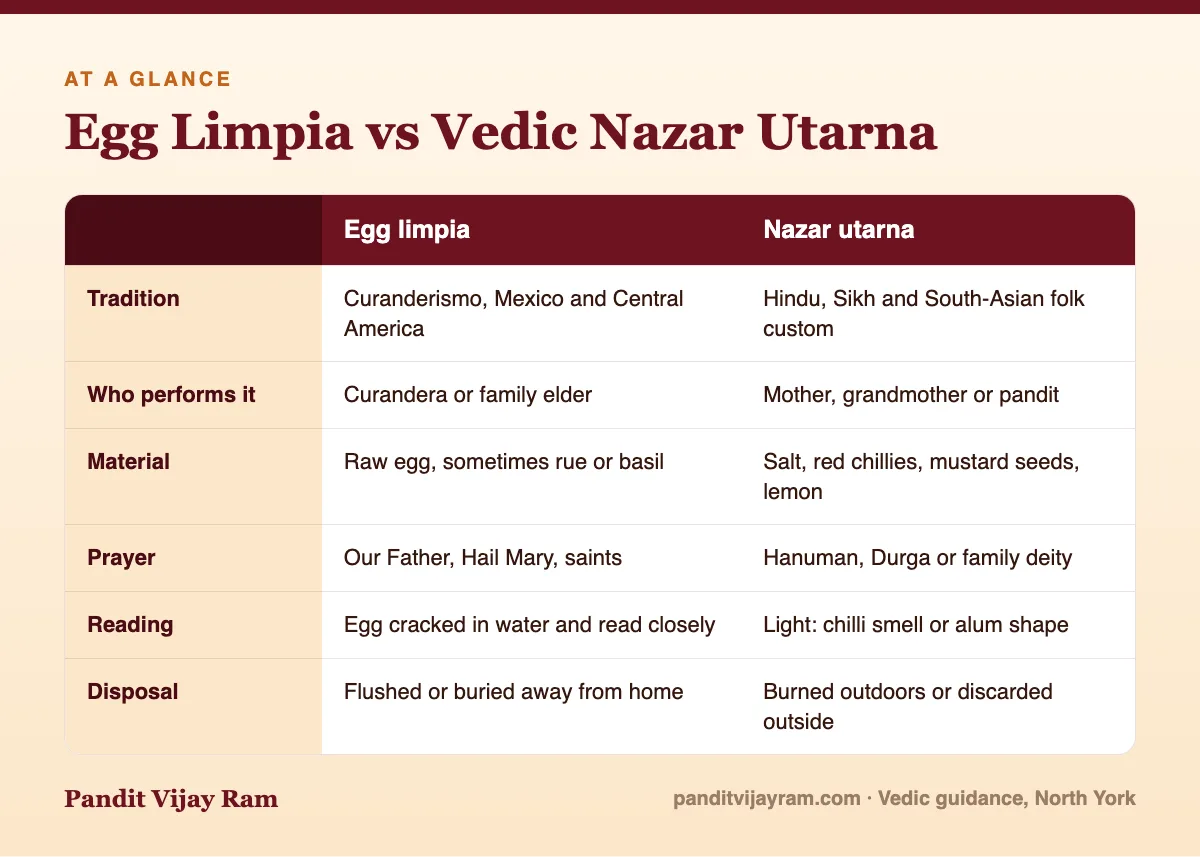
How are egg cleansing and nazar rituals alike and how do they differ?
Both rest on the same idea: admiring or envious eyes can unsettle a person, and a material object passed over the body can draw that off before being thrown away. They differ in religious framing, in who performs them, in the materials used and in how much the object is read afterwards.
Seen side by side, the overlap is striking:
- Shared belief. Mal de ojo and nazar both describe harm from a strong gaze, often admiration of a baby or good fortune.
- Shared method. An absorbent object moves around or over the body with prayer.
- Shared disposal. The object is removed from the home, never eaten, and handled carefully.
- Shared tenderness. Both are most often done for children by people who love them.
And the differences:
- Religious frame. Limpias draw on Catholic saints and Indigenous Mesoamerican healing. Nazar utarna sits within Hindu, Sikh or folk Islamic devotion.
- Who performs it. A limpia is often done by a curandera with a reputation in the community. Nazar utarna is usually a family task, with a pandit involved only for more serious concerns.
- Reading. The egg is read closely and the reading is central. With nazar, reading is lighter; a common sign is that burning chillies give off little sharp smell when nazar is said to be present.
- Herbs. Limpias use rue, basil and rosemary; nazar rituals rarely add herbs.
For a wider cross-cultural view that includes Obeah and Brujería, see the respectful explainer on Obeah, jadu and Brujería traditions.
What does it mean when the egg looks strange in the water?
Within the tradition, bubbles, threads, cloudiness or spots in the water are read as signs of what the limpia removed. Physically, these come from the egg's own structure, its freshness, the water temperature and how hard the shell was rubbed. A reading is interpretation within faith, never proof of a curse.
Eggs are not uniform. A fresh egg has thick white that holds together and two twisted cords, the chalazae, that anchor the yolk and can look like threads. An older egg has thinner white that spreads and clouds. Cold eggs cracked into warm water, or warm eggs into cold, form wisps and bubbles. Rubbing an egg firmly can introduce tiny cracks and air. Small blood or meat spots occur naturally in some eggs.
The same honesty applies to nazar signs. Dried chillies that have lost their oils smell less when burned, and good ventilation carries the smell away.
That does not mean the ritual is empty. For believers, the reading is a way of naming worry and closing it. But it does mean:
- Do not panic over a cloudy glass or a quiet chilli.
- Do not accept a reading as evidence that a relative or neighbour cursed you.
- Be very wary of anyone who uses a reading to sell an expensive follow-up. Some fraudsters swap the egg for one pre-loaded with hair, blood or a small object.
If you have been pressured for money after a reading, the Canadian Anti-Fraud Centre accepts reports, and the guide to negative energy removal scams lists the usual tactics.
Can mixed families use both a limpia and nazar rituals?
Yes, if each is approached with respect and done by people who belong to or understand that tradition. Many Toronto families blend customs naturally. Avoid treating the other culture's ritual as a party trick or a product, ask an elder from that tradition for guidance, and keep the intention on care rather than fear.
In mixed homes, a child may have a Mexican abuela and a Gujarati nani, each with her own protective habits. That is a blessing, not a conflict. A few principles keep it respectful:
- Let each elder lead her own custom. The person raised in the tradition knows its prayers and meanings.
- Don't stack rituals out of anxiety. One gentle practice, done calmly, is better than three done in a panic.
- Avoid commercial borrowing. Buying a limpia kit online without any connection to curanderismo can turn a sacred act into a novelty.
- Respect religious boundaries. A devout Catholic grandmother may not want Hindu mantras added to her limpia, and the reverse is equally true.
For my part, I work within Vedic methods: nazar utarna, mantra, kavach and puja. I do not perform limpias, which belong to curanderas, but I am happy to advise families who keep both customs at home on how the Vedic side fits. The evil eye and nazar removal service begins with a conversation about the family's own traditions.
The cleansing and protection hub gathers the other body and home cleansing guides.
Are egg cleansings and nazar rituals safe for babies?
The rituals themselves are gentle, but raw egg can carry Salmonella, so wash hands and the baby's skin afterwards and avoid broken skin. Burning chillies indoors releases fumes that irritate small lungs. Above all, a baby with fever, diarrhoea, poor feeding or constant crying needs a doctor first, not a limpia or nazar ritual.
In both traditions, symptoms attributed to the evil eye in babies, such as crying, fever, diarrhoea and refusing to feed, overlap with real illness. Infants can become dehydrated quickly. Call your family doctor, Health811 or go to emergency if a baby is lethargic, has a high fever, or has fewer wet diapers than usual.
Practical safety for each ritual:
- Egg limpia. Use an intact egg and avoid cracking it near the baby. Wash your hands and wipe the child's skin with a clean damp cloth afterwards. Never use the egg for food.
- Salt and chillies. Keep the fist closed so nothing falls on the baby. Burn chillies outdoors or on a stove with the fan on, away from the child, or simply discard them.
- Herbs. Rue can irritate skin, especially in sunlight. Brush it lightly over clothing rather than bare skin.
- Kajal. Keep it far from the eyes.
These customs are acts of love. Practising them safely, after medical needs are met, lets them stay that way. For other spiritual practices focused on the body, see the overview of spiritual body cleansing.
The bottom line
Egg cleansing in the limpia tradition and Vedic nazar utarna share a belief in the evil eye and a method of drawing it off with an object and prayer. They differ in religious frame, in who performs them and in how much the object is read. Readings are matters of faith, not proof of curses, and are sometimes exploited by fraudsters. Mixed families can honour both with respect, and every baby's health comes first.
Key takeaways
- A limpia passes a raw egg over the body with prayer and reads it in water.
- Nazar utarna circles salt, chillies, mustard seeds or a lemon seven times.
- Both address the evil eye, but within different religious traditions.
- Egg patterns have physical causes, so a reading is never proof of a curse.
- Babies with fever, diarrhoea or poor feeding need a doctor before any ritual.