
Obeah, Jadu and Brujería: Shared Fears, Different Traditions
A Trinidadian grandmother whispers about obeah, a Punjabi aunty warns about jadu, and a Mexican neighbour mentions brujería after a run of bad luck. Families across North York and the wider GTA carry these words, often with more fear than understanding. This guide explains what each term actually means, where it comes from, what the three traditions share and where they differ sharply. You will also learn which ordinary explanations to check first, why no tradition here deserves mockery, and how to look for help that honours your own background. I work within the Vedic tradition, not within Obeah or Brujería, and I say that openly to every client. In more than forty years of practice I have sat with Caribbean, Latino and South-Asian families who came with the same worried question in different languages. Listening carefully to the words people use, and to the history behind those words, has taught me more than any book. My aim here is simple: replace rumour with a clearer picture, so you can decide your next step calmly.
What does Obeah mean and where did it come from?
Obeah is a set of spiritual, herbal and protective practices that grew among enslaved West Africans in the British Caribbean. An obeah man or obeah woman might heal, protect, find lost property or seek justice. Colonial governments criminalised it, which left a lasting stigma that many Caribbean families still feel today.
The word is used most in Jamaica, Trinidad and Tobago, Barbados, Guyana and the smaller English-speaking islands. Scholars connect its roots to several West African peoples whose healers were forcibly brought across the Atlantic. On the plantations, these specialists kept herbal knowledge alive and offered a sense of power to people who had almost none.
Because Obeah was linked to resistance and uprisings, colonial authorities passed laws against it. Some of those laws lasted long after emancipation, and a few islands still have them in some form. That legal history matters: it is one reason the word carries such fear, secrecy and shame in many homes.
Today Caribbean people hold very different views. Many devout Christians reject Obeah entirely. Others see it as part of their heritage, closer to bush medicine and ancestral wisdom than to anything sinister. It is also distinct from Haitian Vodou, Cuban Santería and Jamaican Revival, which are religions or religious movements with their own clergy and theology.
When a Caribbean client in Scarborough or Brampton tells me someone "put obeah" on the family, I listen to what that phrase means to them before saying anything. For the wider Vedic view of harmful practice, see our honest Vedic guide to black magic.
What is jadu tona in South-Asian homes?
Jadu tona is a Hindi and Urdu expression for magic meant to harm, bind or block someone, while kala jadu means black magic specifically. Tona or totka can describe small household charms. Hindu, Muslim and Sikh families use the words, but each faith answers the fear through its own prayers.
In everyday South-Asian speech the vocabulary overlaps. Nazar is the evil eye, often unintentional and caused by envy or admiration. Jadu implies a deliberate act. Totka can be harmless, like hanging lemon and chillies at a shop door, or it can describe something meant to cause trouble.
Each faith frames the problem differently:
- Hindu households may turn to Hanuman Chalisa, Durga Saptashati recitation, havan or a protective kavach.
- Muslim households speak of sihr and seek ruqyah, recitation of the Qur'an over the affected person, from a trusted imam or reciter.
- Sikh households usually rely on Gurbani and ardas, since Sikh teaching places trust in Naam and discourages fear of charms.
These responses are not interchangeable, and I never ask a client to set aside their own faith. A Muslim family may prefer guidance on sihr framed in Islamic terms, while a Hindu family may want a chart reading alongside prayer. If you are unsure whether you are facing nazar, deliberate jadu or a difficult planetary period, our comparison of kala jadu, nazar and graha dosh sets out the differences clearly.
What does brujería mean for Latino families?
Brujería is the Spanish word for witchcraft. In Latin American and Latino life it can mean feared harmful magic, but it also overlaps with curanderismo, the folk-healing tradition of curanderos who use herbs, prayer and the limpia. Some people today reclaim the word as cultural heritage rather than something evil.
A family from Mexico, Colombia, Ecuador or El Salvador may use brujería loosely. It might describe a trabajo, a "work" done against someone, or an amarre, a love binding. It might also describe the grandmother down the street who cleans a child of mal de ojo with an egg and a prayer to a saint.
Much of this lives inside Catholic devotion. Curanderos pray to saints, use holy water and candles, and see their gift as coming from God. That is very different from the feared bruja of rumour, and lumping the two together insults many sincere healers.
Brujería is also not the same as Santería, also called Lucumí. Santería is a religion of Yoruba origin that developed in Cuba, with initiated priests, orishas and community worship. Treating it as "black magic" is a common and hurtful mistake.
Readers curious about the egg cleansing will find a careful side-by-side in limpia and Vedic nazar removal compared. When Latino clients visit me, I explain where Vedic practice is similar and where it is simply different, so nobody feels their own tradition is being dismissed.
How are Obeah, jadu and brujería similar and how are they different?
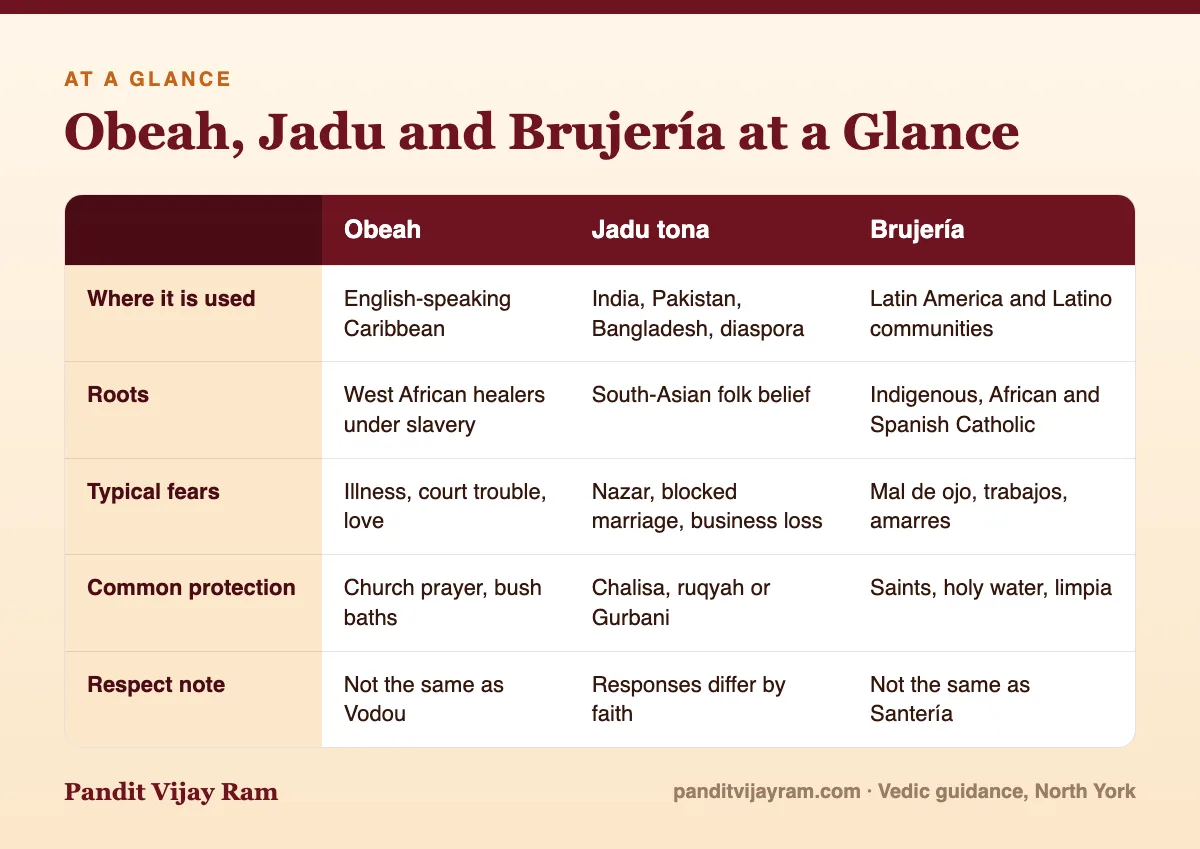
All three share a belief that envy can travel through ritual, that a skilled healer can both harm and protect, and that misfortune may have a hidden human cause. They differ in history, in the spirits or deities involved, and in the religions that surround them. Treat each on its own terms.
Here is a simple way to hold the comparison in mind:
- Origin. Obeah formed under slavery in the Caribbean. Jadu belongs to centuries of South-Asian folk belief alongside Hindu, Islamic and Sikh scripture. Brujería mixes Indigenous, African and Spanish Catholic elements across Latin America.
- Who is feared. In all three, the suspected sender is usually close: a rival, an in-law, a former partner or a jealous neighbour.
- Typical worries. Illness without clear cause, business failure, sudden quarrels and a partner leaving appear in every tradition.
- Healer's role. The obeah practitioner, the curandero and the South-Asian maulvi or pandit are all consulted to protect, not only to harm.
- Religious frame. Each sits inside a wider faith world, Christian, Catholic, Hindu, Muslim or Sikh, that shapes what remedy feels right.
The shared thread is human: fear grows strongest where people feel powerless or envied. The difference is that each culture has built its own language for comfort. Respecting that language is the first step to helping anyone. Vijay Ram ji's black magic removal service works from Vedic methods only and says so plainly.
Could it be something ordinary instead of a spell?
Very often, yes. Before blaming obeah, jadu or brujería, check health, sleep, money pressure, family conflict, workplace stress and the home itself for mould or faulty wiring. Grief and migration stress also mimic a curse. A doctor's visit and an honest look at circumstances come first in any tradition.
Most of the people I see who fear a spell are dealing with something far more ordinary, and often more fixable. A sudden weakness can be anaemia or a thyroid problem. Repeated nightmares can follow stress or a change in medication. A shop losing customers may be facing a new competitor down the road.
A practical first round looks like this:
- Book a check-up with your family doctor and mention every symptom, even the ones that feel spiritual.
- Look at sleep, alcohol, screen time and diet over the last few months.
- Ask whether finances, debt or job insecurity changed recently.
- Notice whether tension with a relative or partner started at the same time.
- Inspect the home for damp, pests, noise or electrical faults.
If low mood, hopelessness or thoughts of self-harm are part of the picture, please see your family doctor, and in a crisis call or text 988 for Canada's Suicide Crisis Helpline. Spiritual practice can sit beside that care, but never in place of it. If a person is threatening or harassing you, that is a matter for the police, whatever tradition they claim to practise.
Where can I get respectful spiritual help in Toronto?
Start with a faith leader from your own tradition if you have one. If you prefer Vedic guidance, look for a practitioner who listens first, asks about ordinary causes, explains the method openly and never insults your background. Avoid anyone who uses fear, demands secrecy or pressures you to pay quickly.
In the GTA you have real choice. Caribbean Christians may speak to a pastor. Catholic Latino families may want a priest's blessing as well as a curandero's limpia. Muslim families can ask a trusted imam about ruqyah. None of this conflicts with seeking a Vedic reading if you also want one.
When clients from outside Hindu tradition come to me, I explain three things at the start:
- I work with Vedic astrology, mantra, puja and protective prayer, and I do not claim to practise Obeah or Brujería.
- Any remedy I suggest is optional and can be adapted so it does not clash with your faith.
- I will ask about health, family and money before I talk about anything unseen.
Many people find that a calm conversation, a look at the birth chart and a simple protective routine is enough to settle the fear. Others need more structured work, which is described on the magic and entities hub. Whatever path you choose, keep control of your decisions and your money, and walk away from anyone who makes you feel smaller for your culture.
The bottom line
Obeah, jadu tona and brujería grew from different histories, yet they answer the same fears about envy, illness and lost love. Respecting each tradition on its own terms matters more than lumping them together as one dark force. Ordinary causes such as health, stress and family conflict deserve the first look, with a doctor or the police where needed. When you want spiritual support, choose a guide who listens, explains openly and honours the faith you already hold.
Key takeaways
- Obeah is a Caribbean healing and protective tradition with West African roots and a painful legal history.
- Jadu tona is the South-Asian phrase for harmful magic, answered differently by Hindu, Muslim and Sikh faith.
- Brujería overlaps with Catholic curanderismo and is not the same as the religion of Santería.
- Check health, money, sleep and relationships before assuming any spell.
- Good help respects your own tradition and never relies on fear or secrecy.