
The Evil Eye Across Cultures: Nazar, Mal de Ojo, Ayin Hara and Malocchio

Walk through a Toronto neighbourhood and you will see the evil eye everywhere: a blue glass bead in a Greek bakery, a hamsa in a Lebanese restaurant, a black dot on a baby at a Punjabi birthday, a red string on a Mexican newborn. The evil eye in different cultures takes many forms, but the worry underneath is strikingly similar. In North York, where families from all of these backgrounds live on the same streets, I am often asked whether these beliefs are really the same thing. This article compares the main traditions side by side: what each calls the evil eye, who is thought to be at risk, how families protect themselves, and how they remove it. It is written with respect for every tradition, including religious teachings that some families hold deeply. In more than forty years of practice in the Vedic tradition, I have found that understanding a neighbour's custom usually deepens respect for one's own, and helps mixed families keep both without conflict.
Which cultures believe in the evil eye?
Belief in the evil eye is recorded across the Mediterranean, the Middle East, North Africa, South and Central Asia, Latin America and among Jewish communities worldwide. Ancient Greek and Roman writers discussed it, the Talmud mentions it, and Islamic hadith affirm it. In South Asia it appears as nazar or drishti.
The idea is very old. Greek and Roman authors wrote about it, and Plutarch discussed in his table talk why some people seemed to harm others with a look. Amulets against it appear in many ancient sites around the Mediterranean.
Today the belief is held, in some form, by families who otherwise have little in common:
- South Asia. Nazar in Hindi, Urdu and Punjabi; drishti or kann drishti in Tamil. In South India, a fierce painted face, the drishti bommai, is hung on houses under construction to draw stares away.
- Turkey, Iran and the Arab world. Al-ayn in Arabic and nazar in Turkish, with the blue glass nazar boncuğu.
- Jewish communities. Ayin hara in Hebrew, keyn eyn hore in Yiddish.
- Italy and Greece. Malocchio and mati, with oil-in-water diagnosis and inherited prayers.
- Latin America and the Caribbean. Mal de ojo, often focused on babies.
What changes from place to place is the language, the materials and the religious framing. What stays the same is the sense that good fortune draws attention, and attention can carry envy. Symbols such as the bead, the hamsa and the nazar battu are compared in hamsa, nazar battu and evil-eye beads.

What is mal de ojo in Latino tradition?
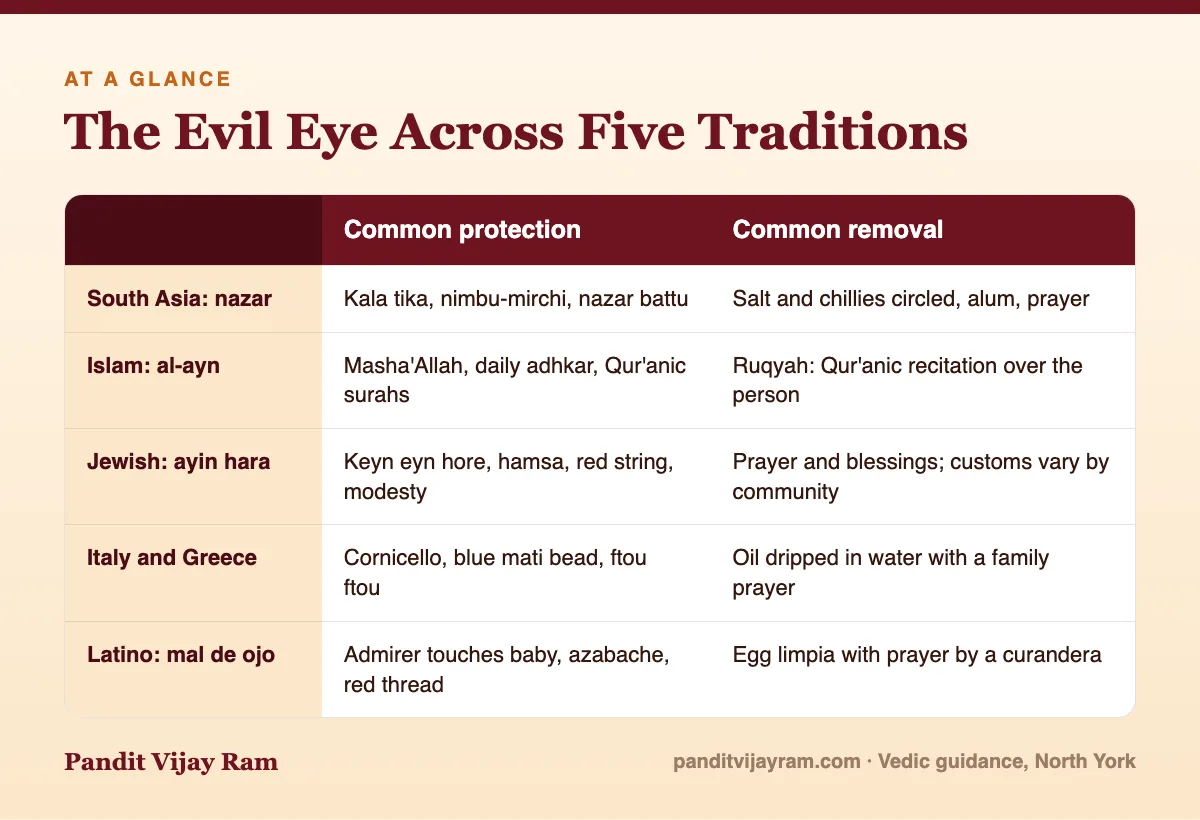
Mal de ojo is the Spanish name for the evil eye. It is most often linked to babies and young children, who may cry, run a fever or refuse to eat after being admired. Families protect infants with red string or azabache bracelets and ask admirers to touch the child, and healers may perform an egg limpia.
In many Mexican, Central American, Puerto Rican, Cuban and Dominican homes, mal de ojo is understood as accidental. A visitor who admires a baby without touching him is thought to leave a kind of heat or weight behind. The simplest prevention is for the admirer to touch the baby gently, often on the head or cheek.
Common protections include:
- Azabache. A small charm of jet, a black stone, often set on a baby's bracelet, especially in Caribbean families.
- Ojo de venado. A large brown seed, the deer's eye, worn on a red string in Mexico.
- A red thread bracelet on the wrist of a newborn.
- Prayer. Many families invoke Catholic saints or the Virgin Mary alongside folk customs.
For removal, a curandera or a grandmother may pass a whole egg over the child with prayers, then crack it into water and read it. That practice, and how it compares with nazar utarna, is covered in egg cleansing, limpia and Vedic nazar. Any baby with fever, poor feeding or listlessness needs a doctor first, whatever the family's tradition.
What does ayin hara mean in Jewish tradition?
Ayin hara is Hebrew for the evil eye. In Jewish thought it refers to the harm that envy or a begrudging look can bring, and to an ungenerous attitude in the one who looks. Families guard against it with discretion, blessings, the phrase keyn eyn hore, the hamsa, and in some communities a red string.
The Talmud discusses ayin hara in several places, and Jewish teachers have long treated it on two levels. One is protective: avoiding showy displays of blessing, not counting children aloud, and adding a phrase like bli ayin hara when sharing good news. The other is ethical: the obligation not to look at another person's good fortune with resentment. In that sense, a good eye, ayin tovah, means generosity.
Customs you may meet in Jewish homes in the GTA include:
- Keyn eyn hore. A Yiddish phrase, no evil eye, said after praise.
- The hamsa. An open-hand symbol hung at home or worn as jewellery, common in Sephardi and Mizrahi families.
- The red string. Associated with Kabbalah and with Rachel's Tomb, tied on the left wrist in some communities.
- Modesty with milestones. Some families hold back baby gifts or announcements until after the birth.
Rabbis differ in how literally they read these customs, and many emphasise the ethical meaning above amulets. That balance between protection and character is something every tradition here shares.
How do Italians and Greeks remove malocchio and mati?
Both traditions use an oil-in-water test. A few drops of olive oil are dripped into a bowl of water while a prayer is said; if the oil spreads or forms an eye shape, the evil eye is read as present. The prayer is repeated until the oil holds together. Many families pass the prayer down privately.
In southern Italy, malocchio is commonly diagnosed and lifted by a woman in the family who knows the prayer. The words are often said to be taught only at particular times, with Christmas Eve frequently mentioned, and kept within the family. Protective charms include the red cornicello, a twisted horn, and the hand gesture of the horns.
In Greece and Cyprus, the evil eye is mati, and the removal is called xematiasma. The healer makes the sign of the cross, drips oil into water and recites a prayer. Yawning or tears during the prayer are often taken as signs that it is working. The familiar blue glass eye, also called mati, is pinned to clothes, hung in cars and given to babies. A light, pretend spit, ftou ftou, after a compliment is a household habit.
A few honest points apply to oil tests in any tradition:
- Oil behaves differently in warm and cold water, and with soap residue in the bowl.
- The reading depends heavily on the person interpreting it.
- The real comfort lies in being prayed for by someone who loves you.
The Orthodox Church has its own prayers against the evil eye, said by a priest, which some families prefer to folk methods.
How is the evil eye understood in Islam and the Middle East?
In Islam, the evil eye, al-ayn, is affirmed in authentic hadith. Protection comes through remembrance of God: saying Masha'Allah when admiring, and reciting the Qur'an, especially Surah al-Falaq, Surah an-Nas and Ayat al-Kursi. Ruqyah, Qur'anic recitation over the affected person, is the recognised remedy. Many scholars discourage amulets.
For Muslim families, the evil eye is not folklore but part of religious teaching. The Prophet Muhammad is reported in Sahih al-Bukhari and Sahih Muslim to have said that the evil eye is real. That gives the subject a seriousness and a clear framework.
- Prevention. Saying Masha'Allah or Barak Allahu feeh when admiring something, and the morning and evening adhkar, the daily remembrances.
- Recitation. The last two surahs of the Qur'an, al-Falaq and an-Nas, known together as the mu'awwidhatayn, and Ayat al-Kursi.
- Ruqyah. Recitation of Qur'anic verses and prophetic supplications over the person, often with water.
- Amulets. The blue bead and the hand symbol, sometimes called the hand of Fatima, are popular across the Middle East and North Africa as culture. Many Islamic scholars regard reliance on such objects as impermissible and encourage prayer instead. Families differ.
I work in the Vedic tradition, and I respect that Muslim readers will want guidance from within their own faith. The teaching is explained more fully in nazar in Muslim tradition, and the site's page on ruqyah healing describes that path.
What do evil-eye beliefs around the world have in common?
Nearly all traditions share four ideas: envy or strong admiration can cause harm, babies and the newly fortunate are most at risk, a blessing or prayer said with praise prevents it, and removal is done by someone close, often an older woman. They also share an ethic of modesty and generosity.
Put side by side, the traditions read like variations on one theme.
- Who is at risk. Infants, brides, pregnant women, new homeowners, successful students and thriving businesses.
- How it is prevented. A blessing with praise, a symbol of an eye or hand, modesty about good news.
- How it is diagnosed. Oil in water, an egg, an alum shape, chillies on a flame, or simply symptoms after a visit.
- Who removes it. A grandmother, a mother, a respected elder, a healer or a religious figure.
- The ethical core. Do not begrudge others their blessings, and do not boast of your own.
For mixed families in the GTA, this overlap makes things easier. A Greek grandmother's oil prayer and a Gujarati nani's salt and chillies can sit side by side, as long as each elder leads her own custom and nothing unsafe is done near a baby. What I discourage is stacking several rituals out of anxiety.
If a worry persists after family customs, the site's nazar removal service works from the Vedic side. The other guides in the evil eye and curses hub look at individual customs in depth.
The bottom line
The evil eye in different cultures goes by many names, from nazar and al-ayn to ayin hara, malocchio, mati and mal de ojo. Across them all, envy and admiration are the feared source, babies and the fortunate are most protected, and prayer with praise is the common shield. Respecting each tradition on its own terms lets mixed families keep their customs calmly and safely.
Key takeaways
- The evil eye is one of the most widely shared beliefs in the world.
- Each culture has its own name, symbol and removal method.
- Most traditions pair praise with a blessing to prevent harm.
- Islam affirms the evil eye and protects through Qur'anic recitation and ruqyah.
- Mixed families can keep several customs if each is done safely and calmly.