
Santería and Candomblé: Respecting Afro-Caribbean and Afro-Brazilian Religions
Latino, Caribbean and Brazilian families in Toronto sometimes tell me a relative "does Santeria" and ask, with some anxiety, whether that is the same as black magic. It is not. Santeria (often written Santería) and Brazil's Candomblé are living religions with priests, initiations, moral teaching and deep histories of survival. I meet people of many faiths in North York, and I have learned to treat each tradition on its own terms. This article explains where the two religions come from, who the orishas are, how worship and initiation work, how Catholic saints became part of the story, and why outsiders have so often misunderstood them. I practise only the Vedic tradition and do not perform Santería or Candomblé rites; I describe them as a respectful outsider. In more than forty years I have found that understanding a neighbour's religion removes most of the fear that rumours create. If you need spiritual help within these traditions, their own priests and houses of worship are the right people to approach.
What is Santería and where did it come from?
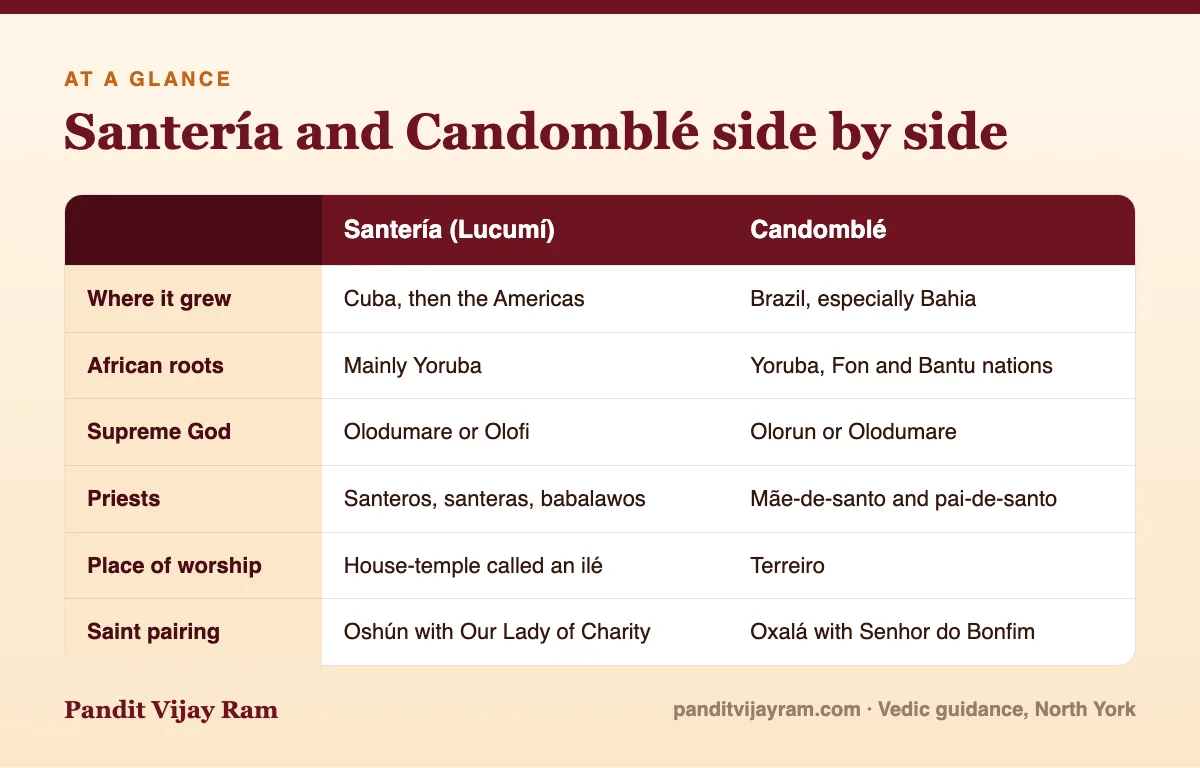
Santería is an Afro-Cuban religion that grew from the faith of Yoruba people brought to Cuba as enslaved labourers. Practitioners often prefer the names Regla de Ocha or Lucumí. It centres on a supreme God, Olodumare, and the orishas, served through initiation, divination, drumming and offerings in house-temples called ilé.
The Yoruba peoples of present-day Nigeria and Benin had a rich religion of orishas, ancestors and divination. In colonial Cuba, enslaved Yoruba and their descendants, known there as Lucumí, kept these practices alive, often through Catholic mutual-aid societies called cabildos. The Spanish word santería, "way of the saints", was first used by outsiders, sometimes mockingly, which is why many devotees prefer Regla de Ocha or Lucumí.
Key roles include:
- Santero and santera: initiated priests and priestesses, sometimes called olorisha.
- Babalawo: male priests of Ifá, a complex system of divination associated with Orula.
- Iyawó: a new initiate, who traditionally wears white for a year after initiation.
- Padrino and madrina: godparents who guide initiates through their religious lives.
Cuban migration over the generations carried the religion to Miami, New York, Mexico, Venezuela and Canada. It is closely related to, but distinct from, Haitian Vodou, which is explained in Haitian Vodou explained respectfully.
What is Candomblé and how is it practised in Brazil?
Candomblé is an Afro-Brazilian religion strongest in Bahia, especially Salvador, though practised throughout Brazil. It honours the orixás through song, drumming, dance and offerings in houses of worship called terreiros, led by a mãe-de-santo or pai-de-santo. Different nations, such as Ketu, Jeje and Angola, reflect Yoruba, Fon and Bantu roots.
Like Santería, Candomblé was rebuilt by enslaved Africans and their descendants, this time in colonial Brazil. Its nations (nações) preserve different African heritages:
- Ketu: Yoruba-rooted, the most widely known, honouring orixás such as Oxalá, Iemanjá and Xangô.
- Jeje: rooted in Fon and Ewe traditions, honouring spirits called voduns.
- Angola: rooted in Bantu-speaking peoples of Central Africa, honouring spirits called inkices.
Several of the oldest terreiros in Salvador were founded and led by women, and senior priestesses, called ialorixá or mãe-de-santo, hold great respect. Ceremonies feature sacred drums, songs in Yoruba-derived liturgical language, and the arrival of orixás in initiated devotees, who then dance in the deity's manner.
Candomblé should not be confused with Umbanda, a newer Brazilian religion that mixes African, Indigenous, Catholic and Spiritist elements. Practitioners of both have faced religious intolerance, including attacks on terreiros, which Brazilian authorities and courts have treated as crimes.
Who are the orishas?
The orishas, or orixás in Brazil, are divine beings or forces in Yoruba-derived religions. Each governs parts of nature and human life and has its own colours, numbers, songs and foods. Widely known orishas include Elegguá, Obatalá, Yemayá, Oshún, Changó, Ogún and Oyá, with spellings varying by country.
Each orisha has a recognisable character, which helps devotees understand both the deity and themselves:
- Elegguá / Exu (Eshu): keeper of crossroads and doors, honoured first in many rites.
- Obatalá / Oxalá: an elder of peace, purity and clear thought, linked with white.
- Yemayá / Iemanjá: mother of the sea and of living things.
- Oshún / Oxum: orisha of rivers, love, beauty and sweetness.
- Changó / Xangô: orisha of thunder, fire, drumming and justice.
- Ogún / Ogum: orisha of iron, work and technology.
- Oyá / Iansã: orisha of wind, storms and transformation.
Above them stands the supreme God, called Olodumare or Olofi in Cuba and Olorun in many Brazilian houses. Practitioners say every person has a guardian orisha, often identified through divination.
Hindu readers may notice parallels with devotion to particular deities, or with an ishta devata, a personally chosen form of the divine. The parallels are real but limited; each tradition has its own theology. The site's kundli reading page explains how Vedic practice looks at a person's spiritual inclinations in its own way.
Why do Catholic saints appear in Santería and Candomblé?
Under slavery and colonial rule, African religions were suppressed, and Catholic saints became a way to honour orishas in public. Over time devotees connected particular saints with particular orishas, such as Changó with Saint Barbara and Oshún with Our Lady of Charity. Scholars call this syncretism, and many devotees remain Catholic.
Some common pairings show how this worked:
- Oshún with Our Lady of Charity of El Cobre, the patron of Cuba.
- Changó with Saint Barbara, both linked with thunder and the colour red.
- Babalú Ayé with Saint Lazarus, associated with illness and healing.
- Yemayá with the Virgin of Regla in Cuba; Iemanjá with Our Lady of the Navigators or the Immaculate Conception in Brazil.
- Oxalá with Senhor do Bonfim in Salvador.
Scholars debate whether this was mainly a disguise, a genuine blending, or both at once. Some modern priests, especially in Brazil, have called for separating orisha worship from Catholic imagery, while others value both. Large public festivals, such as the offerings to Iemanjá on Brazilian beaches, now draw people of many faiths.
For South-Asian readers, the closest everyday parallel might be families who visit both a mandir and a dargah, or who keep pictures of several faiths on one shelf. Religious life is often more layered than official categories suggest. The overview of Obeah, jadu and brujería touches on similar layering in Caribbean and Latino homes.
Are Santería and Candomblé black magic, and how can you show respect?
No. Both are religions with priests, initiations, moral teaching and a focus on healing, guidance and community. The black magic label came from colonial prejudice, sensational media and misunderstanding of practices such as animal offerings. Respect means using their own names, not assuming harm, and asking their priests rather than outsiders.
Animal offerings in some ceremonies are often the focus of outsiders' fears. In these traditions, offered animals are usually cooked and shared by the community, much like sacrificial meals in many religions. In the United States, the Supreme Court case Church of the Lukumi Babalu Aye v. City of Hialeah found that city ordinances targeting Santería sacrifice violated religious freedom.
Simple ways to show respect:
- Use the names devotees prefer, such as Lucumí, Regla de Ocha or Candomblé.
- Do not touch altars, beads (elekes) or offerings you find in a park or by water.
- Do not assume a botánica or a neighbour wishes anyone harm.
- Be wary of online sellers using these religions' names to sell "spells".
- Treat real threats, whatever their claimed source, as a police matter.
When clients worry that brujería or a "Santería spell" has been used on them, I check ordinary causes first and offer Vedic prayer if they want it. The black magic removal page explains that approach without condemning another religion. Related guides sit in the magic and entities hub.
The bottom line
Santeria and Candomblé are Afro-Caribbean and Afro-Brazilian religions rooted in Yoruba and other West and Central African faiths. They honour a supreme God and the orishas through priests, initiation, music and community, and they have survived long persecution. Calling them black magic repeats old prejudice; respect means using their names and asking their own priests.
Key takeaways
- Santería is an Afro-Cuban religion, also called Regla de Ocha or Lucumí.
- Candomblé is an Afro-Brazilian religion strongest in Bahia, led from terreiros.
- Both honour a supreme God and the orishas, rooted in Yoruba tradition.
- Catholic saints became linked to orishas under colonial suppression.
- Neither religion is black magic; respect starts with using their own names.