
Satyanarayan Puja: Story, Samagri and When to Do It
Satyanarayan puja is often the first puja a young family hosts on its own, and the questions start early. Which story is read, what goes on the shopping list, and does it have to be on a full-moon evening? Families in North York, Scarborough and Brampton ask me these things before a housewarming or after a wedding, usually worried they will forget something important. The reassuring truth is that this is one of the gentlest pujas in the Hindu calendar. It asks for sincerity, a clean space, a simple sweet and the patience to hear the katha to its end. In more than forty years of Vedic practice I have watched it bring three generations into one room, which may be its real gift. This guide gives you an outline of the five chapters of the katha, a practical samagri list, the occasions families choose, the order of the home vidhi and the small mistakes that are easy to avoid.
What is the story of Satyanarayan katha?
The katha, traditionally linked to the Skanda Purana, is a set of five short chapters. Sage Suta tells the sages at Naimisharanya how Vishnu taught Narada this vow, then relates how a poor Brahmin, a woodcutter, a merchant and his family, and a proud king each learned to keep promises and honour prasad.
Printed booklets differ in wording and some names, but the shape of the story is stable across most regions.
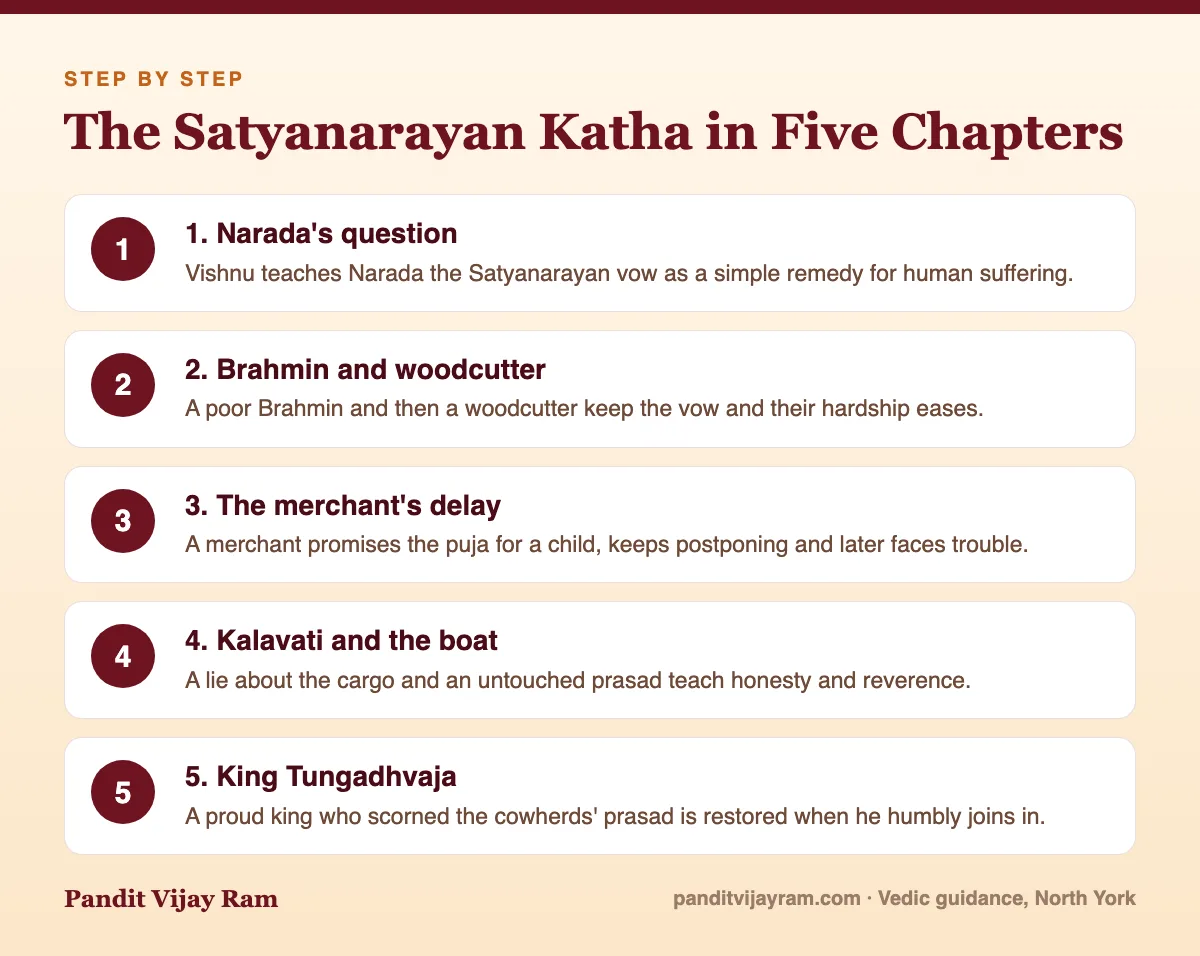
- Chapter one. Narada, troubled by human suffering, asks Vishnu for a simple remedy. Vishnu describes the Satyanarayan vrat, open to anyone of any background.
- Chapter two. A poor Brahmin of Kashi performs the puja and his hardship eases. A woodcutter watching him asks about it, keeps the vow and prospers too.
- Chapter three. A merchant promises the puja if he is blessed with a child. A daughter, Kalavati, is born, but he keeps postponing. Later he is wrongly jailed in a distant kingdom.
- Chapter four. Returning by boat, the merchant lies to a disguised ascetic that his cargo is only leaves, and it becomes leaves. When he repents, the wealth returns. Kalavati, rushing to meet him, leaves her prasad untouched, and the boat vanishes until she goes back and eats it.
- Chapter five. King Tungadhvaja scorns prasad offered by cowherds, loses what he loves, and is restored when he humbly joins their puja.
The moral thread is plain: keep your word, stay humble, and treat even a spoonful of prasad as sacred. That is why hosts make sure every guest receives some before leaving.

What samagri is needed for Satyanarayan puja?
You need a picture or murti of Satyanarayan, a small Ganesh murti or betel nut, a kalash with water and mango leaves, a coconut, panchamrit, tulsi leaves, flowers, a ghee lamp, incense, kumkum, haldi, rice, betel leaves and nuts, fruit, bananas, a yellow cloth and the sweet prasad.
Lay everything out before the priest or family elder sits down. It keeps the puja calm.
- Altar: a low wooden chowki, a yellow or red cloth, the Satyanarayan picture, and four banana stems or leaves at the corners if you can get them.
- Kalash set: copper or steel pot, water, mango leaves, a coconut wrapped in red cloth, a mauli thread.
- Panchamrit: milk, curd, ghee, honey and sugar, mixed with tulsi. It is used to bathe the murti and then shared.
- Puja plate: kumkum, haldi, sandal paste, unbroken rice, flowers, a ghee diya, dhoop or agarbatti, camphor, a bell.
- Offerings: betel leaves, whole supari, seasonal fruit, dry fruit, a few coins, and a sacred thread for the deity.
- Prasad: roasted semolina sheera with ghee, sugar and banana is common in western India; roasted wheat-flour panjiri is common in the north.
Most items are sold at Indian grocers across the GTA. If banana stems are hard to find in winter, banana leaves or simply fresh bananas on the altar are accepted. Our full puja samagri list with Canadian substitutes covers the rest.
When is the best time to do Satyanarayan puja?
Purnima, the full-moon day, is the most traditional choice, with Sankranti and Ekadashi also popular. Families also hold it at a griha pravesh, after a wedding, for a birthday, a new job or a safe return from travel. Evening is customary, but any clean, unhurried time with devotion is accepted.
Unlike many pujas, Satyanarayan is not tied to one festival. The katha itself says it may be done on any day, and that flexibility suits diaspora families who juggle shift work and weekend gatherings.
Common occasions include:
- Monthly Purnima for families who keep it as a regular vow.
- Griha pravesh, often the evening of the move or the first weekend after.
- After a wedding, as the couple's first shared puja in their new home.
- Thanksgiving moments: a recovery, a graduation, a new baby, a citizenship ceremony.
- Before a new start, such as a business opening, alongside Ganesh puja.
Purnima falls on slightly different clock times in Toronto than in India because of the time difference, so read the date from a Toronto panchang rather than an Indian calendar. If you want a wider sense of how lunar days are chosen, see our guide to auspicious days and the panchang.
Some households fast until the puja ends. That is optional, and anyone with diabetes, pregnancy or regular medication should eat normally and offer devotion in other ways.
How is Satyanarayan puja done at home step by step?
The host takes a sankalp, worships Ganesh first, sets up and honours the kalash, then worships Satyanarayan with the traditional offerings and panchamrit bath. The five chapters of the katha are read aloud, aarti follows with camphor or a ghee lamp, and prasad is shared with everyone present.
A family doing it without a priest can follow this order, using a printed vidhi booklet for the Sanskrit lines.
- Purify and sit. Bathe, wear clean clothes and sit facing east or north before the altar.
- Sankalp. Hold water, rice and a flower, state your name, family gotra, the place and your intention, then release them into a plate.
- Ganesh puja. Offer kumkum, rice, a flower and a sweet to Ganesh so the puja starts without obstacles. Our Ganesh puja at home guide has the short form.
- Kalash and navagraha. Honour the kalash as the seat of the deities. Many families also offer rice to the nine planets.
- Main worship. Bathe the murti or sprinkle the picture with panchamrit, then offer cloth, sandal, tulsi, flowers, lamp, incense, fruit and prasad.
- Katha. Read all five chapters while the family listens, ideally without phones.
- Aarti and prasad. Sing Om Jai Jagdish Hare, then share prasad and panchamrit.
Keep the camphor plate on a metal tray away from curtains, and do not leave the lamp burning in an empty room. If you would like a priest to lead, Vijay Ram ji can perform it as part of his puja and anushthan service.
What mistakes should you avoid in Satyanarayan puja?
The most common mistakes are rushing or skipping chapters of the katha, letting guests leave without prasad, using leftover or tasted food as an offering, and turning the puja into a stressful production. Making a promise of puja and then delaying it for years is the very mistake the katha warns against.
None of these are disasters. They are simply the habits the story itself points at.
- Skipping the katha. The reading is the heart of this puja, not a side item. If time is tight, shorten the decoration instead.
- Forgetting prasad. Set aside small packets for guests who leave early and for neighbours or colleagues.
- Tasting the prasad while cooking. Traditionally the sweet is offered before anyone eats from it.
- Delaying a vow. If you promised the puja when a prayer was answered, it is better done simply soon than grandly someday.
- Competition. A modest altar with a full heart is closer to the story than an expensive one.
- Careless disposal. Flowers and leaves should go to compost or a temple collection, not the lake. See our note on disposing of puja items respectfully in Toronto.
If you are unsure whether your family's version is correct, remember that regional differences are normal. A Gujarati, Marathi, Telugu or Bhojpuri household may each do something slightly different, and all are valid.
The bottom line
Satyanarayan puja honours Vishnu as the embodiment of truth, and its five-chapter katha teaches keeping promises and respecting prasad. The samagri is simple and easy to find in the GTA, with panchamrit, tulsi and a sweet prasad at its centre. Purnima is traditional, yet a housewarming, wedding or moment of thanks is equally fitting, so long as the katha is heard in full and every guest receives prasad.
Key takeaways
- Satyanarayan puja worships Vishnu as the Lord of truth.
- The katha has five chapters about keeping vows and honouring prasad.
- Purnima is traditional, but any sincere occasion is accepted.
- Panchamrit, tulsi and sheera or panjiri are the core offerings.
- Share prasad with every guest and dispose of flowers respectfully.