
Home Cleansing for Newtonbrook Homes: A Practical Guide for Local Housing

Home cleansing in Newtonbrook rarely looks like the courtyard rituals many families remember from back home. This corner of North York, centred on Yonge Street and Finch Avenue, mixes apartment and condo towers along the Yonge corridor with townhouse complexes and older detached and semi-detached houses on the side streets. A method that is perfect for a bungalow can trigger a building-wide alarm in a high-rise. Families often come to me unsure what is allowed, worried about neighbours, or simply tired after a difficult season. In more than forty years of guiding households I have learned that the gentlest method that fits your walls is usually the right one. This guide explains how to match a cleansing routine to Newtonbrook housing, which smoke-free practices work in towers, what simple vastu adjustments suit narrow townhouses, when to speak with a landlord or condo board, and which ordinary problems to rule out before assuming anything spiritual. A step-by-step routine closes the guide.
What kinds of homes need different cleansing methods in Newtonbrook?
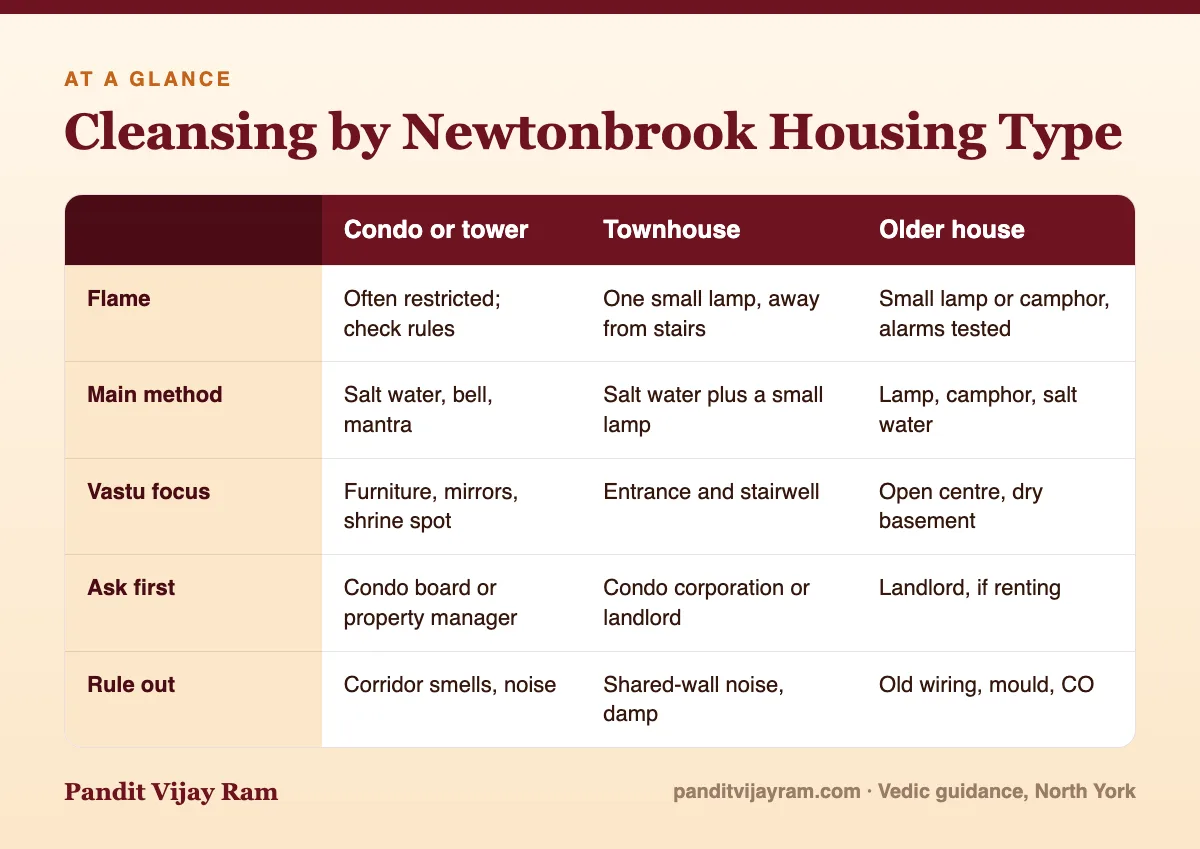
Newtonbrook has three broad housing types: condo and rental towers near Yonge and Finch, townhouse complexes that replaced many postwar houses along Finch and Yonge, and detached or semi-detached homes on quieter streets. Each has different rules about flame, smoke and shared space, so the cleansing method should follow the building, not habit.
Newtonbrook was subdivided for housing in the postwar years, and most of its older landmarks gave way to streets of modest family homes. Since then, many of those houses near the main roads have been replaced by townhouse complexes, and condo buildings have risen along Yonge Street. The result is a neighbourhood where three families on one block may live under three very different sets of rules.
- Towers and condos. Shared ventilation, sensitive corridor alarms and condo declarations that often restrict open flame. Smoke-free methods come first.
- Townhouse complexes. Usually freehold or condo townhouses with shared walls and stacked floors. A small lamp is often fine, but smoke travels upstairs quickly.
- Detached and semi-detached houses. More freedom, but older wiring, basements and furnace rooms need checking before any fire ritual.
Renters in any of these should also read the lease. Basement apartments and rooms in shared houses are common across North York, and the person who owns the smoke alarm is not always the person who lights the lamp.
If you want the general theory behind cleansing before adapting it, start with what spiritual cleansing is. Then come back here to fit it to your Newtonbrook address.

How do you cleanse a Newtonbrook condo without setting off the smoke alarm?
Use methods that make no smoke: wipe floors and doorframes with salt water, ring a bell or play a recorded mantra room by room, sprinkle a little Ganga jal, and open windows briefly for fresh air. Never cover or disconnect an alarm; in Toronto, tenants must not disable one and landlords must keep them working.
A tower unit near Finch station can share air with dozens of neighbours. Dhoop, guggul and a big camphor aarti create visible smoke, and one alarm can send a whole building onto the street. Smoke-free does not mean weaker. Many of the oldest Vedic practices rely on water, sound and intention rather than fire.
Practical smoke-free options:
- Salt-water wiping. A spoon of rock salt in a bucket of water for floors, thresholds and window ledges. Test on hardwood and laminate first. The method is explained fully in salt-water mopping (namak pocha).
- Sound. A brass bell, a conch, or a recorded Hanuman Chalisa moving room by room. Keep volume considerate after dark.
- Water and leaves. Ganga jal or clean water sprinkled with a mango or tulsi leaf.
- Unlit camphor. A few pieces of kapoor left in a bowl give fragrance without flame.
The City of Toronto is clear that landlords must install and maintain working smoke alarms and that tenants must never disable them. Test the alarm monthly with its button, not with smoke. For more ideas, see cleansing a condo or rental without smoke.
Which simple vastu tips work in Newtonbrook townhouses and older houses?
Focus on what you can change without renovation: keep the northeast corner light and uncluttered, give the main entrance a clean, well-lit welcome, clear the space under stairs, and place the shrine where it stays calm. In narrow townhouses, the stairwell and entry matter most because energy and traffic funnel through them.
Vastu was written for open land, not for a three-storey townhouse squeezed between neighbours. Its principles still translate if you treat them as guidance rather than rules. Here is a quick comparison for the two common Newtonbrook layouts:
- Townhouse, ground floor. The front door often opens straight onto stairs. Keep shoes in a closed cabinet, add a warm light, and place a small toran or rangoli sticker inside the door.
- Townhouse, upper floors. Bedrooms stacked over the garage can feel restless. A heavier piece of furniture in the southwest of the main bedroom and a clear northeast window help many families settle.
- Older detached house, main floor. These homes usually have a clearer centre. Keep the brahmasthan, the middle of the house, open rather than stacked with boxes.
- Older house, basement. Damp and clutter collect here. Dry it out, label storage, and avoid placing the shrine below a bathroom.
Expensive gadgets and structural changes are rarely needed. Our guide to vastu remedies without demolition covers low-cost fixes, and vastu for apartments and condos helps tower residents. If you would like someone to read your floor plan with you, a vastu consultation can be done from photos and a sketch.
Should you tell your landlord or condo board before a puja or havan?
Yes, if the ritual involves flame, smoke or many guests. Condo declarations and rules often restrict open flame and the use of common areas, and leases explain maintenance and entry rights. A short, friendly message beforehand avoids alarms and complaints. Smaller smoke-free prayers in your own unit rarely need permission.
Newtonbrook neighbours come from many backgrounds, and the area has large Persian, Mandarin, Russian and Korean-speaking communities alongside South Asian families. Most people are curious and respectful about a neighbour's festival. Problems arise when smoke drifts into a corridor or forty guests block the visitor parking without warning.
A simple approach:
- Read your condo declaration and rules, or your lease, for anything about open flame, barbecues, candles or gatherings.
- Send management or your landlord a short note: the date, what you plan, the safety steps you will take.
- For a havan, ask whether a party room or a balcony is allowed. Often the answer is no, and a temple or a smoke-free version at home is the better choice.
- Keep the reply in writing.
The Condominium Authority of Ontario publishes plain guides on condo rules and disputes, and the Ontario government's renting page explains the standard lease. These are the right places for legal questions; I can only guide the spiritual side.
Our detailed article on puja and havan in a rented Ontario home walks through that landlord conversation. When a full fire ritual is important to the family, consider holding it through puja and anushthan services or at a temple.
When is a heavy feeling at home not a spiritual problem at all?
Rule out ordinary causes first: poor sleep, noise from Yonge Street traffic, damp or mould, a faulty carbon monoxide alarm, money stress or tension between family members. If the heaviness continues after those are checked, or arrives with frightening experiences, then a spiritual assessment and a doctor's visit can both help.
I hear the phrase "the house feels heavy" many times each month. Very often the cause is physical. Busy roads near Yonge and Finch mean constant noise; basement units can hold damp; a new building may still smell of paint and glue. Each of these affects mood and sleep.
Check these before any ritual:
- Air. Test smoke and carbon monoxide alarms. Look for mould on window frames and in closets.
- Sleep and health. Weeks of poor sleep, low mood or headaches deserve a visit to your family doctor. In a crisis, call or text 988.
- People. Overcrowding, a new baby or an ongoing argument change how a home feels.
- Building issues. Repairs that the landlord or board has not addressed. In Toronto, 311 can help with property standards.
When those are sorted and a family still feels unsettled, a calm assessment can help. A negative energy removal consultation starts by listening, not by selling remedies. Vijay Ram ji is based in North York, near enough for most Newtonbrook residents to come in person; see the astrologer in North York page. Newtonbrook's history and parks are covered in our Newtonbrook neighbourhood guide, and families just north of Steeles can read the astrologer in Thornhill page.
The bottom line
Home cleansing in Newtonbrook works best when the method matches the building, from smoke-free practice in towers to a small, careful lamp in older houses. Simple vastu, a tidy entrance and a clear northeast corner help townhouses and detached homes alike. Speak with your landlord or condo board before any flame or gathering, and rule out ordinary causes such as damp, noise and stress first. With those steps in place, a gentle routine and an in-person consultation in North York can support a calmer home.
Key takeaways
- Newtonbrook mixes condo towers, townhouse complexes and older houses, and each needs a different method.
- Tower units should rely on salt water, sound and mantra rather than smoke.
- Never disable a smoke alarm; Toronto landlords must keep alarms working and tenants must not tamper with them.
- Check the lease or condo rules and tell management before any havan or large gathering.
- Rule out damp, noise, sleep and health problems before assuming a spiritual cause.