
What Is Spiritual Cleansing? Meaning, Methods and Honest Limits

Spiritual cleansing is something people reach for when a home feels heavy, a run of arguments will not settle, or they simply feel worn thin and cannot say why. The word gets used for everything from burning sage to a full fire ritual, which makes it hard to know what it actually means. Families in North York and across the GTA often ask me the same first question: is this real, and what exactly would be done? This guide answers that plainly. You will learn the Vedic idea behind purification, the five main families of method, how a practitioner chooses between them, and the limits nobody should hide from you. In more than forty years of Vedic practice I have found that people relax once they understand the logic of a ritual. Fear fades when the steps are clear. Cleansing is a matter of personal faith, so I will also be honest about what it cannot touch. A leaking roof, an untreated illness or a debt problem needs its own practical answer first.
What does spiritual cleansing mean in the Vedic tradition?
In Vedic practice, spiritual cleansing means shuddhi, the restoring of purity to body, mind and place so that prayer can settle. It rests on the idea that daily life leaves residue, much like dust. Rituals of fire, water, sound, smoke and prayer are the traditional ways of washing that residue away.
The Sanskrit word shaucha appears in the yoga texts as one of the personal observances. It covers outer cleanliness, such as bathing and a tidy home, and inner cleanliness, such as honest speech and a calm mind. Shuddhi, the ritual side, builds on that base. A priest does not begin a puja until the space, the vessels and the people have been purified.
Traditional thinking divides impurity into ordinary and specific kinds. Ordinary residue builds up from crowds, arguments, illness in the home and simple neglect. Specific heaviness is linked to events: a death in the family, a frightening incident, or a belief that someone wished you harm. The first kind calls for routine practice. The second may call for a reading and a planned ritual.
It helps to separate cleansing from healing and from worship. Cleansing removes. Healing restores. Worship, or puja, invites a blessing into the space that has been cleared. Many people mix these up, and our comparison of cleansing, energy healing and puja lays out which one fits which need.
Other traditions share the instinct. Latino families know the limpia, Muslim families use ruqyah recitation, and Caribbean households have their own bath and smoke customs. Each has its own theology and deserves respect on its own terms. This guide stays with the Vedic approach, which is the one I practise.
What are the main types of spiritual cleansing?
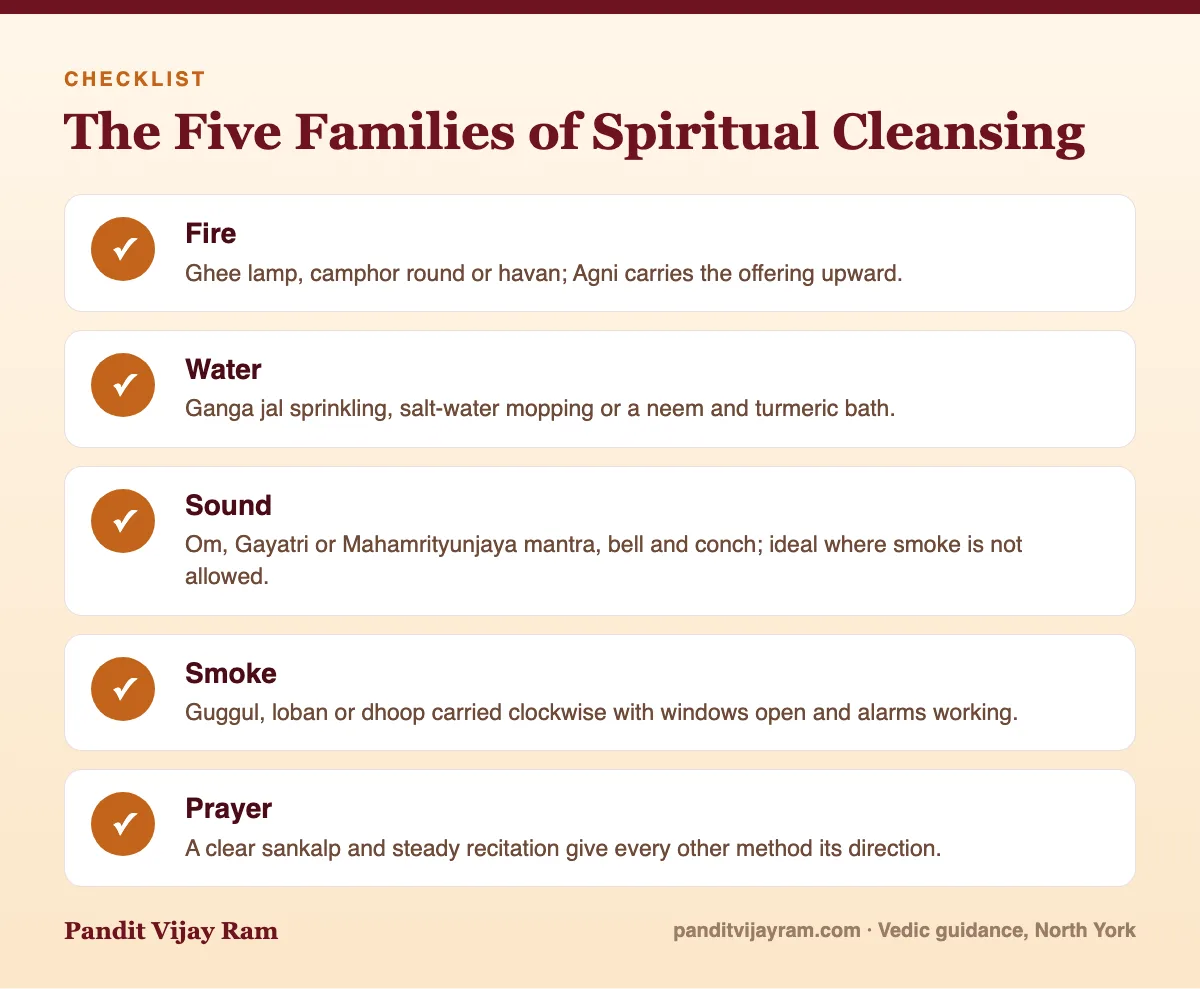
There are five broad families of spiritual cleansing: fire (lamp, camphor, havan), water (ganga jal sprinkling, salt water, ritual baths), sound (mantra, bell, conch), smoke (guggul, dhoop, loban) and prayer (sankalp and recitation). Most real rituals combine two or three of these rather than relying on one.
Here is how the five families work in practice, with the materials each one uses:
- Fire. A ghee diya, a burning camphor tablet carried room to room, or a full havan with samagri and ahuti offerings. Fire is treated as the witness Agni, who carries offerings upward. Our guide to havan as a cleansing ritual covers the fire method in depth.
- Water. Ganga jal sprinkled with a mango or tulsi leaf, rock salt dissolved in mopping water, or a bath with neem and turmeric. Water is the most gentle family and suits daily use.
- Sound. Chanting Om, the Gayatri mantra or the Mahamrityunjaya mantra; ringing a brass bell; blowing a shankh at dawn or dusk. Sound suits condos where smoke is a problem.
- Smoke. Resins such as guggul and loban, or dhoop sticks, carried clockwise through each room with windows open.
- Prayer. A sankalp, which is a stated intention, followed by recitation such as the Hanuman Chalisa or Durga Saptashati. Prayer gives direction to every other method.
Each material has its own use and storage needs, which our Vedic cleansing toolkit explains item by item. Start simple. A lamp, water and a mantra cover most household needs.
How does a practitioner decide which cleansing method to use?
A practitioner chooses a method by asking what is wrong, where it is felt and how long it has lasted. A heavy room may need water and smoke. A person who feels drained may need mantra and a bath. A pattern tied to the birth chart may need graha shanti rather than general cleansing.
When someone describes a problem to me, I work through a short set of questions before I suggest anything:
- Is it the person, the place or an object? A feeling that follows you to work points to the person. A feeling that only appears at home points to the place.
- When did it start? A clear start, such as a move, a death or a quarrel, helps more than a vague sense of trouble.
- What ordinary causes have been checked? Sleep, health, money stress, mould, poor ventilation and noisy wiring all create heaviness that no ritual can lift.
- What does the kundli show? A difficult dasha or a Saturn transit can feel like bad energy. Then the remedy is planetary, not a house cleansing.
- What can the family keep doing? A short practice repeated is worth more than one grand ritual never followed up.
From those answers, a home might get a salt-water mop and camphor round. A person might get a bath and a mantra count. A business might get a Ganesh puja at opening. If the picture points to something heavier, the negative energy removal service starts with a proper assessment instead of a guess.
What can spiritual cleansing not do?
Spiritual cleansing cannot treat illness, mend a relationship by itself, repair a house, settle a legal case or clear debt. It cannot change another person's free will. What it can do is steady the mind, renew a sense of devotion and give a household a shared ritual of fresh starts.
Honesty about limits is part of the practice, not a disclaimer tacked on at the end. Here is what I tell every family who asks.
It is not medicine. Fatigue, low mood, headaches and poor sleep have many physical causes. See your family doctor first. If someone feels hopeless or unsafe, Canada's 9-8-8 Suicide Crisis Helpline is open day and night by call or text.
It is not a repair crew. A damp basement, a gas smell or flickering lights are safety problems. Call a contractor or the utility before anyone lights a lamp.
It is not a way to control others. No genuine ritual should be used to bend a partner, a relative or a rival. Cleansing works on your own life and your own space.
It is not a one-off fix. A ritual done once and then forgotten tends to fade. Steady, modest practice matters more, and our guide to how often to cleanse sets out a sensible rhythm.
Cleansing also carries small risks of its own: smoke, open flame, skin reactions and the anxiety that comes from over-cleansing. Our article on spiritual cleansing side effects covers those in detail.
When should you see a practitioner instead of cleansing at home?
See a practitioner when home practice has been steady for several weeks without any settling, when the trouble began with a specific frightening event, or when you suspect a chart factor. Also seek help if fear is growing rather than easing, since that needs a calm outside view.
Most households never need more than a daily lamp, a weekly mop with salt water and a few minutes of mantra. A practitioner becomes useful in a narrower set of cases.
Signs that outside help makes sense:
- You have practised regularly and nothing has shifted, yet practical causes have been ruled out.
- Problems cluster around one date or event, such as a move, a funeral or a threat.
- Several family members describe the same discomfort in the same room.
- You want a kundli reading to see whether a planetary period explains the pattern.
Signs to step back instead: if you are cleansing several times a day, spending money you cannot spare, or feeling more frightened with each ritual, pause. That pattern needs rest and perhaps counselling, not more ritual.
A good practitioner asks questions before naming a cause, explains every step and never pressures you. The cleansing and protection hub gathers our guides by topic, and the aura cleansing service describes a personal session for those who want one.
The bottom line
Spiritual cleansing is the Vedic practice of shuddhi, restoring purity to a person, home or object. It works through five families of method, fire, water, sound, smoke and prayer, and the right choice depends on what is wrong and where. It has clear limits, so health, safety and practical causes always come first.
Key takeaways
- Spiritual cleansing, or shuddhi, aims to clear residue so that prayer and calm can settle.
- The five method families are fire, water, sound, smoke and prayer, usually combined.
- A practitioner chooses a method after asking about the person, place, timing and chart.
- Cleansing never replaces a doctor, a contractor, a lawyer or a counsellor.
- Modest, steady home practice usually matters more than one large ritual.