
Newtonbrook Neighbourhood Guide: Community, Calm Places and Spiritual Support

This Newtonbrook neighbourhood guide is written for the families who make Yonge and Finch one of the liveliest crossroads in North York. Some arrived last month from Tehran, Seoul, Moscow, Shanghai or Delhi; others have lived on the same crescent for decades. Many of them reach out to me with a similar feeling. The neighbourhood is convenient and full of life, yet home can feel noisy, rushed or lonely, and the old rhythms of prayer have slipped away. In more than forty years of Vedic practice I have found that people settle faster when they know the ground beneath them: who walked these roads before, where the quiet places are, and where neighbours meet. Below you will find a short history of Newtonbrook, a respectful portrait of its communities, the parks and corridors worth walking, the transit links at Finch station, local libraries and community centres, and a simple daily practice for busy households. I close with how residents reach in-person consultations nearby in North York, or remote sessions when travel is difficult.
What is the history of Newtonbrook?
Newtonbrook began as a farming settlement on Yonge Street in the early nineteenth century, with saw and grist mills on the two branches of the Don River. An early Methodist congregation there was named after the Reverend Robert Newton. Large-scale suburban housing replaced most of the old village after the Second World War.
European settlers farmed this stretch of Yonge Street long before subway lines arrived. Mills on the east and west branches of the Don used the water to cut lumber and grind grain, and a small crossroads community formed around them. One local landowner, Lieutenant Colonel William Durie, subdivided part of his property, which is remembered today in the name of Drewry Avenue.
The village passed through York Township and then North York before joining the amalgamated City of Toronto. In the postwar decades the fields were subdivided for family homes, and most of the old buildings disappeared. More recently, many of those homes along Finch and Yonge have given way to townhouses and condo buildings.
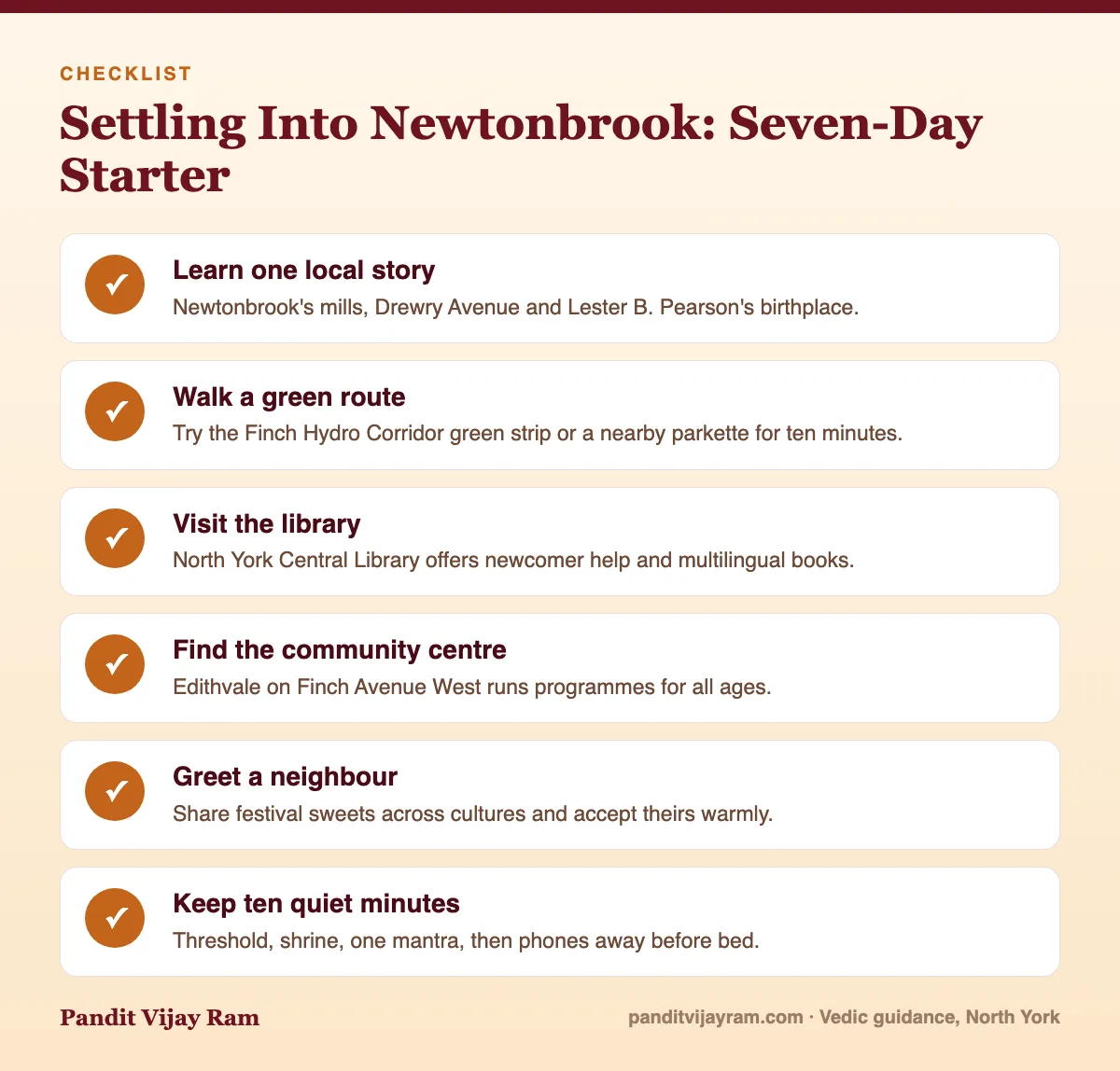
One story surprises many newcomers: Lester B. Pearson, Nobel Peace Prize laureate and later Prime Minister of Canada, was born in Newtonbrook, near Yonge Street and Hendon Avenue. A neighbourhood that produced a peacemaker is a fitting home for families who value harmony.
Knowing this history helps people feel rooted. When someone tells me they feel like a guest in their own neighbourhood, I often suggest learning one local story and sharing it with their children. The same instinct underlies our advice for feeling unsettled after moving to Canada.

Who lives in Newtonbrook today?
Newtonbrook is one of North York's most multilingual neighbourhoods. Besides English, large Persian, Mandarin, Russian and Korean-speaking communities live here, with Persian especially common in the west half and Russian in the east. South Asian families and many others add to the mix along the Yonge corridor.
Walk north from Finch station and you will hear many languages in a single block. Shop signs change script from one storefront to the next. The Toronto Iranian Plaza is one of several community landmarks that show how deeply Persian-speaking families have shaped the area.
For a Hindu, Sikh or Muslim family, this diversity is a gift. Your neighbours mark Nowruz, Lunar New Year, Orthodox Easter, Eid and Diwali, often in the same month. A few gentle habits help everyone live well together:
- Share festival sweets with the family next door, and accept theirs with the same warmth.
- Keep smoke and late-night sound modest in shared buildings, especially during long prayers.
- Ask before assuming. A neighbour's evil-eye charm or Orthodox icon deserves the respect you would want for your own shrine.
In my consultations, people who build one friendship outside their own language group often describe their stress as lighter. Belonging is protective. If tension with a neighbour has already started, our guide to neighbour disputes in the GTA explains calm, practical steps, beginning with conversation and 311 rather than ritual.
Where are the parks and quiet green spaces in Newtonbrook?
Newtonbrook has many small municipal parks run by Toronto Parks, Forestry and Recreation, plus the Finch Hydro Corridor, a long open strip of green beneath the power lines. The east and west branches of the Don River frame the neighbourhood, and the park beside Edithvale Community Centre has ball diamonds, a basketball court and a playground.
Newtonbrook is not a ravine neighbourhood in the way that York Mills is, but its green spaces are close at hand and easy to fit into a day.
- The Finch Hydro Corridor. This open strip runs beneath the hydro lines along the Finch side of the neighbourhood. It is flat and wide, which suits elders and small children.
- Edithvale Park. Next to the community centre on Finch Avenue West, with ball diamonds, a basketball court and a children's playground.
- Neighbourhood parkettes. Dozens of small parks sit among the side streets, ideal for a ten-minute evening walk.
- The Don branches. Valleys on either side of the neighbourhood offer longer walks for those willing to travel a little.
I often suggest a simple practice for these spaces: walk slowly for ten minutes without your phone, repeating a short mantra under your breath. It costs nothing and it works in winter as well as summer.
Gardening helps too. Many Newtonbrook families keep a tulsi plant on a sunny sill; our guide to tulsi plant care in a Canadian winter explains light and watering. Short, grey days can weigh on mood, and winter low mood in Toronto covers when to see a doctor.
How do you get around Newtonbrook by transit?
Finch station, at the northern end of the Yonge branch of TTC Line 1, sits on Newtonbrook's southern edge. The Finch Bus Terminal beside it connects TTC buses with GO Transit and York Region Transit, including Viva rapid buses. That makes Newtonbrook one of the best-connected neighbourhoods in North York.
For many residents, Finch station is the front door of the neighbourhood. Line 1 runs south through North York Centre and Sheppard-Yonge toward downtown, so commuting without a car is realistic.
Useful points:
- Regional buses. GO, York Region Transit and Viva services at the Finch terminal link Newtonbrook with Thornhill, Richmond Hill, Markham and Vaughan. This is how many families reach temples in York Region.
- Crosstown buses. TTC routes along Finch and Steeles run east and west across the city.
- Accessibility. Check the TTC station page for elevator status before travelling with a wheelchair, walker or stroller.
Good transit is also good for elders. Grandparents who would otherwise stay home all winter can reach the library, a seniors' programme or a place of worship on their own. Independence protects mental health.
Neighbours to the south share many of the same routes, and the Willowdale neighbourhood guide covers that side of North York Centre. Families who live just north of Steeles can read the astrologer in Thornhill page.
Where are the community centres, libraries and schools near Newtonbrook?
Edithvale Community Centre on Finch Avenue West is a key recreation hub, and North York Central Library on Yonge Street, just south of Finch, offers one of the city's largest library collections. Local schools include Newtonbrook Secondary, Drewry Secondary and Cummer Valley Middle School, which also act as informal meeting places for parents.
Community life in Newtonbrook is spread across a few anchors:
- Edithvale Community Centre. A City of Toronto centre on Finch Avenue West that hosts recreation programmes and dozens of local groups.
- North York Central Library. A large Toronto Public Library branch on Yonge Street near North York Centre, with study space, newcomer services and multilingual collections.
- Schools. Public and Catholic schools such as Newtonbrook Secondary, Drewry Secondary, Brebeuf College School and Cummer Valley Middle School. Parent councils are a quick route to local friendships.
- Faith communities. Places of worship of many faiths are spread through the area, and Hindu temples are reachable by subway or regional bus.
For temple options in this part of the city, see the guide to Hindu temples in North York. Families caring for parents or adjusting to a new country may also find support through the agencies in our North York family support guide.
A quiet library corner can double as a meditation space for students. Ten minutes of slow breathing before exams settles the mind more than another cup of coffee.
How can Newtonbrook households keep a calm routine and find spiritual support?
Keep the routine short and fixed: a clean threshold, one lamp or offering of water at the shrine, a few minutes of mantra and an evening without screens. When stress persists, see a doctor first. For spiritual guidance, Newtonbrook residents book in-person consultations in North York or phone and video sessions.
Busy Yonge Street households often tell me they have no time to pray. In practice, ten minutes is enough when it happens every day. Try this order:
- Threshold. Wipe the doorstep or condo entrance and set shoes away. Our guide to main door cleansing and threshold rituals includes condo-friendly versions.
- Shrine. Offer water, a flower or a small lamp where building rules allow.
- Mantra. Recite one short prayer eleven or twenty-one times.
- Evening close. Phones away for half an hour before bed.
For a deeper home reset suited to local towers and townhouses, read home cleansing for Newtonbrook homes.
When family tension is the real burden, a family problem consultation begins with listening and practical steps, and adds prayer only where it fits. Vijay Ram ji is based in North York; residents come to him for in-person sessions, and those who cannot travel use phone, video or WhatsApp. Details are on the astrologer in North York page. Persistent low mood, panic or sleeplessness belongs with your family doctor first, and in a crisis you can call or text 988.
The bottom line
Newtonbrook grew from a mill and farming settlement into one of North York's most multilingual neighbourhoods. Its green corridors, Finch station transit and community hubs such as Edithvale and North York Central Library make settling in easier. A short daily routine and friendly ties with neighbours of every faith support a calmer home. Use this Newtonbrook neighbourhood guide as your map, and seek a doctor or an in-person consultation in North York when you need more help.
Key takeaways
- Newtonbrook began as a mill and farm settlement on Yonge Street between two branches of the Don.
- Large Persian, Mandarin, Russian and Korean-speaking communities live alongside South Asian families.
- The Finch Hydro Corridor and many small parks offer easy daily walks.
- Finch station and its bus terminal link Newtonbrook with downtown and York Region.
- A ten-minute daily routine and neighbourly respect help households settle.