
Planning a Hindu Wedding in Scarborough: Licences, Venues and Rituals
A Hindu wedding Scarborough families celebrate can look very different from one hall to the next, and different again from one in North York. One Saturday a Tamil couple ties the thali to the sound of nadaswaram; the next, an Indo-Caribbean family gathers after a matikor night; a Gujarati or Punjabi wedding fills the same banquet room a week later. Behind the colour, every one of these couples faces the same practical tasks: a legal licence, a recognised officiant, a venue comfortable with fire, and a well-chosen time. Many are surprised to learn that the licence is not issued at the Scarborough Civic Centre at all. This guide explains where to go, what Ontario requires, how to agree the havan arrangements with a Scarborough venue, how muhurat and chart matching are approached in different traditions, and how to keep two families' customs in harmony. Over more than forty years I have helped couples from many regional traditions, and I respect each as complete in itself. My base is a straightforward trip for Scarborough families.
Can you get a marriage licence in Scarborough?
Not at a Scarborough counter. The City of Toronto issues marriage licences only at City Hall on Queen Street West and at North York Civic Centre on Yonge Street, by appointment after an online application. The licence is valid anywhere in Ontario for three months, so Scarborough couples simply travel to one of those two offices.
Couples often assume the Scarborough Civic Centre handles licences because it houses other City services. The City's marriage licence page names only the two offices above, so plan the trip into your schedule. Both are on Line 1, which Scarborough residents usually reach by Line 2.
Prepare these before the appointment, because the counter will not issue a licence without them:
- The online application, printed and signed in ink by both partners, with its application number noted.
- Four pieces of original ID in total, two government-issued pieces for each partner. Names must match across documents. The City refuses copies, phone photos, expired cards, health cards and SIN cards.
- Proof that any earlier marriage has ended. A Canadian divorce needs the original or court-certified certificate; a divorce from another country needs a Foreign Divorce Authorization from Ontario first.
The City asks couples to apply within ninety days of the intended date. Many Scarborough families combine the licence trip with other errands so the elders can come along. For a comparison of counters in Peel, York and Durham regions, see our guide to marriage licences across the GTA. The equivalent North York planning guide, Hindu weddings in North York, takes a different route through the same steps.

What makes a Hindu marriage legally valid in Ontario?
Ontario requires a marriage licence or, in limited cases, the publication of banns, and an officiant who is registered with the province. A religious officiant qualifies when their religious body recognises them as entitled to perform marriages. After the ceremony the couple, witnesses and officiant sign, and the marriage is registered before a certificate can be issued.
In practice this means one important question for your priest: are you registered to solemnise marriages in Ontario? Many temple priests and community pandits are, and they will be familiar with signing and sending the forms. Some visiting priests from abroad are not, which is no reflection on their learning; it simply means a registered officiant must also take part, or a short civil ceremony must be added.
Points that cause problems for Scarborough couples:
- Age. Ontario requires both partners to be at least eighteen, with narrow exceptions that need consent or a court order.
- The ninety-day application window and three-month validity. Booking the licence too early means it can expire before the muhurat.
- Who posts the forms. Agree in writing that the officiant will submit the signed licence.
- Name changes. Registration and a marriage certificate come first; changing documents comes after.
The City of Toronto also performs civil ceremonies in a wedding chamber at North York Civic Centre and at Old City Hall, with two witnesses aged sixteen or over present in person. Couples sometimes use one to satisfy the legal step on a convenient weekday and keep the full Hindu rites for the chosen day.
How do Tamil, Indo-Caribbean and North Indian weddings differ?
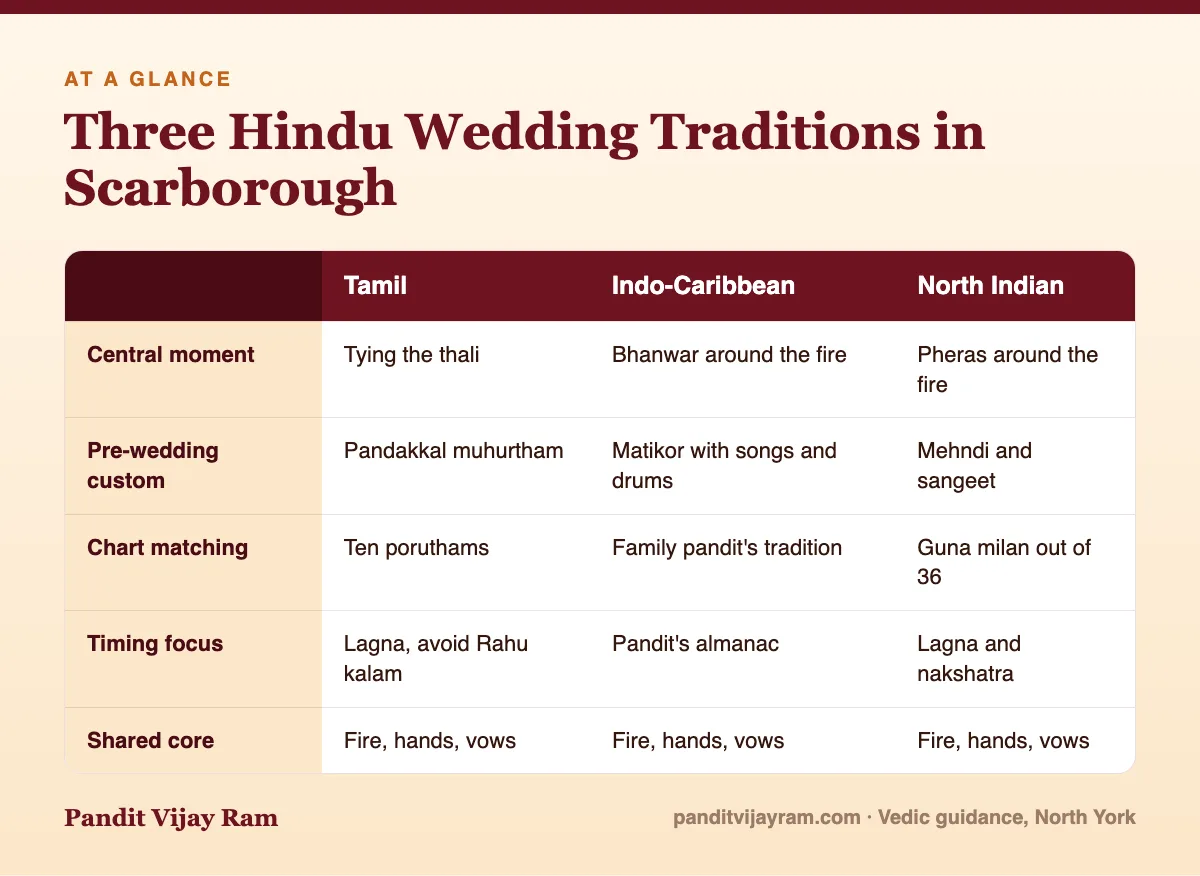
All three honour the sacred fire and the joining of two families, but the central moment differs. In Tamil weddings the tying of the thali is usually the high point. Indo-Caribbean weddings keep pre-wedding customs such as the matikor and often follow a pandit-led sequence shaped in the Caribbean. North Indian weddings centre on the pheras around the fire.
Scarborough's mix of communities means many guests will be watching an unfamiliar tradition. Knowing the shape of each ceremony helps everyone take part respectfully.
- Tamil Hindu weddings. Commonly include Ganapathi puja, the kashi yatra in some families, kanyadanam, the thali or mangalyam tied by the groom while music swells, and the saptapadi, with the bride's toe ring placed during the steps in many families. Rahu kalam is avoided when fixing the time.
- Indo-Caribbean Hindu weddings. Families with roots in Guyana, Trinidad and Tobago and Suriname often hold a matikor, a women's ceremony with songs and drumming, before the wedding, and the ceremony itself includes kanyadan, the lawa or parched rice offering, and the bhanwar or circling of the fire. Our article on Indo-Caribbean Hindu life in the GTA describes these traditions with care.
- North Indian weddings. Feature the baraat, jaimala, kanyadaan, the pheras and sindoor, with regional differences between Punjabi, Gujarati, Bengali and other families.
Customs vary within every community, from family to family and village to village. Ask the elders what matters most to them and let the priest explain each step aloud. A wider view of how the core rites hold together is in our guide to Hindu wedding rituals in the GTA.
What should you agree with a Scarborough venue about the sacred fire?
Confirm in writing whether the venue permits a live flame, the kund size and fuel allowed, where the mandap may stand relative to detectors and exits, and who supervises the fire. For outdoor or backyard ceremonies, remember Toronto does not permit open-air burning unless Toronto Fire Services issues a cultural fire authorization after inspecting the site.
Scarborough couples choose between three broad kinds of venue, and each brings different questions.
- Banquet halls. Experienced with Hindu weddings and often have a standard policy. Ask for it in writing, including any limit on ghee, camphor and the duration of the fire.
- Temple wedding halls. Some temples host ceremonies on their premises. The temple's own priests and committee set the rules; ask early whether outside priests may officiate.
- Homes and gardens. A backyard ceremony is intimate, but an outdoor havan is open-air burning under Toronto rules. Toronto Fire Services handles requests for fires connected with a cultural or religious practice through a Cultural Fire Authorization and inspects before approving. Indoors at home, keep the kund small and away from smoke alarms.
Your priest can adapt the ceremony to the venue's limits. A small copper kund with a few measured offerings, or a single ghee lamp representing Agni, keeps the rite intact. I tell couples that the gods count devotion, not flames, and families who accept the venue's conditions calmly start their married life without a quarrel. If anxiety about the day itself is affecting the bride or groom, our note on nazar at weddings explains traditional protective customs.
How do families fix the muhurat for a Scarborough wedding?
The muhurat is calculated from the panchang for Toronto, using local sunrise and time zone, the tithi, nakshatra and the lagna rising at the key rite. Tamil families often consult a Tamil panchangam and avoid Rahu kalam; North Indian families commonly check guna milan; Indo-Caribbean pandits follow their own almanac traditions. Indian timings cannot simply be copied.
Two steps come first: matching the charts and choosing the moment. They use related but different methods.
Matching. North Indian practice usually scores compatibility through ashtakoota guna milan out of thirty-six points. Tamil and other South Indian traditions often use the ten poruthams, such as dina, gana, rasi and rajju. Neither score is a verdict on a couple; both are tools for understanding temperament and timing. Our guide to kundli matching for a love marriage explains how to read a low result without panic.
Timing. Once a season is chosen, the astrologer looks for days with favourable tithi and nakshatra, then the lagna that will rise during the thali tying, the pheras or the bhanwar. Daylight and time zone change these windows, which is why a date given by relatives in Jaffna, Chennai, Georgetown or Delhi will not match Toronto. More on that is in choosing a wedding muhurat in Canada.
I usually give Scarborough couples a small set of suitable windows so they can match them with venues and family travel. Readings for both partners can be arranged through the Scarborough astrologer page, and the love marriage guidance page explains how I support couples whose families need time to agree.
How can two families keep a mixed-tradition wedding peaceful?
Agree the essential rites first, decide which family's customs lead which event, and put the plan in writing before invitations go out. Let a respected elder from each side speak for their family. Give guests a short explanation card, and keep the legal steps simple so no one is stressed on the day.
Scarborough has many weddings between communities: Tamil and Telugu, Guyanese and Punjabi, Hindu and Christian, Sri Lankan and Indian Tamil. These unions are a gift, and they need a little extra planning.
A decision rule that works for most families:
- Name the non-negotiables. Each family lists the two or three rites without which the marriage would not feel complete.
- Find the shared core. Fire, the joining of hands and the vows appear in almost every Hindu tradition.
- Divide the events. One family's customs lead the pre-wedding night; the other's lead the ceremony; both share the reception.
- Choose one priest to coordinate. Even if two priests take part, one should hold the order of service.
- Write it down. A one-page plan shared with both sets of parents prevents misunderstandings.
If disagreement between families is becoming painful, or one set of parents is still unsure about the match, calm conversation helps more than ultimatums. Our article on in-law problems offers gentle ways to begin, and couples who want spiritual support through that season can consult in person in North York or remotely.
The bottom line
Planning a Hindu wedding Scarborough families will remember starts with the practical steps: a licence from City Hall or North York Civic Centre, an officiant registered in Ontario, and the venue's sacred-fire rules agreed in writing. Choose a muhurat calculated for Toronto and match charts with the method your tradition uses. Then honour each family's essential rites, divide the events fairly and explain the ceremony to guests. Handled in that order, the day can be joyful for everyone.
Key takeaways
- Scarborough couples get their Ontario licence at City Hall or North York Civic Centre.
- The licence is valid for three months, so time the appointment within ninety days of the date.
- Confirm that your priest is registered to solemnise marriages in Ontario.
- Tamil, Indo-Caribbean and North Indian weddings share a core but differ in their central rite.
- Muhurat timings must be calculated for Toronto, not copied from another country.