
Tulsi Vivah: Meaning, Story and How Families Celebrate
Tulsi vivah is one of the most charming festivals in the Hindu year: a full wedding, with mandap, bridal finery and pheras, held for a potted plant and a small black stone. Children love it, grandparents remember it from their villages, and many diaspora families want to keep it alive even when the tulsi has spent the autumn on a windowsill in Ontario. Families in North York, Markham and Mississauga ask me what the ceremony actually means and whether a simple home version is enough. In more than four decades of Vedic practice, I have found that understanding the story behind it, which is more complex than many expect, makes the evening far richer. This guide explains the meaning of the Tulsi–Shaligram marriage, the story of Vrinda and Jalandhara, when the festival falls, how families celebrate in different regions, and a step-by-step method for a home tulsi vivah that respects both the custom and the plant.
What is the meaning of Tulsi vivah?
Tulsi vivah celebrates the marriage of Tulsi, revered as the goddess Vrinda and a form of Lakshmi, to Vishnu, represented by a Shaligram or a Krishna murti. It honours devotion and faithfulness, marks the end of Chaturmas when Vishnu is said to wake from cosmic rest, and signals that the season for human weddings has begun.
The festival works on several levels at once.
- Devotional. Tulsi is the plant most beloved of Vishnu. No offering to him is considered complete without a tulsi leaf, so honouring her as his bride expresses that closeness.
- Calendrical. Chaturmas, the four months from Devshayani Ekadashi to Prabodhini Ekadashi, is traditionally a time when Vishnu rests and many families avoid weddings. His awakening reopens the calendar.
- Social. In many villages, the tulsi vivah was the first wedding of the season, rehearsing the songs and rituals that would follow.
- Personal. Couples hoping to marry, and families praying for a daughter's happy marriage, often take part with special devotion.
Some communities treat the kanyadaan, the giving away of the bride, as a blessed act for a couple who have no daughter of their own. Others share the role among relatives.
The Shaligram itself is a fossil ammonite found in the Gandaki river of Nepal, worshipped as a natural form of Vishnu. Families without one use a small Krishna or Vishnu murti, or a picture. For how this festival connects to the wider wedding season, see our guide to Hindu wedding rituals in the GTA.

What is the story of Tulsi vivah?
In the best-known version, Vrinda was the deeply devoted wife of the powerful asura Jalandhara, whose strength depended on her faithfulness. To end his tyranny, Vishnu took Jalandhara's form and broke her vow, and Jalandhara fell. Grieving, Vrinda cursed Vishnu to become stone, the Shaligram. He honoured her as tulsi and promised to marry her.
Versions appear in several Puranas and regional retellings, and they do not agree on every detail.
- Vrinda's devotion. She is described as a woman of unusual virtue, so faithful that her husband becomes nearly invincible in battle, even against the gods.
- The deception. When Jalandhara wages war, Vishnu appears to Vrinda in her husband's form. Her vow is broken, and Shiva is then able to defeat Jalandhara.
- The curse. Realising what has happened, Vrinda curses Vishnu to become a black stone. In many tellings he accepts this, which is why the Shaligram is worshipped as Vishnu.
- Transformation. Vrinda gives up her body. From the place where she passes, or from her ashes, the tulsi plant grows.
- The promise. Vishnu blesses her to be worshipped in every home and to be wedded to him each year, and declares that he will accept no offering without her leaf.
It is not a simple tale. Many devotees and scholars read it as a story about the cost of cosmic order to an innocent person, and about Vishnu's atonement through the yearly wedding. Telling children the whole story, gently, often leads to good conversations about honesty and keeping faith.
When is Tulsi vivah celebrated?
Tulsi vivah is held in the bright half of the lunar month of Kartik, most often on Prabodhini Ekadashi, also called Dev Uthani Ekadashi, or the following Dwadashi. Many families may perform it on any evening up to Kartik Purnima. Read the tithi from a Toronto panchang, since lunar days can begin at different local times.
The window, from Ekadashi to Purnima, gives families some freedom, which helps in the GTA where weekday evenings are busy.
- Prabodhini Ekadashi: the traditional day Vishnu awakens. Many families fast and hold the vivah in the evening.
- Dwadashi: preferred in some Maharashtrian and Gujarati households, after the Ekadashi fast is broken.
- Any day to Kartik Purnima: accepted in many traditions, so a weekend evening within the window is common.
Families who keep the Ekadashi fast should follow the same health cautions as any vrat. People with diabetes, pregnancy or regular medication should eat normally and can offer the vivah itself as their devotion. Our article on Ekadashi fasting discusses the practice and who should not fast.
Because this period falls in an Ontario autumn, the tulsi will usually be indoors already. Hold the ceremony near the plant's usual spot rather than carrying it outside into the cold. For keeping the plant healthy through the season, see our tulsi winter care guide.
How do different families celebrate Tulsi vivah?
Customs vary widely. Gujarati families may hold elaborate processions and a full wedding feast. Maharashtrian homes build a sugarcane mandap and sing mangalashtak verses. North Indian families often keep it simple with a lamp, songs and seasonal fruit. Some temples hold a community vivah, and Indo-Caribbean families mark it with temple services and bhajans.
A few regional patterns are worth knowing, especially in mixed households.
- Gujarat: some temples and families stage a full wedding, with the Shaligram brought as the groom in a procession, and a jaan of guests singing on the way.
- Maharashtra: a small mandap of sugarcane stalks around the tulsi vrindavan, rangoli, the reading of mangalashtak, and a cloth held between bride and groom that is lowered at the auspicious moment.
- Uttar Pradesh and Bihar: sugarcane, singhara, amla, ber and sweet potatoes are offered, and women sing folk wedding songs.
- Rajasthan: in some places, a procession carries the Shaligram to the bride's home with music.
- Temples in the GTA: many host a community tulsi vivah, which suits families without a garden or a Shaligram.
None of these is more correct than the others. Families from different regions often blend them, perhaps a Maharashtrian mandap with North Indian songs. If you are thinking about the timing of real weddings that will follow, our guide to wedding muhurat in Canada explains how dates are chosen for Toronto.
Can you do Tulsi vivah at home without a priest?
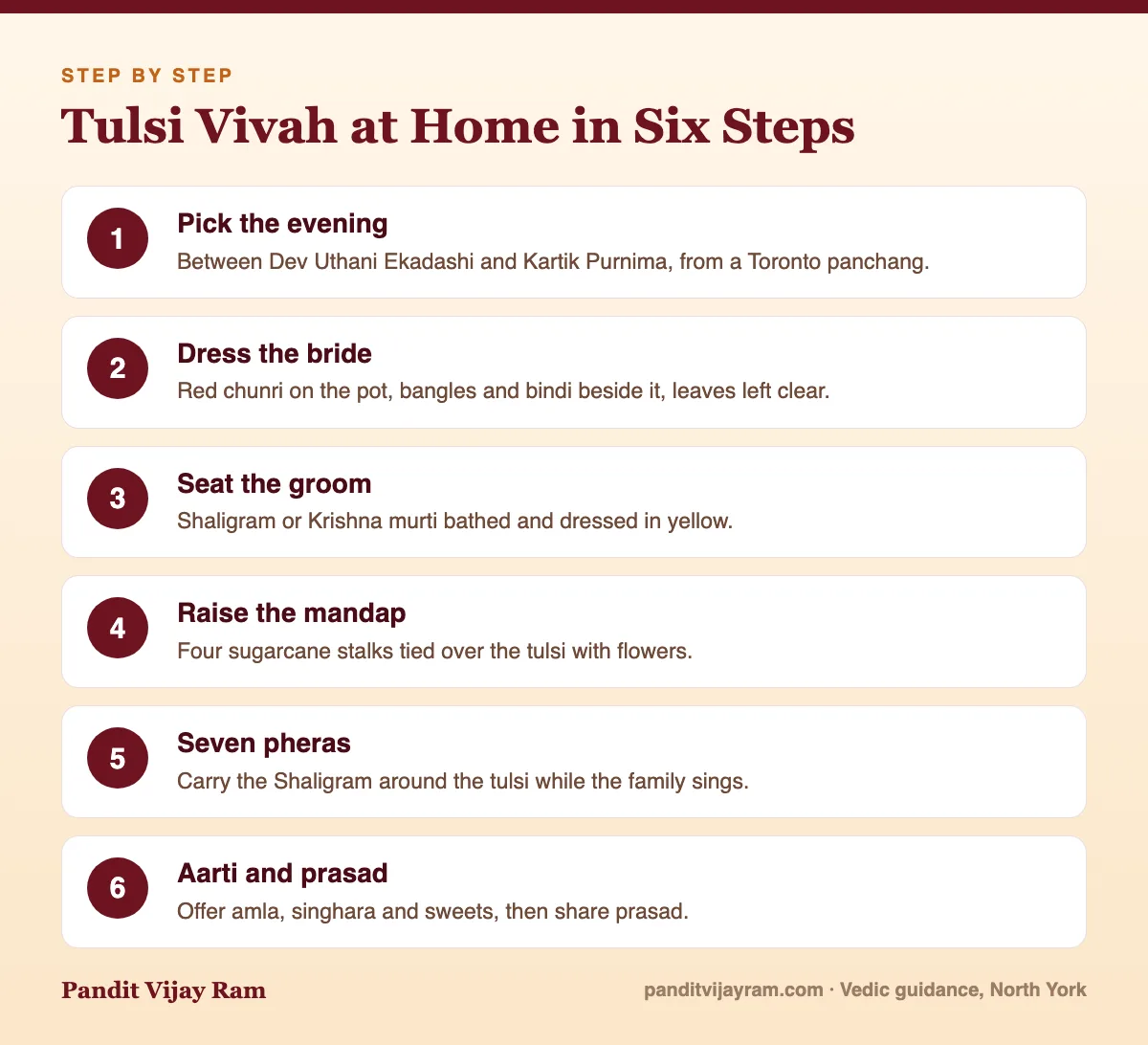
Yes. Most families perform tulsi vivah at home themselves. You need a healthy tulsi plant, a Shaligram or a small Vishnu or Krishna murti, red cloth and bridal items for Tulsi, sugarcane or a small mandap, a lamp, flowers, seasonal produce and prasad. An elder leads the sankalp, songs and pheras.
Handle the plant gently. It is both the goddess and a living thing that has to survive the winter.
- Dressing the bride. Drape a red chunri lightly over the pot, not the leaves, and place bangles, a bindi and a little sindoor on the pot or a small stand beside it. Heavy powder on leaves blocks light.
- The groom. Bathe the Shaligram or murti, dress it in a small yellow cloth and place it on a plate beside the tulsi.
- The mandap. Four short sugarcane stalks tied together over the pot, or a simple frame of flowers. Many GTA grocers stock sugarcane in autumn.
- The pheras. A family member carries the Shaligram around the tulsi seven times while others sing.
- Light. One diya on a metal plate at a safe distance from the cloth, never under the chunri.
If your tulsi has not survived, worship a picture of Tulsi or a fresh sprig with sincerity. Families who prefer a priest-led vivah, perhaps with a Satyanarayan katha the same evening, can arrange it through Vijay Ram ji's puja and anushthan service. After the festival, return the plant to its usual light, and compost the sugarcane leaves and flowers.
The bottom line
Tulsi vivah marries the sacred tulsi, honoured as Vrinda, to Vishnu as the Shaligram, and it marks his awakening and the start of the wedding season. Its story of Vrinda and Jalandhara is about devotion, loss and atonement, and it deserves to be told in full. Celebrate between Dev Uthani Ekadashi and Kartik Purnima using a Toronto panchang, keep the home tulsi vivah simple, and treat the plant with the same care as the goddess it represents.
Key takeaways
- Tulsi vivah weds the tulsi plant to Vishnu as the Shaligram or a Krishna murti.
- It falls between Dev Uthani Ekadashi and Kartik Purnima.
- The Vrinda and Jalandhara story is about devotion, deception and atonement.
- Regional customs differ, from sugarcane mandaps to full processions.
- Dress the pot rather than the leaves so the plant stays healthy indoors.