
Diwali, Navratri and Holi in Markham: Local Celebrations and Practical Rules
Diwali in Markham catches many newcomers by surprise. Relatives in other cities talk about lighting fireworks freely on the night, yet Markham's rules treat Diwali like any ordinary day: fireworks need a permit. I am Pandit Vijay Ram, a Vedic astrologer based in North York, and each autumn York Region families ask me about muhurats, Lakshmi puja and, increasingly, whether the sparklers are legal. This guide sets out what the City of Markham's own fire services pages say about family fireworks and open-air fires, explains why a Holika Dahan bonfire is usually not possible in Markham's urban neighbourhoods, and describes where community celebrations tend to happen without inventing dates that shift each year. It finishes with a safe plan for lamps, Navratri worship and Holi colours at home. In more than forty years of practice I have found that families enjoy festivals most when the practical questions are settled early, leaving the evening itself for prayer and togetherness.
Do you need a permit for Diwali fireworks in Markham?
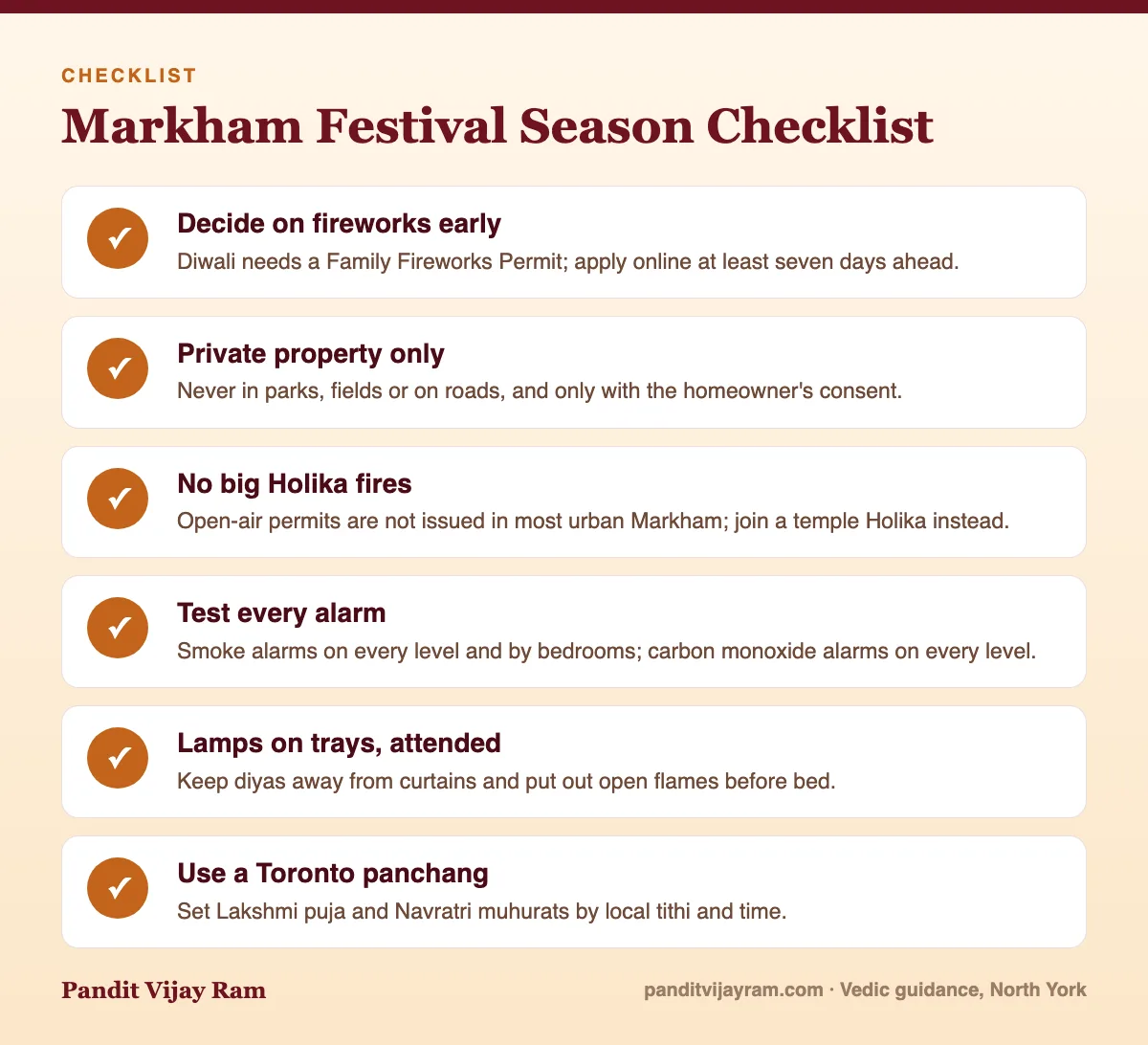
Yes. The City of Markham's Family Fireworks Permit page lists only four permit-free days: Victoria Day, the day before it, Canada Day and the day before it. Every other day, including Diwali, requires a permit, applied for online at least seven days in advance. Fireworks are never allowed on City property.
Markham's approach differs from some neighbouring cities, so do not rely on what a cousin in another municipality says. The City's fire services page is the authority.
- Permit-free days. Only the day before Victoria Day, Victoria Day, the day before Canada Day and Canada Day.
- All other days, including Diwali. A Family Fireworks Permit is required. Apply online through the City at least seven days before you plan to light anything. The City charges a permit fee, shown on its page.
- Where. Only on private property with the homeowner's consent. Never on City property, which includes parks, sports fields and roads.
- Penalties. The City warns that people who break the rules can be fined under Ontario's Provincial Offences Act.
Practically, this means a Diwali fireworks plan in Markham starts in October, not on the night. If you rent, you also need the owner's consent. Condo residents should assume balconies and common areas are off-limits under building rules.
Many Markham families now choose a fireworks-free Diwali: more lamps, a longer puja, a family meal and perhaps a visit to relatives elsewhere. Our comparison of Diwali fireworks rules across GTA cities shows how Markham compares with its neighbours, and the Richmond Hill festivals guide covers the next city over.
Can you light a Holika Dahan bonfire in Markham?
Usually not in the city's urban areas. Markham requires an Open Air Fire Permit for open burning and does not issue them south of 17th Avenue and west of 10th Line, which covers most built-up neighbourhoods. A small recreational fire may be allowed there if by-law conditions are met. Check with Markham Fire first.
Holika Dahan, the bonfire lit on the eve of Holi, commemorates Prahlad's devotion and the burning away of arrogance. A large stacked bonfire, however, rarely fits a Markham subdivision.
The City's fire permits page explains:
- Open burning needs a permit, and permit holders must notify the fire department on each day they burn.
- No open-air permits are issued south of 17th Avenue and west of 10th Line. That area includes most of Markham's urban and suburban housing.
- Only clean wood, brush or vegetation may be burned, and the pile must stay small.
- In restricted areas, recreational fires such as a small roasting fire may be allowed if by-law conditions are met.
For most families the respectful answer is to join a community Holika at a temple or cultural centre, or to mark the moment symbolically at home: a lamp, a coconut, a little grain and the story of Prahlad told to the children. The meaning lives in the devotion, not the size of the flames.
Our explainer on Holika Dahan rules and safe alternatives in the GTA describes the ritual in detail. The same caution applies to an outdoor havan kund: ask Markham Fire before lighting one in the yard.
Where do Markham families celebrate Diwali, Navratri and Holi together?
Most public Hindu festival celebrations in Markham happen at temples and cultural centres, such as the Sanatan Mandir Cultural Centre and the Vedic Cultural Centre of Arya Samaj Markham, and at halls rented by community associations. The City's own events calendar focuses on civic festivals, so check temple and association announcements each season.
Unlike some cities, Markham's official events listing does not centre on Diwali or Navratri. The celebrations are community-led, which gives them a warm, neighbourhood feel.
- Temples. Markham's mandir and Vedic centre hold special pujas, havans and satsangs during the festival seasons. Our guide to Hindu temples in Markham explains each institution's style.
- Cultural associations. Regional and language groups rent halls or City community centre rooms for garba and dandiya nights, Diwali dinners and Holi socials. Tickets, dress codes and food rules are set by the organiser.
- Parks and gazebos. The City's renting space page says a permit must be obtained to use a park gazebo for an event or gathering. Contact the City before planning a group Holi in a park.
- Nearby cities. Many families also attend temples in Richmond Hill and north Scarborough during the busiest festival nights.
For Navratri, remember that garba is joyful but the observance is devotional: daily worship of the Goddess, fasting where health allows, and kanya pujan near the end. Our Navratri plan for GTA families offers a balanced approach, including when fasting is not advisable.
Sikh and Hindu neighbours often share the season too; our piece on festivals Sikh and Hindu families share in the GTA explores that overlap.
How do you keep Diwali lamps and puja safe in a Markham home?
Markham Fire asks residents to keep working smoke alarms on every level and inside and outside sleeping areas, plus carbon monoxide alarms on every level. Test them before Diwali. Place diyas on metal trays away from curtains, keep flames attended, and use LED lamps on balconies and in children's rooms.
Markham's fire safety page gives the basics: working smoke alarms on every level of the home and inside and outside sleeping areas, tested monthly, with batteries replaced at least yearly and units replaced every ten years. It also asks residents to keep carbon monoxide alarms working on every level. The page flags homes with a second unit, such as a basement apartment, as carrying extra fire risk.
A sensible Diwali setup for a Markham home:
- Test alarms the weekend before the festival.
- One main lamp in the puja corner, with a few diyas rather than dozens.
- Trays and distance. Clay diyas on metal or ceramic trays, away from curtains, blinds and paper decorations.
- Basement units. If tenants live below, tell them about the puja and keep stairwells clear of lamps.
- Bedtime rule. Put out every open flame before sleeping, or switch to an electric lamp for the night.
The Lakshmi-Ganesh puja itself needs only a clean home, a lamp, flowers, sweets and sincere prayer. Our step-by-step Lakshmi-Ganesh puja at home gives the sequence, and condo residents will find practical tips in Diwali diyas in condos and apartments. Families who want a Ganesh puja performed with full vidhi can read about the Ganesha puja and havan I conduct.
How can Markham families keep festivals joyful, meaningful and neighbourly?
Plan the permit or skip fireworks, keep the puja at the centre, and involve the neighbours. Share sweets, keep noise reasonable, and clean up Holi colours promptly. Choose the puja time from a Toronto panchang rather than an Indian calendar, and give children real roles so the traditions pass naturally to the next generation.
Markham is a city where immigrants make up a majority of residents, with Chinese, South-Asian, European and many other communities living side by side. Festivals are a chance to share, not only to celebrate.
- Share the sweets. A box of mithai or a plate of laddoos for the neighbours turns curiosity into friendship.
- Respect quiet. Even with a permit, keep fireworks brief and early in the evening.
- Holi courtesy. Use skin-safe colours, protect cars and fences, and wash driveways the same day.
- Panchang timing. Lakshmi puja, Navratri ghatasthapana and Holika Dahan follow local tithi and muhurat. Use a panchang calculated for Toronto.
- Children's roles. Rangoli, filling diyas, ringing the bell, telling the story of Rama, Durga or Prahlad.
In families where elders and young adults disagree about how to celebrate, I suggest a simple compromise: the puja is non-negotiable and done together; the social parts can be flexible. That keeps the sacred core while respecting busy lives.
Some families ask me which festival days suit new beginnings, house blessings or remedies for a difficult planetary period. Those answers come from an individual chart rather than a general list. My page for Markham clients explains how such consultations are arranged.
The bottom line
Diwali in Markham needs a Family Fireworks Permit, because the City's permit-free days are limited to Victoria Day and Canada Day and the days before them. Open-air fire permits are not issued across most of urban Markham, so Holika Dahan is best observed at a temple or symbolically at home. Temples, cultural associations and careful home puja carry the festival season, kept safe by working alarms and kept warm by sharing with neighbours.
Key takeaways
- Markham requires a permit for Diwali fireworks; apply online at least seven days ahead.
- Fireworks are never allowed on City property, including parks, fields and roads.
- Open-air fire permits are not issued south of 17th Avenue and west of 10th Line.
- Temples and cultural associations lead Markham's Diwali, Navratri and Holi celebrations.
- Working smoke and carbon monoxide alarms on every level come before any festival lamp.