
Hindu Temples and Community Centres in Markham: A Respectful Visitor's Guide

Searching for Hindu temples in Markham can be confusing, because many results point to the busy temple strip along Markham Road, which actually lies in north Scarborough. The City of Markham itself has its own Hindu institutions with distinct traditions and a strong community life. I am Pandit Vijay Ram, a Vedic astrologer based in North York, and York Region families often ask me where to begin. This guide introduces two Markham institutions whose official websites I checked, the Sanatan Mandir Cultural Centre and the Vedic Cultural Centre of Arya Samaj Markham, explains how their styles of worship differ, and offers practical etiquette for a first visit. It also looks at the City of Markham's community centres, such as Aaniin, as shared civic spaces, and at how a temple visit can strengthen practice at home. In more than forty years of practice I have found that knowing a temple's tradition before you arrive is the simplest way to feel welcome there. I am not affiliated with any institution mentioned.
Which Hindu temples and Vedic centres are in Markham?
Two established institutions stand out: the Sanatan Mandir Cultural Centre on Woodbine Avenue, a temple and cultural centre begun by the Gujarat Samaj of Toronto, and the Vedic Cultural Centre of Arya Samaj Markham, a havan-centred Vedic community. Many other temples serving Markham families lie just over the border in Richmond Hill and Scarborough.
Sanatan Mandir Cultural Centre (SMCC). York Region's business directory lists the centre on Woodbine Avenue in Markham. Its own website says it was started by the Gujarat Samaj of Toronto to preserve Gujarati culture and now serves the Hindu community across the GTA. Its listed services include daily aarti, pooja, katha, yagya and havan, weddings, home and business opening ceremonies, death rituals and funeral arrangements. Community life is just as visible: a Sunday satsang with bhajan, pravachan and mahaprasad, a seniors' club, a ladies' group, a youth corner, a library, children's Baal Vidyalaya classes, yoga and help for new immigrants.
Vedic Cultural Centre, Arya Samaj Markham. The City of Markham has recognised the centre's community role publicly; a City news release honoured its late former president, Amar Erry, for his interfaith and cultural work in Markham. The centre's website lists religious services and special days, Arya Bal Vihar for children, yoga, a seniors' club, a Vedic library, English classes, help for new immigrants and a food bank.
Nearby temples. Families in Markham also travel to temples in Richmond Hill and to the Markham Road corridor in Scarborough. Our guides to Hindu temples in Richmond Hill and Hindu temples in Scarborough cover those neighbours, and the GTA-wide temple guide gives the bigger map.
How is worship at an Arya Samaj different from a mandir with murtis?
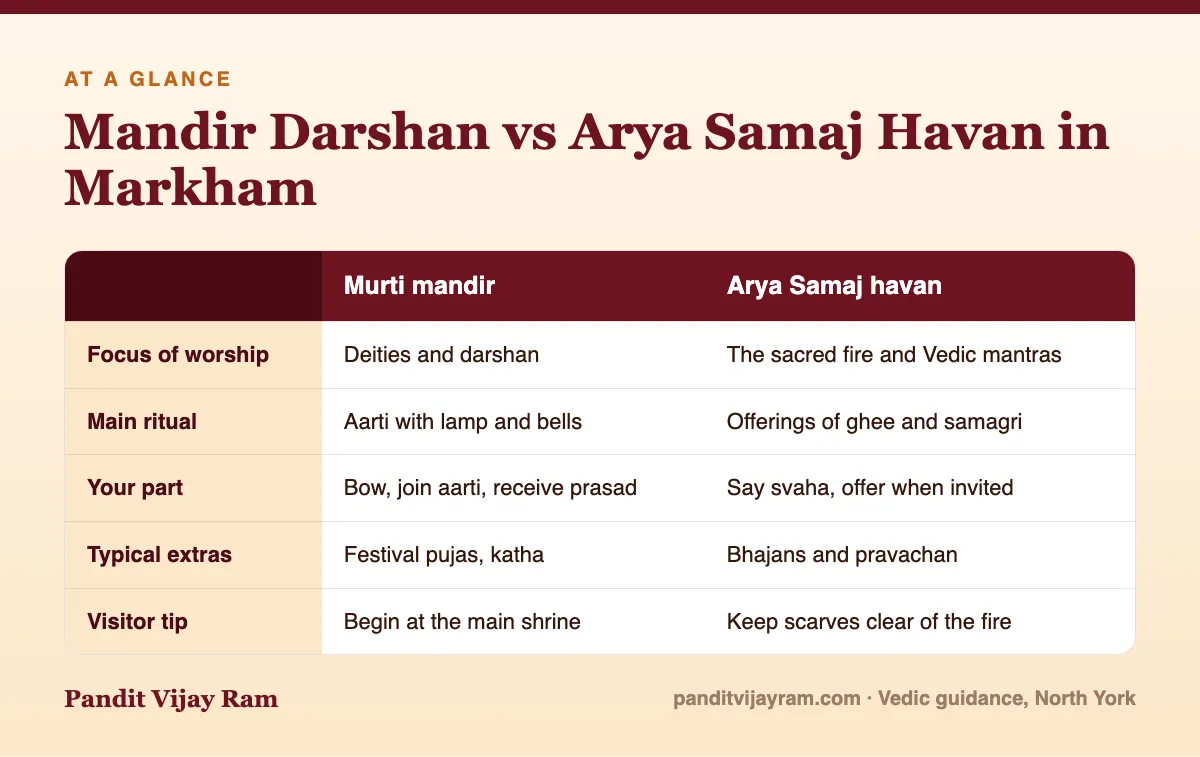
Arya Samaj, founded by Dayananda Saraswati, does not practise murti puja. Worship centres on the havan, with Vedic mantras chanted as offerings are made to the sacred fire, followed by bhajans and a talk. A traditional mandir such as Sanatan Mandir offers darshan of deities, aarti and prasad. Both welcome respectful visitors.
Markham offers a useful contrast within the Hindu tradition. Knowing which kind of service you are attending helps you take part without awkwardness.
At a murti-based mandir you will usually:
- Bow or fold your hands before each deity, often beginning with Ganesha.
- Join the aarti, when a lamp is waved before the deities with singing and bells.
- Receive prasad, sanctified food, at the end.
- See festival decorations and special pujas linked to the panchang.
At an Arya Samaj havan you will usually:
- Sit around a havan kund on the floor or on chairs nearby.
- Hear mantras from the Vedas, with the congregation saying svaha as samagri and ghee are offered.
- Listen to bhajans and a short pravachan, a talk on Vedic teaching.
- Find no murtis; the fire itself is the focus.
Neither is more correct. Many families attend both at different times of life. If havan appeals to you, our explanation of havan as a Vedic purification ritual describes its meaning. For families who want a havan or anushthan performed for a specific intention, the puja, havan and anushthan page explains how I conduct them.
What etiquette should first-time visitors follow at a Markham temple?
Remove your shoes, dress in modest clothing, and enter quietly. Silence your phone, sit where the congregation sits, and follow the volunteers' lead during aarti or havan. Offer flowers, fruit or a donation if you wish, but nothing is compulsory. Ask before photographing the shrine or the havan fire.
A few habits make any first visit comfortable, at a Gujarati mandir, an Arya Samaj havan hall or a South Indian temple.
- Call or check online first. Programmes change around festivals and community events.
- Dress modestly. Covered shoulders and knees. A dupatta or scarf is handy; some families cover their heads during havan.
- Shoes and hands. Leave footwear on the rack and wash or sanitise your hands.
- Phones away. Switch to silent; take calls outside.
- Seating. Some halls seat men and women on different sides. Follow what you see.
- Fire etiquette. At a havan, wait to be invited before making an offering, and keep sleeves and scarves clear of the flame.
- Prasad and mahaprasad. Receive with the right hand or both hands. Eat what you take.
- Volunteer. Offering to clear plates after a Sunday satsang is a quick way to become part of the community.
Families visiting from other traditions, including Sikh, Jain and Indo-Caribbean Hindu households, are generally welcome. When in doubt, ask a volunteer politely; questions asked with respect are almost always answered warmly. If you are preparing for a significant visit, such as a wedding blessing or a memorial, a short cleansing before an important event can help you arrive settled.
How do Markham's community centres fit into Hindu community life?
The City of Markham runs fifteen community centres, including Aaniin, Angus Glen, Cornell, Milliken Mills and Markham Village. They are secular public spaces, but cultural associations often rent their multipurpose rooms for language classes, yoga and festival socials. Many also house a library branch, useful for newcomer families.
Temples carry the sacred, but much of Markham's Hindu community life happens in ordinary civic buildings. The City lists fifteen community centres, among them Aaniin, Angus Glen, Armadale, Cornell, Milliken Mills, Markham Village and Thornhill.
Aaniin Community Centre and Library on 14th Avenue is a good example. The City explains that aaniin is an Ojibway word for hello or welcome, chosen to greet Markham's many communities. The building combines a library, a pool, a gymnasium, a fitness centre and multipurpose rooms. A City release also notes that its atrium is named for Amar Erry, the Arya Samaj Markham leader honoured for promoting unity across faiths.
Rooms at City facilities are booked through the City's facility booking system. Before planning a puja, bhajan evening or festival meal in a public room, ask about:
- open flame, incense and diyas, which are often restricted indoors;
- food preparation and serving rules;
- decoration and clean-up expectations.
For a larger ritual such as a naming ceremony or a havan, a temple hall is usually the better choice. Our guide to Diwali, Navratri and Holi in Markham covers the City's fire and fireworks rules for festivals.
How can a temple visit in Markham strengthen practice at home?
Treat the temple as a teacher. Learn one aarti, mantra or havan prayer there, then repeat it at home on a fixed day each week. Keep a small, clean shrine or havan corner, bring prasad home to share, and let children take part. Regular modest practice outlasts occasional grand gestures.
The calm you feel at a Sunday satsang fades by Wednesday unless something carries it home. That bridge does not need to be elaborate.
- Adopt one prayer. Ask a temple volunteer or the priest to teach you the words of an aarti or the Gayatri Mantra. Recite it at home each morning.
- Set up a corner. A shelf in the north-east of the home, a lamp, water and an image, or for Arya Samaj families a small havan kund used with care. Our guide to keeping a home mandir clean offers a simple routine.
- Learn alongside children. Bal Vihar and Baal Vidyalaya classes teach stories and values; repeat them at the dinner table.
- Ask about family rites. Both Markham institutions list ceremonies such as weddings and home blessings. For questions to ask any priest, see finding a pandit in the GTA.
Sometimes people ask me for a personal reading after a meaningful temple visit, wanting to understand a difficult period in their chart. That is a private conversation, separate from the temple. My astrologer page for Markham residents explains how those consultations work. Health or emotional crises should go first to your family doctor, or to 9-8-8 for urgent support.
The bottom line
Hindu temples in Markham include the Sanatan Mandir Cultural Centre, with its Gujarati roots and wide community programmes, and the Vedic Cultural Centre of Arya Samaj Markham, where the havan is the heart of worship. Simple etiquette, from removing shoes to waiting before offering at the fire, makes first visits easy. Markham's community centres complement these temples as shared civic spaces, and one prayer learned at the temple and repeated at home keeps devotion alive during the week.
Key takeaways
- Sanatan Mandir Cultural Centre on Woodbine Avenue offers aarti, havan, satsang and community programmes.
- The Vedic Cultural Centre of Arya Samaj Markham centres worship on havan rather than murtis.
- Markham Road temples are mostly in north Scarborough, not the City of Markham.
- Markham's community centres, such as Aaniin, are secular spaces with their own rules on flame and food.
- Learning one prayer at the temple and repeating it at home builds steady practice.