
Career Astrology: What a Chart Can Suggest About the Right Field

Choosing a field of work is one of the heaviest decisions a young person or a career changer faces, and families often want help. In South Asian homes it is common for parents to ask an astrologer which profession a child should follow. I hear this question in North York every week, from students choosing a university programme, from newcomers whose foreign credentials are not yet recognised, and from mid-career workers who feel stuck. This guide explains what career astrology actually looks at, the traditional links between planets and fields, how the D10 chart is used, and, just as importantly, what a chart cannot tell you. It also shows how to combine a reading with aptitude assessments, labour-market information and honest conversations about interests. In more than forty years of practice, I have learned that the chart is most useful as a mirror for temperament. It is least useful when it is treated as a job allocation. Used in the right order, it can add a thoughtful layer to a decision that should rest mostly on practical ground.
Can astrology tell you which career is best for you?
Astrology can suggest themes and temperament, such as a pull toward structure, communication, care or competition, but it cannot tell you which job is best. There is no scientific evidence that charts predict occupation. A sensible approach treats the chart as one reflective input beside aptitude, interests, training options and the job market.
People hope for a single answer: "You should be a doctor." A chart does not work that way. A strong Mercury might suit accounting, journalism, software, sales or teaching. A strong Mars might suit surgery, engineering, policing, sport or construction. The same planet points to many fields.
There is another reason for modesty. Classical texts were written for societies with very different work. Software development, logistics, digital marketing and countless other modern jobs did not exist. Astrologers map them onto old categories by analogy, and analogies vary from one reader to the next.
So I frame career readings around three questions:
- What kind of work environment does this chart suggest the person may enjoy?
- Which strengths appear repeatedly in the chart?
- Which current dasha themes might affect how the person approaches change?
The answers are a starting point for conversation. They should be tested against what the person actually enjoys and does well.
Vijay Ram ji's business and career guidance works on this basis. For a detailed technical look at the career house itself, see our guide to the 10th house and career.

Which planets are linked with which careers in Vedic astrology?
Traditional associations link the Sun with authority and government, the Moon with public-facing and care roles, Mars with technical and protective work, Mercury with commerce and communication, Jupiter with teaching, law and advising, Venus with arts and hospitality, and Saturn with labour, systems and large organisations. Rahu and Ketu add unconventional or research themes.
The table-style list below summarises common associations. Writers differ, so treat it as a sketch rather than a rulebook.
- Sun: administration, government, leadership, roles carrying public responsibility.
- Moon: nursing and care work, hospitality, food, public relations, roles involving the public and emotions.
- Mars: engineering, surgery, police and armed forces, firefighting, sport, real estate and building trades.
- Mercury: trade, accounting, writing, media, teaching languages, software and analysis.
- Jupiter: teaching, law, finance and advising, religious work, counselling and mentoring.
- Venus: arts, design, fashion, music, beauty, luxury goods, hospitality and entertainment.
- Saturn: manufacturing, mining, agriculture, logistics, labour, social services, long-term institutional work.
- Rahu: technology, foreign links, aviation, media, unconventional or new industries.
- Ketu: research, healing traditions, spiritual work, highly specialised technical skills.
A planet only becomes career-relevant when it is connected to the 10th house, its lord, the ascendant or the D10 chart, and when it has strength. Exaltation and debilitation matter here, as our guide to planetary dignity explains.
Notice how broad each list is. That breadth is honest. It also shows why the person's own interests must narrow the choice.
What does the D10 dashamsha chart show about career?
The D10, or dashamsha, is a divisional chart that splits each sign into ten parts and is traditionally read for career, status and public work. Astrologers check its ascendant, its 10th house and how the main career planets from the birth chart are placed in it. It depends heavily on an accurate birth time.
Each sign spans thirty degrees, so each dashamsha portion is three degrees. The rising degree moves through a dashamsha segment in roughly twelve minutes on average, which means the D10 ascendant can change with a small error in birth time.
That sensitivity creates a practical rule:
- If the birth time is recorded to the minute, the D10 can be used as a meaningful secondary layer.
- If the time is known only roughly, treat D10 conclusions very cautiously, or leave them out.
- If the time is unknown, the D10 cannot be used at all.
When it is reliable, the astrologer looks for agreement. Suppose Mercury rules the 10th in the birth chart, sits in a kendra in the D10 and is well placed there. The commerce and communication theme is then repeated, and the reading gives it more weight.
Disagreement is common too. A birth chart may emphasise Saturn while the D10 favours Venus, which some readers interpret as a creative role inside a large, structured organisation. Different astrologers will read such mixtures differently, which is a reminder that the method is interpretive.
For the wider system of divisional charts, see our guide to vargas and divisional charts.
How should a chart be combined with aptitude and the job market?
Put the practical inputs first: interests, proven skills, aptitude or interest assessments, training costs and actual labour demand. Then use the chart to reflect on temperament and timing. If a field suggested by the chart has poor prospects in your region or does not match your abilities, the practical evidence should win.
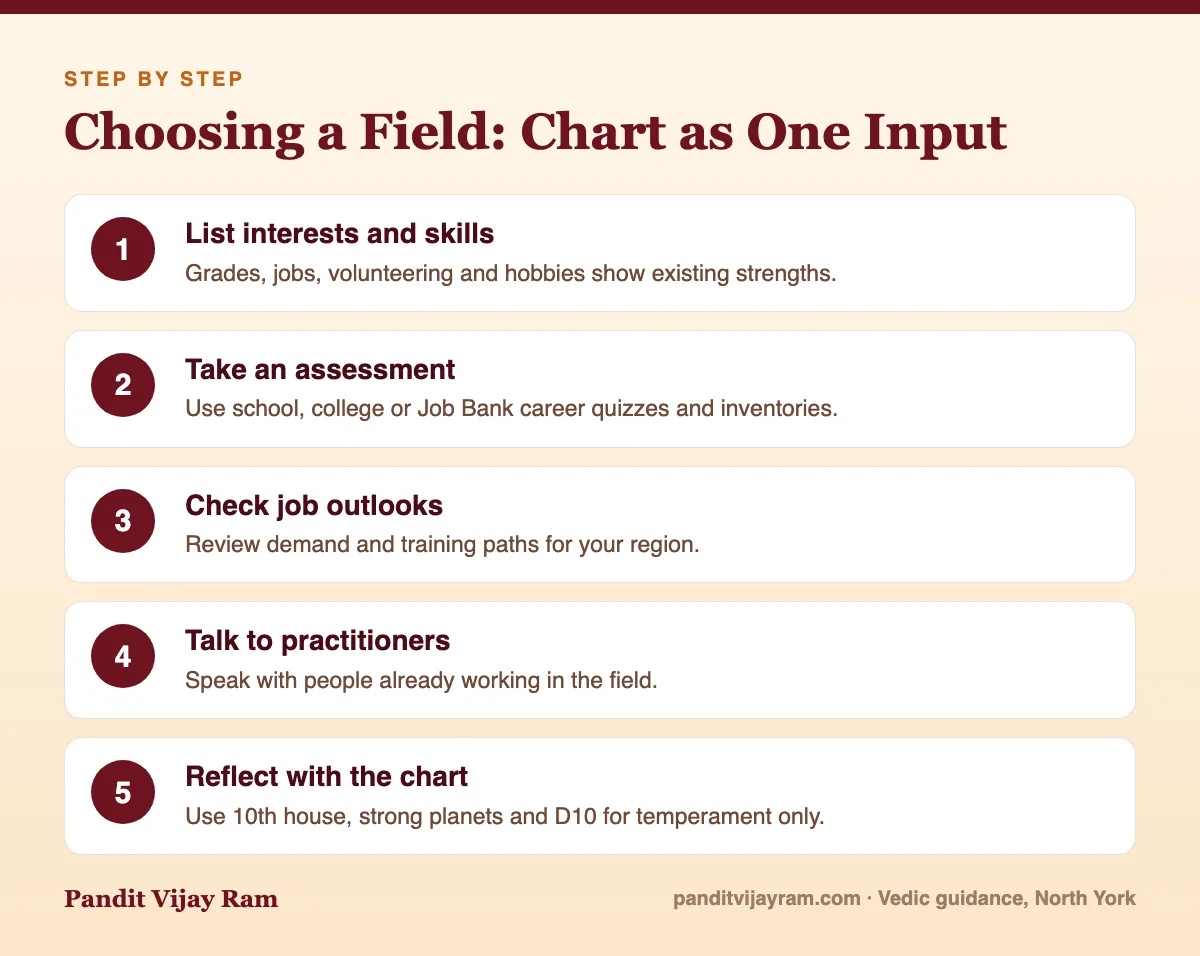
Here is a simple decision method I suggest to students and their parents.
- List interests and strengths. School results, part-time jobs, volunteering and hobbies show what a person already does well.
- Try a structured assessment. School guidance offices, college career centres and Canada's Job Bank offer career quizzes and interest inventories.
- Check the market. Job Bank publishes job outlooks and wage information by occupation and region. Look at the Toronto area specifically if you plan to stay.
- Talk to people in the field. An hour with someone doing the job tells you more than any chart.
- Consider the training path. Duration, cost, licensing and, for newcomers, credential recognition all matter.
- Then look at the chart. Does it describe a temperament that would enjoy the shortlisted options? Is the current dasha one that tradition links with study, change or consolidation?
If the chart and the practical evidence agree, families usually feel more settled. If they disagree, the practical evidence should guide the decision.
Students under heavy pressure can also benefit from our article on study stress and Saraswati practice. A choice made under anxiety is rarely a good one.
What are the limits of career astrology?
Career astrology cannot predict job offers, promotions, salaries or the success of an application. It relies on interpretation that varies between astrologers, often depends on precise birth times, and maps modern jobs onto old categories. It also should not pressure a young person into a field chosen by the family rather than by interest and ability.
Some limits are technical. Others are human, and those matter more.
- No evidence of prediction. Controlled studies have not found that charts predict occupation. A reading offers reflection, not forecasting.
- Interpretive variation. Two experienced astrologers may emphasise different planets for the same person.
- Birth-time dependence. D10 and many fine details collapse if the time is uncertain.
- Old categories. Modern work has to be matched to classical meanings by analogy.
- Family pressure. A chart can be misused to override a young person's wishes. I am careful not to let a reading become a weapon in that argument.
Questions such as "Will I get a government job?" are common. Our article on government job indicators covers the traditional factors and why exam preparation counts for far more. People considering a mid-life move can read about career change and astrology.
Finally, if career worries are affecting sleep, appetite or mood for weeks, please speak with your family doctor. Work stress is real stress, and it deserves real care.
The bottom line
Career astrology works best as a mirror for temperament, read through the 10th house, strong planets and, with an accurate birth time, the D10 chart. Planet-field associations are broad, so they suggest directions rather than specific jobs. Aptitude, interests, training paths and labour-market information should carry the most weight in any decision. Used in that order, career astrology can add a thoughtful layer without taking the choice away from the person whose life it is.
Key takeaways
- A chart suggests temperament and broad themes, not a specific job.
- Each planet links with many possible fields, so personal interests must narrow the choice.
- The D10 chart is useful only when the birth time is precise.
- Aptitude, skills and labour-market evidence should outweigh astrological suggestions.
- No chart can predict job offers, promotions or salaries.