
Children Not Listening: Parenting Stress and Vedic Support

You ask three times for shoes to go on, and the fourth time you hear yourself shouting. Then the guilt arrives. Parents searching for children not listening remedies are usually tired, loving people who feel they have run out of ideas. In North York and across the GTA, I meet many mothers and fathers juggling long commutes, shift work and grandparents' opinions, all while trying to raise children in two cultures. This guide covers why young children stop listening, which parenting basics make the biggest difference, when to involve your paediatrician or the school, and what a child's kundli can and cannot tell you. It also explains why I do not blame nazar or bad energy for ordinary childhood behaviour, and which simple prayers help a parent stay steady. Through forty years of family consultations, I have watched countless parents discover that a calmer evening routine changed more than any remedy I could give.
Why does my child not listen to me?
Most children who do not listen are tired, hungry, overstimulated, absorbed in play or screens, or testing limits as a normal part of growing up. Long or repeated instructions are easy to tune out. Sometimes hearing, attention, language or anxiety plays a part, which is why a check with a doctor matters if the pattern persists.
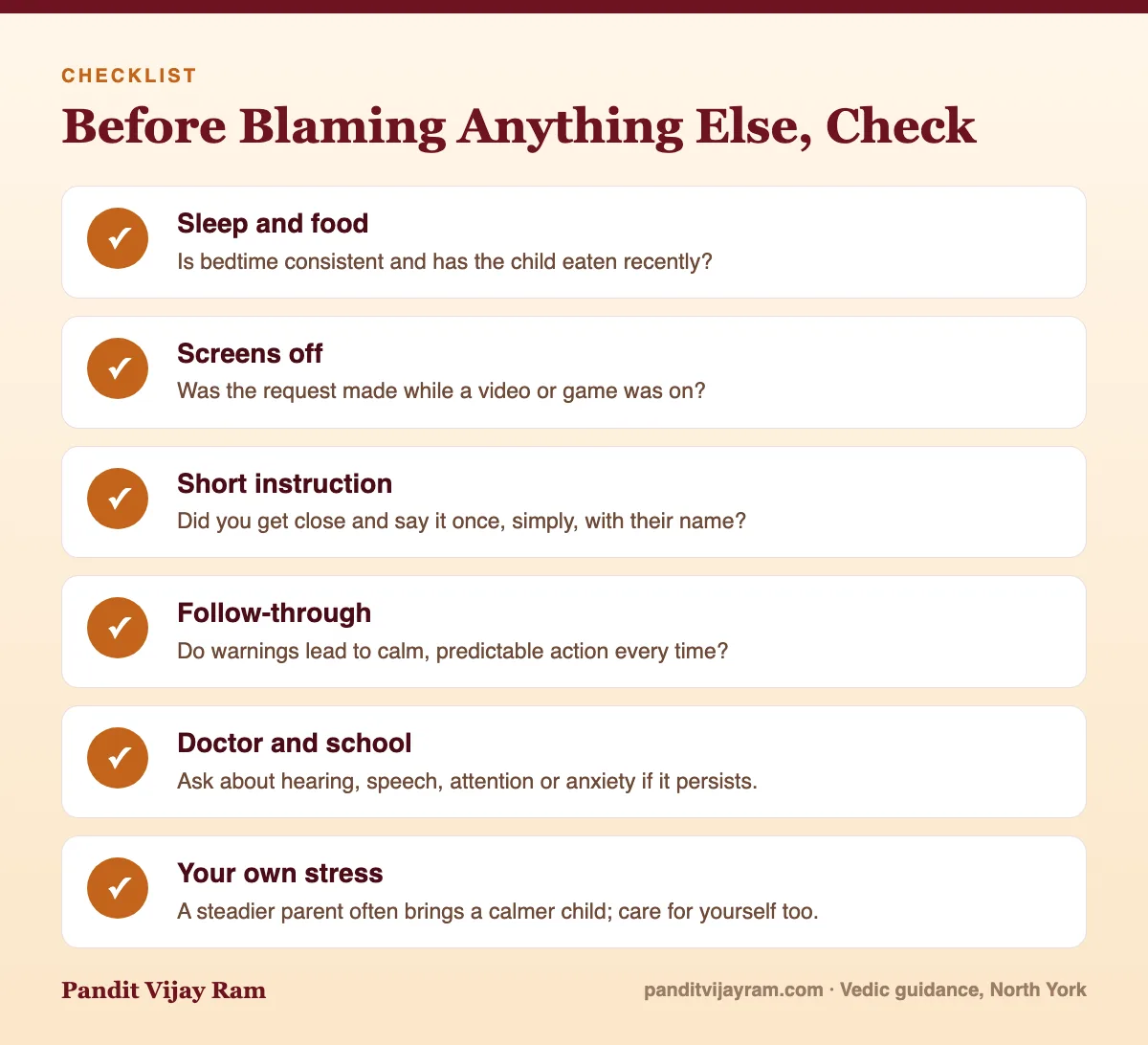
Before looking anywhere spiritual, I ask parents a few ordinary questions. How much is the child sleeping? When did they last eat? Was the request given from across the room while a tablet was on? The answers often explain a great deal.
Common, everyday reasons children tune out:
- Fatigue and hunger. Late bedtimes and skipped snacks make cooperation much harder.
- Screens. A child absorbed in a video genuinely may not register your voice.
- Too many words. A long lecture loses a young child within seconds.
- Inconsistent follow-through. If "last warning" is said five times, children learn to wait.
- Big changes. A new sibling, a move, a new school or parents' stress can show up as defiance.
- Normal development. Toddlers and young children push limits to learn independence.
Some patterns need a professional view. If a child seems not to hear you even when calm, struggles to follow simple steps, or has frequent intense meltdowns, speak to your paediatrician or family doctor. Hearing problems, speech delays, attention differences and anxiety are common and treatable, and early support helps.
If a child talks about seeing frightening figures or invisible friends, the post on children who see ghosts or imaginary friends keeps child development first.

How do I get my child to listen without yelling?
Get close, make eye contact, and give one short, clear instruction. Offer simple choices, warn before transitions, and follow through calmly every time. Praise cooperation specifically. Keep consequences small, related and predictable. Most of all, spend a few minutes of undivided, playful time with your child daily, because connected children cooperate more readily.
These are the parenting basics that research and experience both support. They work across cultures, and none requires special equipment.
- Come close. Walk over, kneel to their level and use their name.
- Say it once, simply. "Shoes on, please." Then wait a moment.
- Offer a choice. "Red socks or blue socks?" gives control within your limit.
- Warn before change. "Five more minutes, then bath" helps children shift from play.
- Follow through kindly. If shoes still aren't on, help put them on without a lecture.
- Notice the good. "You came the first time I called" teaches more than criticism.
- Daily connection time. Ten minutes of play led by the child, with phones away.
Shouting tends to work briefly and then escalate. Physical punishment harms children and the parent-child bond, and it is not something I support in any form.
Many GTA public health units, libraries and community centres run parenting workshops. Your school or family doctor can point you to programmes nearby. Asking for help is not failure; it is good parenting.
For households where grandparents parent differently, agree on two or three shared rules so the child hears one message. Our family problem guidance can help multigenerational homes find that agreement.
Can nazar or negative energy make a child stubborn?
Some families believe nazar can unsettle a child, and gentle customs such as a kala tika are part of many households. But ordinary stubbornness, tantrums and not listening are normal childhood behaviour. Treating them as evil eye can delay real help for sleep, hearing, learning or anxiety, and it can leave a child feeling something is wrong with them.
I respect the instinct behind nazar customs. Loving relatives want to protect a child. Yet I have seen families spend months on remedies while a child's hearing problem or anxiety went unnoticed. I would not want that for any family.
A simple decision rule I share with parents:
- Sudden change with illness signs, such as fever, pain, poor feeding or unusual sleepiness: see a doctor promptly.
- Ongoing difficulty with listening, learning or behaviour over weeks: speak to your paediatrician and the school.
- Ordinary bad days after a party or a busy week: rest, routine and comfort.
- If you still want a custom, a brief prayer or kala tika is gentle. Avoid anything that frightens the child or involves fire close to them.
Children notice what adults say about them. A child told repeatedly that a bad eye has made them naughty may start to believe they are bad. It is kinder to say, "You're tired, let's rest," and keep protective prayer quiet and loving.
The post on signs of nazar on a person lists the ordinary causes to rule out first, which apply even more strongly to children.
What does a child's kundli say about behaviour?
In Vedic astrology the Moon reflects a child's emotional nature, Mercury their learning and speech, the ascendant their temperament, and the fifth house intelligence and creativity. A reading may describe a sensitive, strong-willed or restless temperament. It describes tendencies to understand and nurture, never a label, and it cannot diagnose any condition.
Parents sometimes bring me a child's chart hoping to find the reason for difficult behaviour. I am glad to read it, as long as we use it to understand the child better rather than to fix a label on them.
Points I commonly look at:
- The Moon and its sign. Emotional sensitivity and what soothes the child.
- The ascendant and its lord. Basic temperament: fiery and quick, steady and slow, curious and talkative.
- Mercury. Speech, learning style and how the child processes instructions.
- Mars. Energy and assertiveness; a strong Mars child often needs physical activity.
- The fifth house. Intelligence, creativity and the parent-child bond itself.
A useful reading might say: this child feels things deeply and needs calm transitions, or this child has abundant energy and needs outdoor play before homework. That can help parents adjust their approach with compassion.
A chart cannot diagnose ADHD, autism, hearing loss or anxiety. If you have concerns, the paediatrician and school support team are the right first step, and the chart can sit alongside their advice.
For a careful reading, see the kundli and horoscope service. If your child is older and school is the main struggle, the guide to Saraswati practice for students covers study routines.
Which Vedic practices help with parenting stress?
Practices that calm the parent help most: a short morning prayer before the day starts, Ganesha mantra before difficult moments, a family evening lamp with a simple song, Saraswati prayer for school-age children, and Monday Shiva prayer for patience. Shared rituals also give children a predictable, warm routine they look forward to.
When parents ask for a remedy for a child, I often gently turn the question around. The most powerful influence on a child's behaviour is the mood of the adults around them. So I suggest practices that steady you.
- Two minutes before the children wake. Sit with tea, light a diya and repeat Om Namah Shivaya a few times. Begin the day calm rather than rushed.
- A pause mantra. When frustration rises, silently say Om Gam Ganapataye Namah once before you speak.
- Evening aarti together. Let the child ring the bell or hold the lamp plate with you. Five minutes of shared ritual is a warm transition to bedtime.
- Bedtime story from the epics. Krishna, Hanuman and Prahlad stories carry values children absorb naturally.
- Saraswati Vandana for students. A short verse before homework, without pressure.
Keep these light and joyful. Children who are forced through long rituals often grow to resent them, while children invited into short, happy ones often keep them for life. The same principle applies to older children, as the post on teenagers in immigrant families explains.
If your stress feels constant or you feel low most days, please speak with your family doctor. Caring for your own health is part of caring for your child.
The bottom line
Children not listening remedies work best when they start with sleep, routine, short clear instructions and daily connection. A paediatrician or school check is wise when the pattern persists, because hearing, attention and anxiety are common and treatable. Ordinary childhood stubbornness is not nazar, and labelling it that way can delay help. Gentle Vedic practice is most useful for steadying the parent and giving the family warm shared rituals.
Key takeaways
- Fatigue, hunger, screens and long instructions explain much not-listening.
- One short instruction, given up close, works better than shouting.
- Persistent difficulty deserves a paediatrician and school check.
- Ordinary stubbornness is normal development, not evil eye.
- Vedic practice helps most by steadying the parent and the home.