
Negative Energy Removal Scams: 9 Warning Signs to Watch For

It usually starts with a kind message or a stranger who seems to know something about your troubles. Within a week there is a curse, a deadline and a fee, and then a second fee because the first ritual "revealed something worse". Negative energy removal scams cost families in Canada dearly, and the people most often targeted are those already frightened: a grieving widow, a newcomer far from family, parents of a sick child. I hear from people in North York and across the GTA who have lost savings this way, and the shame they feel is often worse than the money. This article lists the nine warning signs I would want any friend to recognise, explains why these frauds work so well on good people, sets out what an honest practitioner does instead, and tells you exactly where to report fraud in Canada. I have practised Vedic astrology and healing for over forty years, and I believe exposing these tactics protects genuine faith as much as it protects your wallet. Nobody should ever be frightened into paying for prayer.
What are the warning signs of a fake spiritual healer?
The clearest warning signs are fear and pressure. A fake healer creates urgency, raises the price repeatedly, asks for valuables or untraceable payment, tells you to keep it secret, and claims certain results. Any one of these deserves a pause. Several together almost always mean fraud, whatever the person's dress, title or reviews.
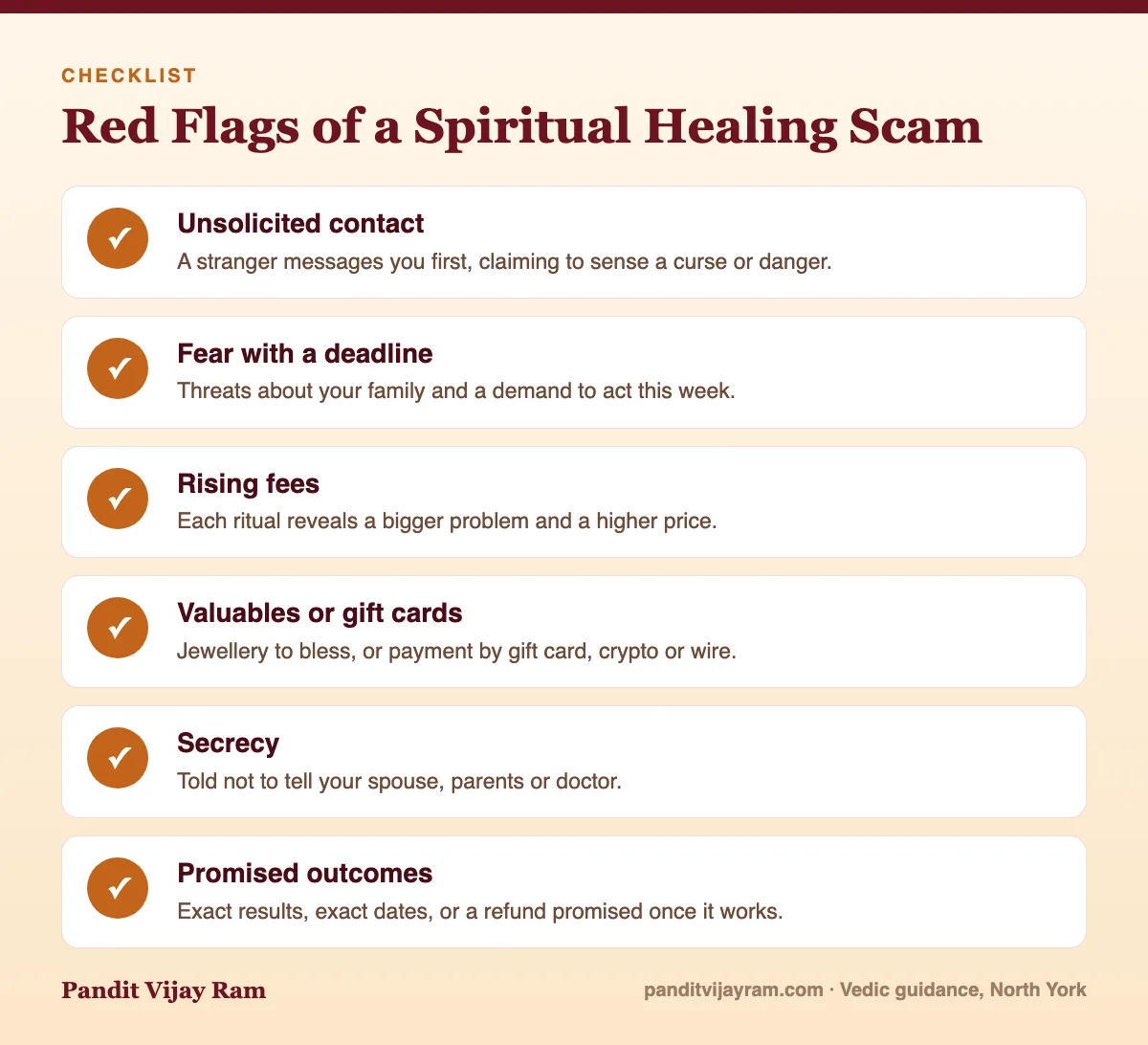
Here are the nine red flags, in the order victims usually meet them:
- They contacted you first. An unsolicited message on Instagram, WhatsApp or Facebook saying they "sensed" a curse on you.
- A threat with a deadline. "Your husband will leave within the month" or "someone in your family will fall ill unless we act now."
- A diagnosis before any conversation. They name black magic from a photo or your date of birth before asking a single question about your life.
- Fees that keep growing. Each ritual uncovers a deeper problem with a higher price.
- Requests for gold, cash or jewellery to "cleanse". The valuables are wrapped in a cloth for blessing and quietly swapped.
- Untraceable payment. Gift cards, cryptocurrency, wire transfers to another country, or cash only.
- Demands for secrecy. "If you tell your family, the ritual will fail."
- Promises of certainty. Exact outcomes, exact dates, or an offer to return your money once the result arrives.
- Threats if you leave. Warnings that stopping will make the curse return worse, or demands for more to "close" the work.
Some practitioners are not deliberate criminals but still misuse fear. The test is the same: does this person make you calmer and clearer, or more frightened and dependent? Our guide to choosing a genuine cleansing practitioner covers the positive side of this question.

Why do spiritual scams work on intelligent people?
These scams target emotion, not intelligence. They arrive when people are grieving, isolated, unwell or worried about a child or marriage, and they use real cultural beliefs to sound credible. Fear narrows judgement, secrecy removes the family members who might object, and small first payments make larger ones feel like protecting an investment.
Fraud researchers describe a familiar pattern in confidence tricks: build trust, create a crisis, isolate the victim, then escalate. Spiritual frauds follow it closely.
- Trust: the fraudster speaks your language, knows your festivals and uses respectful terms like "beta" or "sister". They may wear religious dress or display images of deities.
- Crisis: they name a fear you already have. Many people already worry about nazar or a jealous relative, so the claim feels like confirmation.
- Isolation: the instruction to tell nobody cuts off the spouse or sibling who would have said "this is wrong".
- Escalation: each payment makes the next feel necessary. Stopping would mean admitting the earlier money was lost.
In the GTA, police have warned communities about so-called blessing scams, where elderly people are approached in shopping plazas, told a family member is cursed, and persuaded to bring jewellery and cash for a ritual. The bag they take home contains worthless items.
Nobody who falls for this is foolish. They were frightened, and someone used that fear deliberately. If it has happened to you, the most helpful thing is to tell a trusted person and report it. If the experience has left you anxious or unable to sleep, please talk to your family doctor too. The overview on what black magic really is can help calm the fear the fraudster planted.
How do I report a spiritual healer scam in Canada?
If you are in danger or being threatened, call 9-1-1. Otherwise report the fraud to your local police non-emergency line and to the Canadian Anti-Fraud Centre online or by phone at 1-888-495-8501. Tell your bank immediately if you paid by card or transfer. Keep messages, receipts, phone numbers and photos as evidence.
Victims often delay reporting out of embarrassment or fear that the curse threats are real. Reporting is how police connect cases and stop the same person moving on to the next family. A practical checklist:
- Stop paying. Do not send any further money, however the person threatens.
- Save everything. Screenshots of chats, call logs, usernames, bank records, gift card numbers and any items they gave you.
- Call your bank or card company. Ask whether the payment can be stopped or disputed. Act quickly.
- Report to police. Use the non-emergency number unless you feel in danger; in Toronto this is the Toronto Police Service line, and in York or Peel regions their own services.
- Report to the Canadian Anti-Fraud Centre. The centre gathers fraud reports nationally and shares information with law enforcement.
- Tell family or a friend. The secrecy was part of the fraud; ending it weakens the fraudster's hold.
- Block and report the account on the social platform where contact started.
If the fraudster has personal details such as your address, photos or immigration information and is threatening to use them, tell police specifically. Those threats can be offences in their own right.
What does an honest negative energy practitioner do instead?
An honest practitioner starts by listening, asks about health, sleep, money and relationships, and often finds ordinary causes. They explain fees before any work, never escalate through fear, welcome your family's involvement and your doctor's advice, give you practices to do yourself, and are comfortable if you seek a second opinion.
It helps to know what good practice looks like, so the contrast is clear. Here is what I believe any genuine practitioner should do, and what I hold myself to:
- Listen before naming anything. The first session is mostly questions. The negative energy assessment guide describes what those questions are.
- Rule out ordinary causes. Medical, financial, family and housing explanations are discussed openly, and referrals are made.
- Speak about fees plainly and in advance. No surprise costs added after a ritual.
- Accept any payment method that leaves a record. No gift cards, no crypto, no demands for jewellery.
- Avoid fear language. No deadlines, no threats about family members, no warnings that leaving will bring harm.
- Teach self-practice. A mantra, a lamp, a protective thread, so you are not dependent.
- Respect your other beliefs and advisers. Your doctor, your imam or priest, your family.
- Make no promises of certain outcomes. Prayer and remedies support you; they do not command results.
If a practitioner falls short on several of these, walk away. You lose nothing by pausing. You can read more about my approach on the negative energy removal service page and the about Pandit Vijay Ram page.
Can I recover money lost to a spiritual healing scam?
Sometimes, but not always. Card payments and some bank transfers can be disputed if reported quickly. Cash, gift cards, wire transfers and cryptocurrency are much harder to recover. Report to your bank, police and the Canadian Anti-Fraud Centre straight away, and be cautious of anyone who then offers to recover the money for a fee.
One of the cruellest follow-ups to a scam is the recovery scam. After a family has lost money, a second person contacts them claiming to be a lawyer, an investigator, or another healer who can "break the fraudster's spell" and return the money. They ask for an upfront fee. This is fraud too.
Reasonable expectations:
- Credit card: card issuers often allow disputes for fraud within a set window. Call as soon as possible.
- Debit or e-Transfer: contact your bank immediately; recovery depends on how fast the money moved.
- Gift cards: call the card issuer with the card numbers; occasionally unspent balances can be frozen.
- Cash or jewellery: recovery generally depends on police locating the person.
- Cryptocurrency: very difficult to trace; report anyway.
Beyond money, the fear the scam planted often lingers. People keep wondering whether the curse was real. If that worry is with you, a calm, honest conversation can help separate fact from manipulation. Gentle self-practice from the mantras guide is a good place to rebuild confidence in prayer on your own terms. More protective guides are gathered on the cleansing and protection hub.
The bottom line
Negative energy removal scams rely on fear, urgency and secrecy, and recognising those three tactics protects you better than any amulet. Watch for the nine red flags, from unsolicited contact to requests for jewellery or gift cards. Report fraud to police and the Canadian Anti-Fraud Centre quickly, and choose practitioners who make you calmer, involve your family and speak plainly about fees.
Key takeaways
- Fear, urgency and secrecy are the core tactics of spiritual fraud.
- Never hand over jewellery or cash to be blessed.
- Gift cards, crypto and wires are fraudsters' favourite payments.
- Report to police and the Canadian Anti-Fraud Centre quickly.
- Beware recovery scams offering to return lost money for a fee.