
Interpretation Services in GTA Hospitals and Courts

A grandmother nods at the doctor without understanding the diagnosis. A teenage son translates his father's bail hearing while trying not to cry. These scenes happen across the GTA every day, and they put both the patient and the family in a painful position. Families in North York, Brampton and Scarborough often tell me they did not know professional interpreter services Toronto hospitals and Ontario courts offer existed, or felt embarrassed to ask. In more than forty years of guiding families, I have seen how much fear lifts when a person finally hears hard news in their own language. This guide explains how to request an interpreter in a GTA hospital, when Ontario provides court interpreters and how to ask for one, the free interpretation route for survivors of violence, and why relatives, especially children, should not interpret in serious matters. It offers practical steps only; for legal questions about your case, speak with a lawyer or legal clinic.
How do you ask for an interpreter in a GTA hospital?
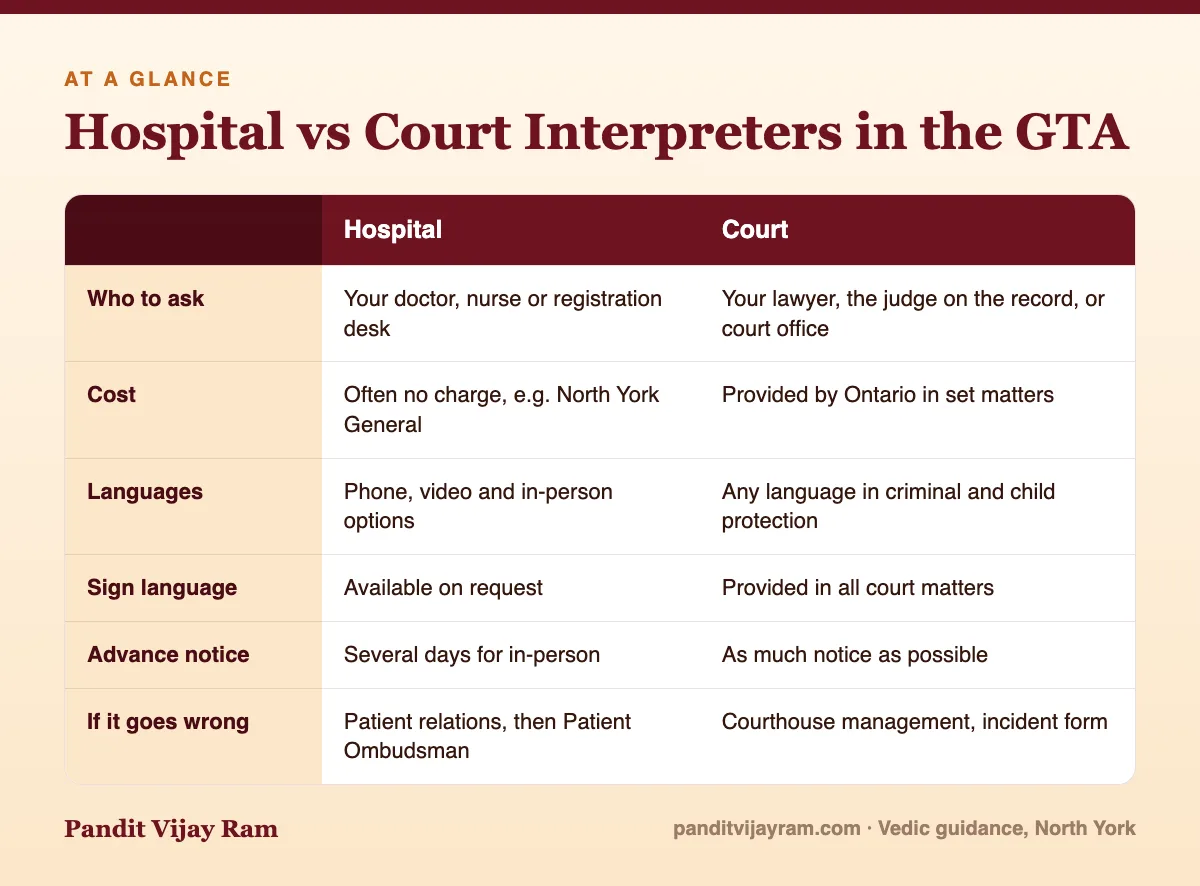
Tell your doctor, nurse or the registration desk that you need an interpreter and name the language. Hospitals such as North York General say qualified medical interpreters are provided at no charge, by phone, video or in person. For planned appointments, ask ahead, since in-person interpreters may need several business days' notice.
Most large GTA hospitals now offer professional interpretation, though each organises it differently. Two verified examples:
- North York General Hospital says it provides qualified medical interpreters at no charge. Patients are asked to tell their health care provider if they need interpretation, and the provider arranges it. Options include telephone, virtual and in-person interpreting, with sign language available. In-person requests usually need a few business days' notice.
- Sunnybrook Health Sciences Centre describes staff using phones and tablets to reach audio and video interpreters in many languages, including American Sign Language, and scheduling in-person interpreters when needed. It also records each patient's preferred language in their chart.
Steps that help:
- Say clearly at registration: I need a Punjabi interpreter (or Tamil, Urdu, Gujarati, Hindi, Bengali).
- Ask that your preferred language be noted in your record.
- When booking a test or surgery consultation, request an interpreter at the same time.
- If no one is arranged, ask the nurse again before the doctor begins.
A family member can still sit beside you for comfort. The interpreter carries the words; your relative carries your hand. For elders, our guide to South Asian seniors services in the GTA lists helplines that also offer interpretation.

Why shouldn't family members interpret in serious medical or legal matters?
Relatives are not trained in medical or legal terms, may soften bad news, and carry their own emotions and interests. Sunnybrook notes that relying on family burdens them and risks important medical information being misrepresented. Children especially should never deliver a diagnosis, consent discussion or court testimony.
In our communities it feels natural for the English-speaking child to help. For a pharmacy question, that may be fine. For a cancer diagnosis, surgery consent, mental health assessment or court appearance, it is not.
Why professional interpreters matter:
- Accuracy. Words like benign, malignant, surety or plea have precise meanings. A wrong word can change a decision.
- Neutrality. A spouse may not translate questions about abuse. A son may hide how ill his mother is to protect her. A sibling in a property dispute may have a stake.
- Confidentiality. Patients may not reveal symptoms, pregnancies or fears in front of relatives.
- The child's wellbeing. A child who must tell a parent about a terminal illness, or interpret police questions, carries that weight for years.
Sunnybrook's own article on interpretation notes that patients who cannot communicate in their preferred language often have worse outcomes, and that leaning on relatives places an unnecessary burden on them.
I have sat with families where a daughter interpreted her father's diagnosis and changed it to spare him. When he later learned the truth, the trust between them broke. In our tradition, satya, truthfulness, is a form of care. A trained interpreter helps families keep it. Our guide on caring for elderly parents discusses this kind of honest support.
When does Ontario provide a court interpreter?
Ontario's Ministry of the Attorney General provides interpreters in any language for criminal and child protection matters, sign language in all court matters, and any language when the court orders it. In civil, family and small claims cases, other languages are provided if the litigant qualifies for a fee waiver; French is provided in all of them.
Ontario's Get a court interpreter page states that you have the right to a court interpreter if you need one, and sets out when the province provides them:
- Criminal and child protection matters: any language required.
- Civil, family and Small Claims Court: any language if the litigant qualifies for a fee waiver; French is provided in all such matters.
- Sign language: in all court matters.
- Any language when the court orders it.
The page notes that accused persons, sureties and counsel may all need interpretation.
Family court matters such as separation, custody and support are common for families I speak with. If you cannot afford fees, ask the court office about a fee waiver, because it also affects interpreter access. Free legal help is described in our guide to legal clinics and legal aid in the GTA for family matters.
None of this is legal advice. Your lawyer, a duty counsel lawyer at the courthouse, or a community legal clinic can tell you how the rules apply to your case.
How do you request a court interpreter in the GTA?
If you are accused, your lawyer may request an interpreter at the first appearance; if not, tell the judge or your lawyer on the record at your first court date. Counsel should phone the court office early and speak with the interpreter coordinator. Have the language, appearance type, date, time and courthouse ready.
Ontario's court interpreter page gives a clear process. Follow it in this order:
- Accused person: ask your lawyer to request an interpreter at your first appearance. If that does not happen and you need one, say so to the judge or your lawyer on the record at your first court date.
- Surety: ask counsel to request interpretation, or call the court office if you are attending to end your surety obligation.
- Lawyers and paralegals: give court staff as much notice as possible. Phone the court office, ask for the interpreter coordinator or designated staff, and make sure the request is recorded.
- Prepare the details: the language and any dialect, who is requesting, the type of appearance, the date and time, and the court location.
If the interpretation was poor, Ontario says you can contact management at the courthouse and ask for an Interpreter Incident Report Form.
Court appearances frighten many families. Prayer can steady the heart before a hearing, and our article on facing a false accusation offers spiritual steadiness alongside practical steps. If a case is weighing on you, our court case guidance focuses on calm and protection, never on promising a verdict. The legal work belongs with your lawyer.
Where can survivors of violence get a free interpreter?
Ontario funds free multilingual interpreter services for newcomer and refugee survivors of domestic violence, sexual violence and human trafficking, available around the clock in over 70 languages, including sign language. Support is arranged through community agency staff, such as shelters and counselling agencies, rather than requested directly by the survivor.
Ontario's page on interpreters for domestic violence, sexual violence and human trafficking victims explains that agency staff working with a newcomer or refugee client can request free interpretation. It lists regional agencies, including the Barbra Schlifer Commemorative Clinic for the Toronto area and Multilingual Community Interpreter Services for the Greater Toronto Area and Central Region. Sign language interpreting is arranged through the Canadian Hearing Society.
What this means in practice:
- Contact a shelter, crisis line or counselling agency first. Tell them your language. They can request an interpreter for meetings, safety planning and appointments.
- You do not need a relative to translate sensitive details about abuse.
- In immediate danger, call 911. Our list of emergency and non-emergency numbers every GTA family should know covers police lines by region.
Our domestic violence help guide for the GTA lists shelters and helplines. A survivor speaking through an abusive partner or in-law is not truly free to speak. A neutral interpreter protects that freedom.
Other everyday interpretation routes exist too. 211 Ontario answers in more than 150 languages, and Toronto Public Library notes that interpreters in many languages are available at its branches. Newcomers can learn more in our guide to settlement services in the GTA.
The bottom line
Interpreter services in Toronto hospitals and GTA courts exist so that patients and families hear the truth in a language they understand. Ask your care team for a medical interpreter and note your preferred language in your record. In court, Ontario provides interpreters in criminal, child protection and sign-language matters, and in other cases where fee waivers or court orders apply. Keep relatives, especially children, as comforters rather than translators in serious matters.
Key takeaways
- Tell your care team you need an interpreter; North York General provides them at no charge.
- Ontario provides court interpreters in any language for criminal and child protection matters.
- Sign language interpreters are provided in all Ontario court matters.
- Survivors of violence can get free interpreters through community agencies in over 70 languages.
- Family members, especially children, should not interpret diagnoses, consent or testimony.