
Hindu Temples and Community Centres in Mississauga: A Respectful Visitor's Guide
Looking for Hindu temples in Mississauga can feel oddly hard when you are new to the city, a student far from family, or simply returning to faith after years away. Map searches mix active mandirs with closed listings, and nobody tells you what to wear or where to sit. I am Pandit Vijay Ram, a Vedic astrologer based in North York, and families from Peel often ask me which temple suits them. This guide names three Mississauga temples whose own websites I checked, explains what each offers, and walks through first-visit etiquette in plain terms. It also covers the City's community centres, which host many cultural and faith-adjacent gatherings, and shows how a temple visit can feed a calm daily practice at home. In more than forty years of practice I have seen that a regular temple connection steadies people more than any single ritual. I am not connected to any temple named here; I simply want you to arrive informed, respectful and at ease.
Which Hindu temples are active in Mississauga?
Three well-established Mississauga temples publish their own programmes online: the Hindu Heritage Centre on Mississauga Road, Mississauga's Ram Mandir, and the Shri Vitthal Hindu Mandir on Timberlea Boulevard. Other smaller mandirs exist too. Because programmes change, check each temple's own website or call before your first visit.
The Hindu Heritage Centre sits on Mississauga Road near Streetsville. It combines a prayer hall with classrooms and a banquet hall, and its website lists daily aarti, a daily havan, regular classes, an Ayurveda course and a seniors club. Families book it for samskaras and festival gatherings, and visitors of every background are welcome.
Mississauga's Ram Mandir is a registered charity serving devotees across the city. Its site describes daily puja and aarti, cultural classes, programmes for seniors and youth, a banquet hall, a small pooja store and practical information on the disposition of ashes. If you are arranging last rites, read our guide to scattering ashes and asthi visarjan in Ontario alongside the temple's own advice.
The Shri Vitthal Hindu Mandir on Timberlea Boulevard is dedicated to Vitthal and Rukmini. It is a non-profit run largely by volunteers, with cultural events and community programmes listed on its site.
Public lists name several further mandirs in Mississauga. I have left out any I could not confirm on an official page. For a wider map, see our region-by-region guide to Hindu temples across the GTA, and if you live closer to the north end of Peel, the Brampton temples guide covers your neighbours.
What should I wear and do on my first visit to a mandir?
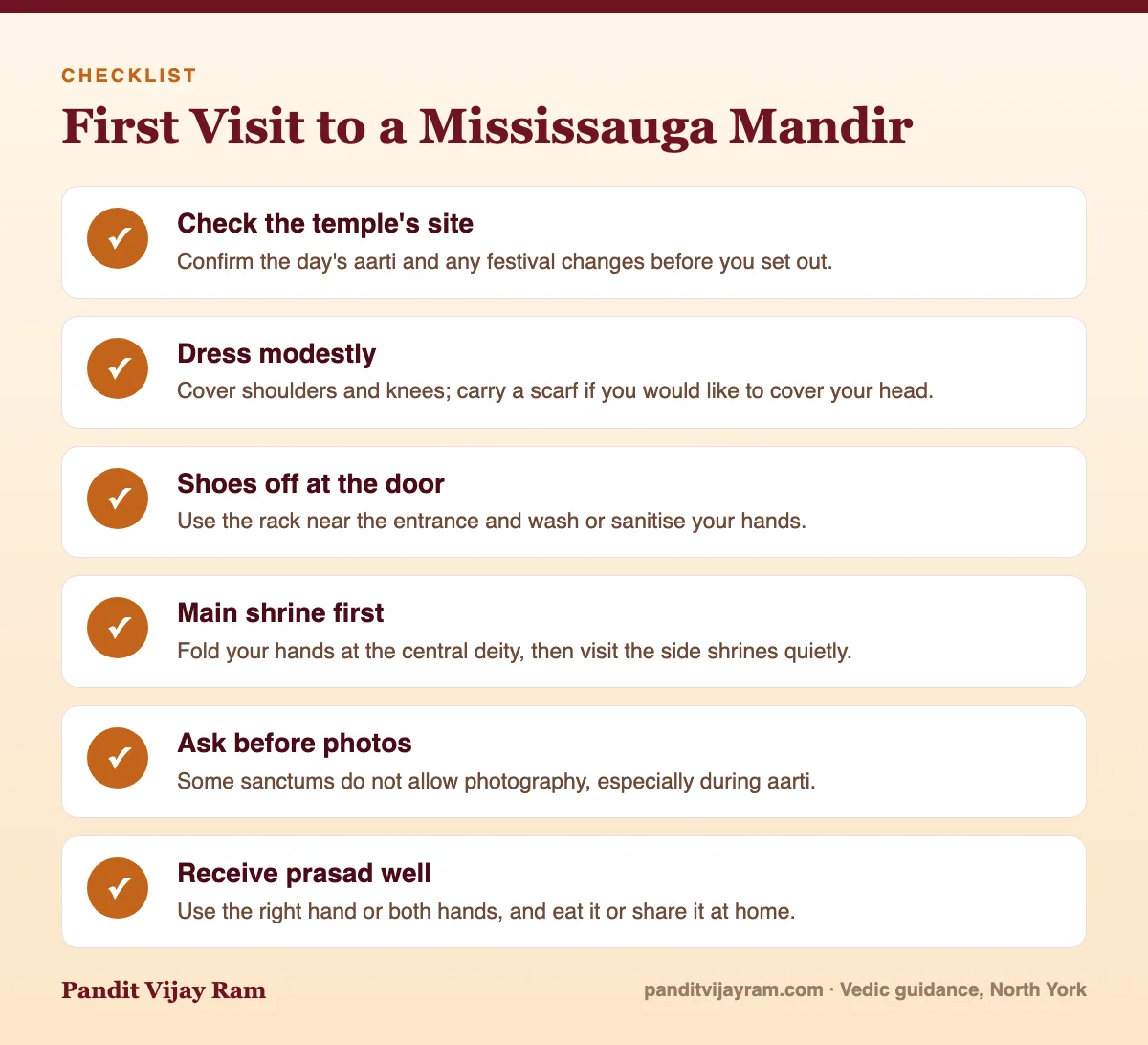
Wear modest, comfortable clothing that covers shoulders and knees, and remove your shoes at the rack near the entrance. Wash or sanitise your hands, keep your phone on silent, and sit where others sit. Ask a volunteer before taking photographs, and accept prasad with your right hand or both hands.
Temple etiquette is simpler than many newcomers fear. Volunteers at Mississauga temples are used to first-time visitors, including friends from other faiths. A few habits show respect everywhere:
- Shoes off. Leave footwear on the rack or shelf at the entrance. Socks are usually fine.
- Modest clothes. Loose trousers, a long skirt, a kurta or a sari all work. Some temples offer a scarf if you wish to cover your head.
- Quiet entry. Bow or fold your hands at the main shrine first, then visit the side shrines.
- Sitting. Sit cross-legged or on a chair at the side. Try not to point your feet toward the deities.
- Offerings. Flowers, fruit or a small donation are welcome but never compulsory.
- Prasad. Receive it with the right hand or both hands, and eat it rather than discarding it.
- Photos. Ask first. Some sanctums do not allow photography during aarti.
If you are menstruating, recently bereaved, or unsure about a custom from your family's region, simply ask the priest or a volunteer. Practices differ between communities, and a quiet question is always better than worry. People who want a calm, protective routine before a visit sometimes read our guide on a simple cleansing before an important day.
How do Mississauga community centres fit into Hindu community life?
The City of Mississauga runs community centres such as Malton, Meadowvale, Mississauga Valley, Churchill Meadows and Erin Meadows. They are public, non-religious facilities, but cultural groups often book their rooms for language classes, bhajan evenings, yoga and festival socials. Rental and programme details are on the City's locations page.
A temple is a sacred space with its own rules and governing committee. A municipal community centre is something different: a public building open to everyone, run by the City. Both matter to Hindu families in Mississauga, for different reasons.
The City's locations page lists community centres across Mississauga, among them Malton, Meadowvale, Mississauga Valley, Churchill Meadows, Erin Meadows, Burnhamthorpe, River Grove and Clarkson. These buildings host city recreation programmes and can be rented through the City's locations and rentals service. Community associations, seniors' groups and cultural societies use such rooms for gatherings that a temple hall may not suit, such as a mixed-faith Diwali potluck or a dance rehearsal.
Two practical points help. First, public facilities have their own rules on open flame, food and decorations, so a havan or a lamp ceremony may not be allowed indoors. Ask the booking office before you plan one. Second, a community centre does not replace a temple for samskaras such as a naming ceremony or a wedding. For those, speak with a temple priest or read our questions to ask when choosing a pandit in the GTA.
For the season of lights and colours, our guide to Diwali, Navratri and Holi in Mississauga explains the City's fireworks and open-air fire rules in detail.
How can a temple visit support daily practice at home?
A temple visit works best as an anchor rather than a one-off. Learn one aarti or mantra there, bring home a small portion of prasad or a flower from the shrine, and repeat the same short prayer each morning. Small, steady routines at home carry the temple's calm into ordinary days.
Many people tell me they feel peaceful in the mandir and scattered again by Monday. That is normal. The temple shows you what calm feels like; home is where you practise it. A few ideas bridge the two:
- Learn one prayer properly. Ask a temple volunteer for the words and rhythm of the aarti you liked. Sing it at home on the same day each week.
- Keep a modest home shrine. A clean shelf facing east or north, one lamp, one image and fresh water are enough. Our guide to cleansing a puja room or home mandir gives a weekly routine.
- Respect old items. Faded pictures, broken murtis and dried flowers need respectful disposal, not the garbage. See our notes on disposing of puja items in the GTA.
- Join a class. Language, music and scripture classes at Mississauga temples connect children to the tradition far better than lectures at home.
When a family wants a larger ritual at home, such as a griha pravesh or a Ganesh puja, I explain the steps and the meaning so they can take part fully. You can read about the ceremonies I offer on the puja, havan and anushthan page.
When does a temple visit need extra help or support?
If you are grieving, frightened by a family conflict or worried about negative energy, a temple can offer prayer and belonging, but it is not a counselling service. Pair spiritual support with your family doctor, a counsellor or community agencies. Personal astrological guidance is a separate, private conversation with a practitioner you trust.
Temples in Mississauga are run by committees and volunteers who already carry a heavy load. They welcome people in distress, yet they cannot assess anxiety, depression or a household in crisis. Please be honest with yourself about what kind of help you need.
A simple rule of thumb works well:
- For belonging and devotion, the temple is ideal. Go regularly, volunteer, sit in the hall.
- For health, sleep or mood problems, see your family doctor first. In a crisis, call or text 9-8-8.
- For family, settlement or legal stress, local agencies help. Our guide to family and newcomer support in Mississauga lists them.
- For a private reading of your chart or a remedy plan, consult a practitioner who explains everything openly.
I work only within the Vedic tradition and I respect every temple, gurdwara, mosque and church my clients attend. If you would like a personal kundli reading or a conversation about protection prayers, my astrologer page for Mississauga residents explains how consultations work. Be wary of anyone near a place of worship who approaches you with fear-based warnings and a price list; that is a sales pitch, not seva.
The bottom line
Hindu temples in Mississauga, including the Hindu Heritage Centre, the Ram Mandir and the Shri Vitthal Hindu Mandir, each offer worship, classes and community life of their own. Simple etiquette, from removing shoes to asking before photographs, makes a first visit easy. City community centres complement temples as neutral spaces for cultural gatherings, and a short daily prayer at home carries the temple's calm into ordinary life.
Key takeaways
- The Hindu Heritage Centre, Mississauga's Ram Mandir and the Shri Vitthal Hindu Mandir all publish programmes on their own websites.
- Remove shoes, dress modestly and ask a volunteer before taking photographs.
- City community centres are public buildings with their own rules on flame and food.
- One prayer learned at the temple and repeated at home builds steadier practice than occasional big rituals.
- Temples offer devotion and belonging; health and family crises also need doctors and local agencies.