
Diwali, Navratri and Holi in Mississauga: Local Celebrations and Practical Rules

Diwali in Mississauga brings lamps to balconies from City Centre towers to Meadowvale cul-de-sacs, and with them a small flood of questions. Can we light sparklers in the backyard? Is a Holika fire allowed? Where do the big public celebrations happen? I am Pandit Vijay Ram, a Vedic astrologer based in North York, and every autumn families from Peel ask me these things alongside their puja questions. This guide sets out what the City of Mississauga's own pages say about fireworks and open-air fires, describes the kind of public celebrations the city hosts without pinning dates that change each year, and offers a safe, meaningful plan for Diwali, Navratri and Holi at home. In more than forty years of practice I have learned that the calmest festivals are the well-prepared ones: rules checked, neighbours considered, and the puja kept at the centre. Please confirm any date-specific detail with the City before you buy fireworks or plan an outdoor fire.
Can you set off fireworks for Diwali in Mississauga?
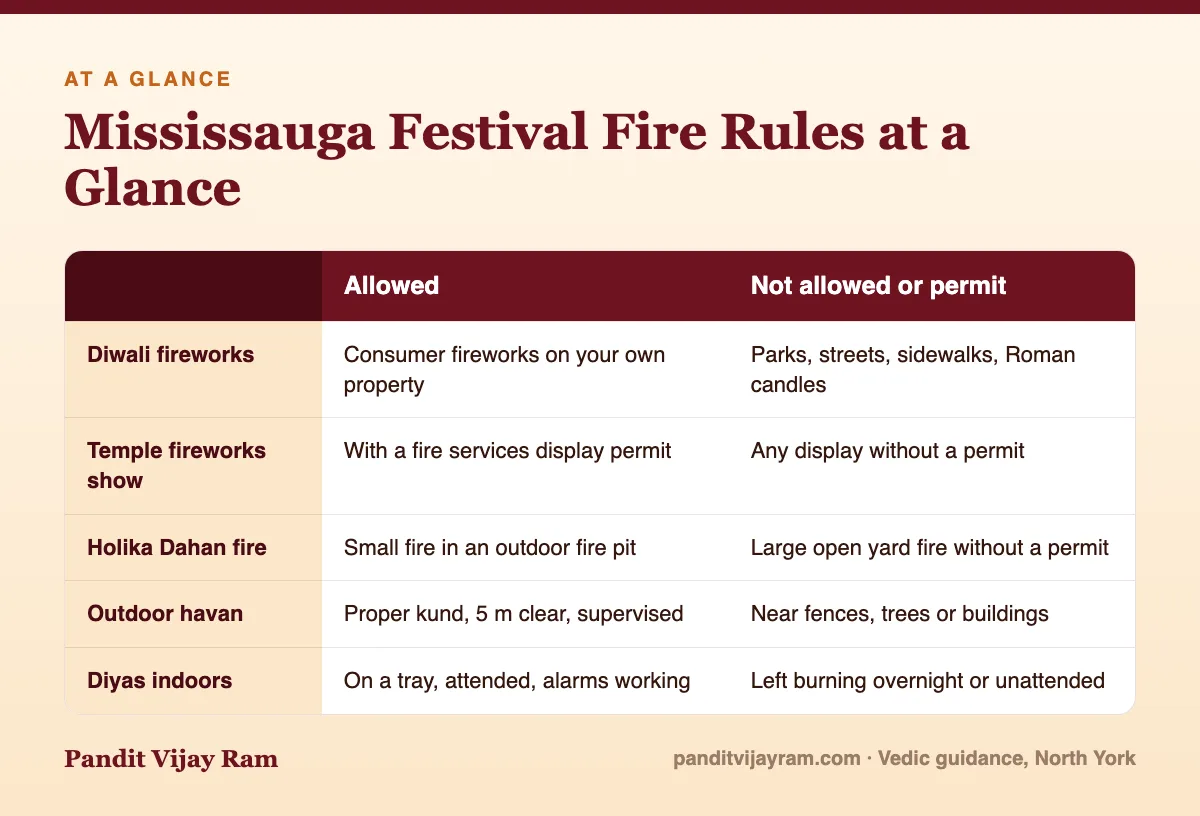
Yes, within limits. Mississauga's fireworks by-law names Diwali as one of its holidays, so residents may use low-hazard consumer fireworks on their own private property without a permit during a set evening window. The City confirms the Diwali day each year, and fireworks are never permitted in parks or on streets.
The City's fireworks page sets out the rules for families. Read it before you shop, because the details are specific.
- Which days. Consumer fireworks are allowed without a permit on a short list of holidays: Lunar New Year, Victoria Day, Canada Day, Diwali and New Year's Eve. The City confirms the Diwali date for each year.
- Where. Only on private property you own or occupy, or on someone else's property with the owner's written permission. Never in a park, on a street, sidewalk or boulevard, or on other public property.
- What. Only low-hazard consumer fireworks. Roman candles are prohibited.
- Buying. Purchase from a licensed retailer, by an adult, in the days leading up to a holiday but not on the day itself.
- Bigger shows. A display for a temple or community group needs a permit from Mississauga Fire and Emergency Services, with a certified operator and insurance.
Complaints about fireworks on private property or residential streets go to 311. Unsafe use on major roads goes to Peel Regional Police, and problems in City parks or school grounds go to the City's Facility Watch Program.
Condo residents should also read their building's rules, since balconies and common areas are usually off-limits. Our guide on fire-safe Diwali diyas in condos covers that setting, and the GTA-wide fireworks comparison helps if relatives live in other cities.
Where are public Diwali and South Asian festivals held in Mississauga?
Mississauga Celebration Square, the City's main outdoor event space beside the Civic Centre downtown, hosts hundreds of free festivals each year; check its listings for Diwali and other South Asian events. Temples and cultural associations also hold their own Diwali, Navratri and Holi programmes. Check each organiser's listings, because dates change annually.
Public celebrations in Mississauga tend to come in three forms.
- Celebration Square. The City describes the square on City Centre Drive as its premier venue for outdoor events, with hundreds of free festivals a year. Community organisers book it for cultural festivals, so look at the square's event listings each autumn to see whether a Diwali programme is confirmed for the season.
- Temples. Mississauga's mandirs mark Diwali with Lakshmi puja, Navratri with nightly aarti and garba, and Holi with bhajans and, in good weather, outdoor colour play. Our guide to Hindu temples in Mississauga names the temples whose websites I checked.
- Halls and community centres. Cultural associations often rent banquet halls or City community centres for garba nights and Diwali socials. Ticketing, dress codes and food rules belong to each organiser.
For Navratri, the dance is only part of the observance. Fasting, the daily worship of the Goddess and kanya pujan on the eighth or ninth day carry the meaning. Our Navratri plan for GTA families explains fasting sensibly, and the guide to kanya pujan walks through that ritual step by step.
If you go to a large outdoor event, plan transport early, keep children close in crowds and dress for the evening chill.
Is a Holika Dahan fire or outdoor havan allowed in Mississauga?
It depends on the setup. The City says outdoor fire pits, chimineas and cooking fires need no permit, but other open fires in a yard do. Any fire must stay at least five metres from buildings, property lines and trees, be supervised until fully out, and have a hose or extinguisher ready.
Holika Dahan, the bonfire on the eve of Holi, is the festival moment most likely to clash with city rules. A large stacked bonfire in a suburban backyard is not the same as a small fire in a proper fire pit, and Mississauga treats them differently.
According to the City's open-air burning page:
- Outdoor fire pits, chimineas, outdoor fireplaces and cooking fires do not need a permit.
- Other fires in an open yard or field do need a permit from Mississauga Fire and Emergency Services.
- Every fire must be at least five metres from buildings, property lines, trees and other combustibles.
- Fires must not create excessive smoke or smell for neighbours, must never be left unattended, and need a hose or extinguisher nearby.
For most households the honest answer is a small, symbolic fire. A few sticks of clean wood, a coconut and some grain in a manufactured fire pit, lit with prayer, carries the same meaning as a towering pile. Many families now attend a temple's community Holika instead. Our article on Holika Dahan and bonfire alternatives in the GTA explains the ritual and its safer forms.
The same rules apply to an outdoor havan kund. Indoors, a havan is a matter for the homeowner, the landlord or the condo board, and good ventilation matters.
How do I keep Diwali lamps and puja safe at home?
Place diyas on a metal tray away from curtains, keep them out of reach of children and pets, and never leave a burning lamp or candle unattended. Make sure smoke alarms work on every level and outside sleeping areas. In a high-rise, remember your unit alarm is not linked to the building system.
The City's home fire safety page reminds residents that the Ontario Fire Code requires a working smoke alarm on every level of a home and outside all sleeping areas. Landlords must keep rentals compliant, and tenants must not remove batteries. Mississauga's guidance adds two points that matter at Diwali: never leave candles burning when you leave a room or go to sleep, and in an apartment, your own smoke alarm does not trigger the building's fire alarm.
A practical Diwali setup looks like this:
- Choose one main lamp for the puja and a few diyas, rather than dozens of open flames.
- Use a metal or ceramic tray with a little water or sand beneath clay lamps.
- Keep lamps off windowsills with blinds or curtains.
- Use LED diyas on balconies and in children's rooms.
- Before bed, put out every flame and keep only the main lamp in a safe spot, or switch to an electric lamp overnight.
The puja itself needs no fireworks at all. Clean the home, light the lamp, offer sweets and flowers, and recite the Lakshmi and Ganesh prayers together. Our guide to Lakshmi-Ganesh puja at home gives the full sequence. Families who want a Durga or Navratri havan performed with proper vidhi can read about the Durga puja and havan I conduct.
How can Mississauga families keep festivals meaningful and neighbourly?
Keep the puja at the centre and the noise in proportion. Tell neighbours before a fireworks evening, clean up debris the same night, and invite them to share sweets. Choose a festival muhurat from a Toronto panchang, and let children help with rangoli, lamps and prayers so the meaning passes on.
Mississauga is a city of many faiths living close together, in towers and in townhouse rows. A festival that brings your family joy can keep a shift worker awake or frighten a neighbour's dog. A little courtesy keeps goodwill intact.
- Give notice. A short note or message to neighbours on fireworks night is appreciated.
- Clean up. Soak spent fireworks in a bucket of water before disposal and sweep the driveway before morning.
- Share. A plate of mithai to the house next door has built more friendships than any speech about tolerance.
- Mind the timing. Use the panchang for the puja muhurat, and the City's rules for fireworks. They are separate questions.
Children remember festivals through their hands: drawing rangoli, filling diyas, ringing the bell. Give them real jobs. Older relatives can tell the story behind each festival, from Rama's return to Durga's victory and Prahlad's faith.
Some families also ask me which days in the season suit a new start, a house blessing or a remedy for a difficult period in the chart. Those are personal questions, answered from a birth chart rather than a general calendar. My page for Mississauga clients explains how a consultation works.
The bottom line
Diwali in Mississauga is a named fireworks holiday, but only on your own property, only with consumer fireworks and only within the City's published window. Outdoor fires for Holika or a havan follow the open-air burning rules, so a small fire pit is the safe choice. Celebration Square and local temples carry the public celebrations, while lamps, prayer and neighbourly courtesy keep the home festival meaningful.
Key takeaways
- Mississauga lists Diwali as a holiday for consumer fireworks on private property, never in parks or streets.
- The City confirms the Diwali fireworks day each year, so check before buying.
- Fire pits and cooking fires need no permit; larger open fires in a yard do.
- Celebration Square hosts free festivals, and temples run their own Navratri and Holi programmes.
- One well-placed lamp and a heartfelt puja matter more than the size of the display.