
Hindu Temples and Community Centres in Brampton: A Respectful Visitor's Guide
Looking for Hindu temples in Brampton often starts with a practical need: a place for a child's naming ceremony, a Navratri evening, a havan after a death, or simply somewhere to sit quietly after a hard week. Brampton is one of Canada's most diverse cities, and its religious life reflects that. Families who come to see me in North York from Brampton often tell me they drive past several mandirs and gurdwaras on the way and are not sure which one suits them, or how to behave on a first visit. This guide introduces verified Hindu temples serving Brampton, explains respectfully how Sikh gurdwaras differ from Hindu mandirs, offers simple etiquette for newcomers and young people who have not visited before, and points to community centres and libraries where Brampton families meet outside worship. In more than forty years of practice, I have found that a family's home prayer grows stronger when it is connected to a living temple community, even one they visit only a few times a year. Please confirm visiting details with each temple directly, because schedules and services change.
Which Hindu temples serve Brampton families?
Several mandirs serve Brampton. Hindu Sabha Mandir on The Gore Road in the city's north-east is one of the best known. Bhavani Shankar Mandir on Nexus Avenue offers puja bookings and cultural programmes. Shri Gauri Shankar Mandir is another Brampton temple run by volunteers and priests. Each has its own deities, traditions and calendar.
Brampton's Hindu community is large and varied, with families tracing roots to Punjab, Gujarat, Uttar Pradesh, Tamil Nadu, Nepal, Guyana and Trinidad, among many places. Temples reflect that variety in their deities, languages of worship and festival customs.
- Hindu Sabha Mandir sits on The Gore Road in north-east Brampton. It is a large, long-established temple and a gathering point for many families in the area.
- Bhavani Shankar Mandir is on Nexus Avenue. Its own website describes a temple rooted in Satya Sanatan Dharma with a particular focus on youth, offering puja bookings, cultural programmes, facility bookings and a small samagri store.
- Shri Gauri Shankar Mandir is a Brampton temple managed by volunteers and experienced priests; its name honours Shiva and Parvati together.
Other mandirs operate in Brampton and just across the borders in Mississauga, Vaughan and Caledon. For a wider map, see our guide to Hindu temples across the GTA.
When choosing, think about what you need: a temple with a priest available for samskaras, one with classes for children, or simply one close enough to visit regularly. A temple's website or front office will tell you which pujas they perform and how to book a priest.
How is a gurdwara different from a mandir in Brampton?
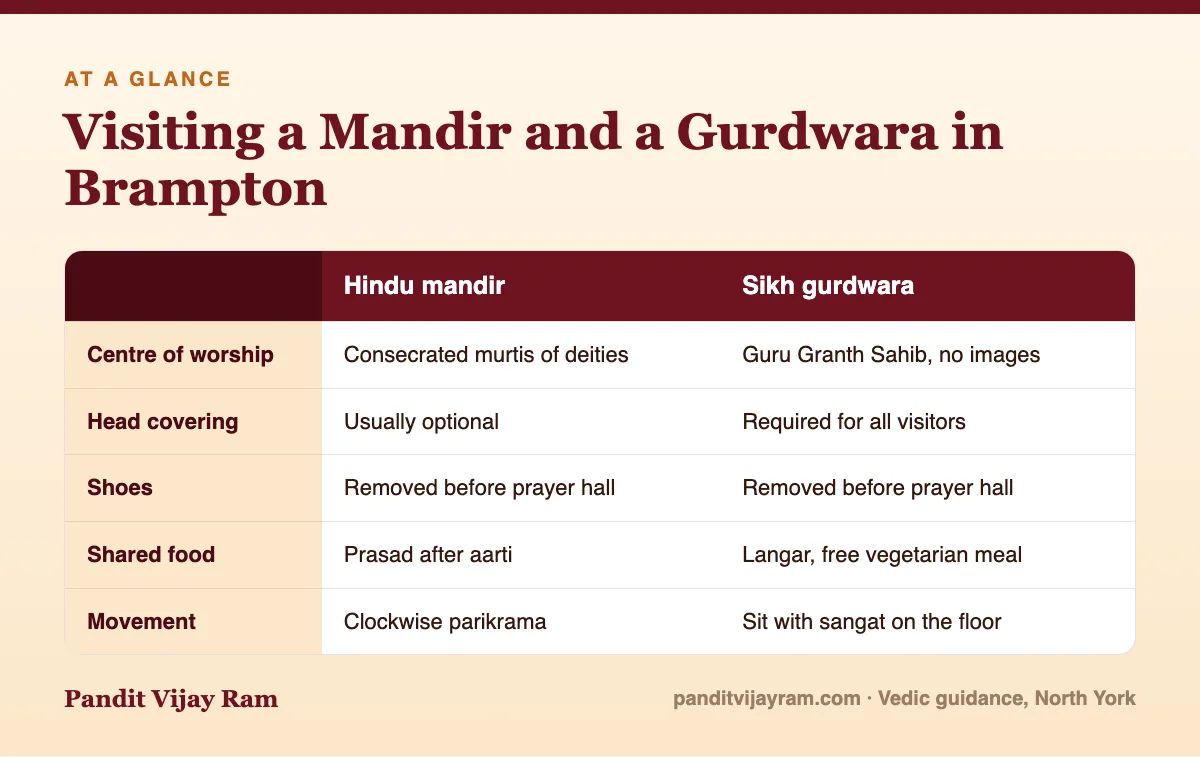
A gurdwara is a Sikh place of worship, and Sikhism is a distinct religion with its own Gurus and scripture. The Guru Granth Sahib sits at the centre of the prayer hall, and there are no murtis. Most gurdwaras welcome people of every faith and serve langar, a free vegetarian community meal.
Brampton has one of Canada's largest Sikh communities, and gurdwaras are a visible part of the city. Hindu and Sikh families in Punjab and here have long shared neighbourhoods, festivals and sometimes marriages, but the two religions are distinct, and respecting that distinction matters.
- Scripture at the centre. In a gurdwara the Guru Granth Sahib is placed on an raised throne in the prayer hall and treated as the living Guru. There are no images of deities.
- The Nishan Sahib. A tall flagpole bearing the Sikh flag identifies a gurdwara from a distance.
- Langar. The community kitchen serves free, always lacto-vegetarian meals to everyone regardless of religion, with people eating together.
- Open to all. People of every faith are welcomed into a gurdwara.
Brampton gurdwaras include Gurdwara Dasmesh Darbar in the north-east of the city, and many Brampton families also attend Ontario Khalsa Darbar on Dixie Road in neighbouring Mississauga. If you are Hindu and attend a Sikh wedding, an Akhand Path or a Vaisakhi celebration, follow the gurdwara's customs fully. Our guide to Vaisakhi and Lohri in the GTA explains those festivals with care.
Please do not describe a gurdwara as a Hindu temple or Sikhs as a Hindu sect. Getting this right is a simple act of respect toward neighbours.
What etiquette should first-time visitors follow in a Brampton mandir?
Dress modestly, remove shoes at the entrance, wash your hands, and enter quietly. Accept prasad with the right hand, walk clockwise around the shrine, avoid pointing your feet toward the deities and ask before taking photographs. If unsure, watch what regular devotees do or ask a volunteer politely.
Many young people raised in Brampton visit a mandir mainly at Diwali, and newcomers may be used to very different temple customs back home. A few simple habits make any first visit comfortable:
- Clothing. Shoulders and knees covered; avoid leather belts and bags in temples that ask for it.
- Shoes. Remove them at the shoe racks before the prayer hall. Socks are usually fine.
- Hands and mouth. Wash hands; avoid eating or chewing gum inside.
- Movement. Walk clockwise during parikrama, keep your right side toward the shrine and step around anyone seated in prayer.
- Offerings. Flowers, fruit or sweets are common. Hand them to the priest or place them where indicated, not directly on a murti.
- Prasad. Receive it with the right hand, or with both hands cupped.
- Phones and photos. Silence your phone. Many temples restrict photography inside the sanctum.
In a gurdwara the customs differ: visitors of all genders cover their heads, and scarves are usually provided at the entrance. Shoes come off there too, and tobacco and alcohol are never brought onto the premises.
Nothing here should make you anxious. Temples in Brampton welcome learners, and a sincere visitor who makes a small mistake is treated kindly.
Which Brampton community centres and libraries bring families together?
Outside worship, Brampton's recreation centres and Brampton Library branches host cultural programmes, classes and gatherings. Gore Meadows Community Centre is one well-used hub, and Brampton Library runs branches including Chinguacousy, Four Corners, Gore Meadows and Springdale, with programmes such as newcomer services and free legal advice sessions.
Not every gathering happens at a temple. Many Brampton families meet at the city's recreation centres for sports, dance classes and community events, and the City of Brampton uses some of them as hubs for larger celebrations. Gore Meadows Community Centre, for example, has served as a shuttle point for the City's own Diwali Mela.
Brampton Library is a quieter but valuable resource. Its branches include Chinguacousy, Claireville, Cyril Clark, Four Corners, Gore Meadows, Mount Pleasant Village, South Fletcher's, South West and Springdale. The library lists newcomer services, a world languages collection, storytimes, teen meetups and free one-on-one legal advice sessions. For a family that has just arrived, a library card can be the first piece of Canadian paperwork that feels welcoming.
These spaces are shared by every community in the city, which makes them good places for interfaith friendship. Children who meet Sikh, Muslim, Christian and Hindu classmates at a library programme grow up comfortable with difference.
For festival-season events and the rules around fireworks and park gatherings, see our guide to Diwali, Navratri and Holi in Brampton. Families who want personal guidance alongside temple life can read the Brampton astrologer page.
How does temple life connect with prayer at home?
The temple and the home altar support each other. A temple visit brings community, darshan and the guidance of priests, while daily prayer at home keeps devotion steady between visits. Many families bring prasad, flowers or holy water home, and ask the temple priest for help with larger pujas and samskaras.
In Vedic tradition the home is itself a small temple. A clean altar in the north-east, a lamp lit morning and evening and a few minutes of mantra each day keep the household connected to the divine between temple visits. The temple adds what a home cannot: the presence of a consecrated murti, the energy of shared worship and priests trained in ritual.
Ways Brampton families link the two:
- Bring home prasad and share it with family members who could not come.
- Ask the temple which day suits a havan for a new home or a child's first haircut.
- Return worn-out pictures and old puja items to a temple that accepts them, rather than discarding them.
- Learn an aarti or bhajan at the temple, then sing it at home with children.
Our guide to cleansing a puja room or home mandir explains how to keep the altar fresh. For devotees of Hanuman ji, Hanuman puja at home gives a simple weekly routine. If you are looking for a priest for a ceremony, our article on questions to ask a pandit in the GTA helps you choose well. Larger rituals are described on the puja and anushthan page, and couples planning a wedding can see the Brampton love marriage guidance page.
The bottom line
Hindu temples in Brampton, from Hindu Sabha Mandir to Bhavani Shankar Mandir and Shri Gauri Shankar Mandir, offer families darshan, priests and community. Gurdwaras are the places of worship of a distinct faith, Sikhism, and visitors should follow their customs with equal respect. Simple etiquette, community centres and libraries, and a steady home altar together keep devotion alive between festivals.
Key takeaways
- Hindu Sabha Mandir, Bhavani Shankar Mandir and Shri Gauri Shankar Mandir all serve Brampton.
- Gurdwaras are Sikh places of worship, distinct from mandirs, and welcome people of all faiths.
- Dress modestly, remove shoes and walk clockwise around the shrine in a mandir.
- Brampton Library and community centres offer shared spaces for families of every faith.
- Daily prayer at home and regular temple visits strengthen each other.