
Is It Safe to Live in a House Where Someone Died?

You may have found the perfect home and then learned that the previous owner passed away inside it. Or perhaps you are renting and a neighbour mentioned it in passing, and now the stairs creak differently at night. Feeling uneasy about a house where someone died is very human, and it says more about our care for the dead than about any danger. Families from North York, Etobicoke and Richmond Hill have asked me whether they should still move in, and the answer I give is almost always calm. In this guide you will learn what the practical checks are, why grief and imagination can make a house feel heavy, what Hindu tradition actually says about death at home, and a gentle sequence for blessing the space so it feels like yours. I have sat with families through many deaths and many new beginnings over forty years, and I have seen that respect and routine settle a home far more reliably than fear. Nothing here replaces a home inspector, a lawyer or a doctor.
Is it bad luck to live in a house where someone died?
Hindu tradition does not treat a home as unlucky simply because a death took place there. For generations many people hoped to die peacefully at home among family. What tradition asks for is respect, the proper rites by the family, and a purification before a new household begins its life in the space.
It helps to look at this plainly. In any house more than a few decades old, someone has probably died, whether in a bedroom, during an illness or simply in old age. Before hospitals became the usual place of death, most people died at home. If death itself made a home unsafe, very few homes anywhere would be fit to live in.
In Hindu understanding, the soul does not belong to the bricks. After death, the family's rites, the thirteen days of observance and the later shraddh are meant to help the departed move on in peace. Those rites belong to the person's own family, wherever they now live. A new owner does not inherit a spiritual debt.
What a new household can offer is courtesy. A short prayer for the person who lived there before, lighting a lamp, and a purification before moving in are respectful gestures. They are a way of saying, gently, that the home is beginning a new chapter.
If the death is in your own family, the customs are different. The guide to cleansing the home after a death in the family covers sutak and shuddhi in detail. This article is mainly for people moving into a home where a stranger passed.
What should I check practically before moving in?
Treat it like any home purchase or rental, with a few extra questions. Ask how the person died if you feel comfortable, whether professional cleaning was done, and whether flooring, drywall or ventilation was affected. Get an independent home inspection and ask a real estate lawyer about anything you are unsure of.
Most deaths at home leave no physical trace at all. Occasionally, when a person passed alone and was not found for some time, there can be real cleaning and repair needs. These are practical matters with practical answers.
- Professional cleaning. After an unattended death, specialised trauma or biohazard cleaners are normally used. Ask whether this was done and whether subfloor or drywall was replaced where needed.
- Air and odour. A lingering smell usually points to materials that were not fully removed, not to anything spiritual. A home inspector can advise.
- Gas, carbon monoxide and wiring. If the death involved a fire, gas or a fault, ask what was repaired and keep working carbon monoxide and smoke alarms on every floor.
- Paperwork. Rules about what sellers or landlords must tell buyers or tenants vary by province and situation. A real estate lawyer is the right person to ask; I cannot give legal advice.
Once these are settled, many people find their unease shrinks on its own. If you are preparing to move, the sequence in cleansing a new house before moving in fits naturally after the practical work is finished.
Why does a house feel heavy after learning someone died there?
Knowledge changes perception. Once we know a death happened in a room, the brain pays closer attention to every creak, draft and shadow, and ordinary sensations start to feel meaningful. Grief, tiredness from moving and the stress of a new mortgage add to it. This is normal and usually fades with time.
Psychologists describe how expectation shapes what we notice. If you are told a room is sad, you will search it for sadness, and the mind is very good at finding what it searches for. This is not foolishness. It is how attention works.
Several ordinary things tend to pile up in the first weeks in a new home:
- unfamiliar sounds from the furnace, ducts, pipes and neighbours;
- broken sleep from the move itself;
- money worries after closing costs or a first rent cheque;
- old grief of your own that the story has stirred.
When clients tell me a room feels cold or watchful, I first ask how they are sleeping and whether a recent loss is on their mind. Often the house is carrying a feeling that belongs to us. Giving that feeling its own space, through rest, talking to someone, or a visit to your family doctor if anxiety is strong, frequently changes how the home feels.
If you keep noticing sounds or a sense of presence after these checks, the guides on feeling a presence in the house and old-house noises go further.
How do I spiritually cleanse a house where someone died?
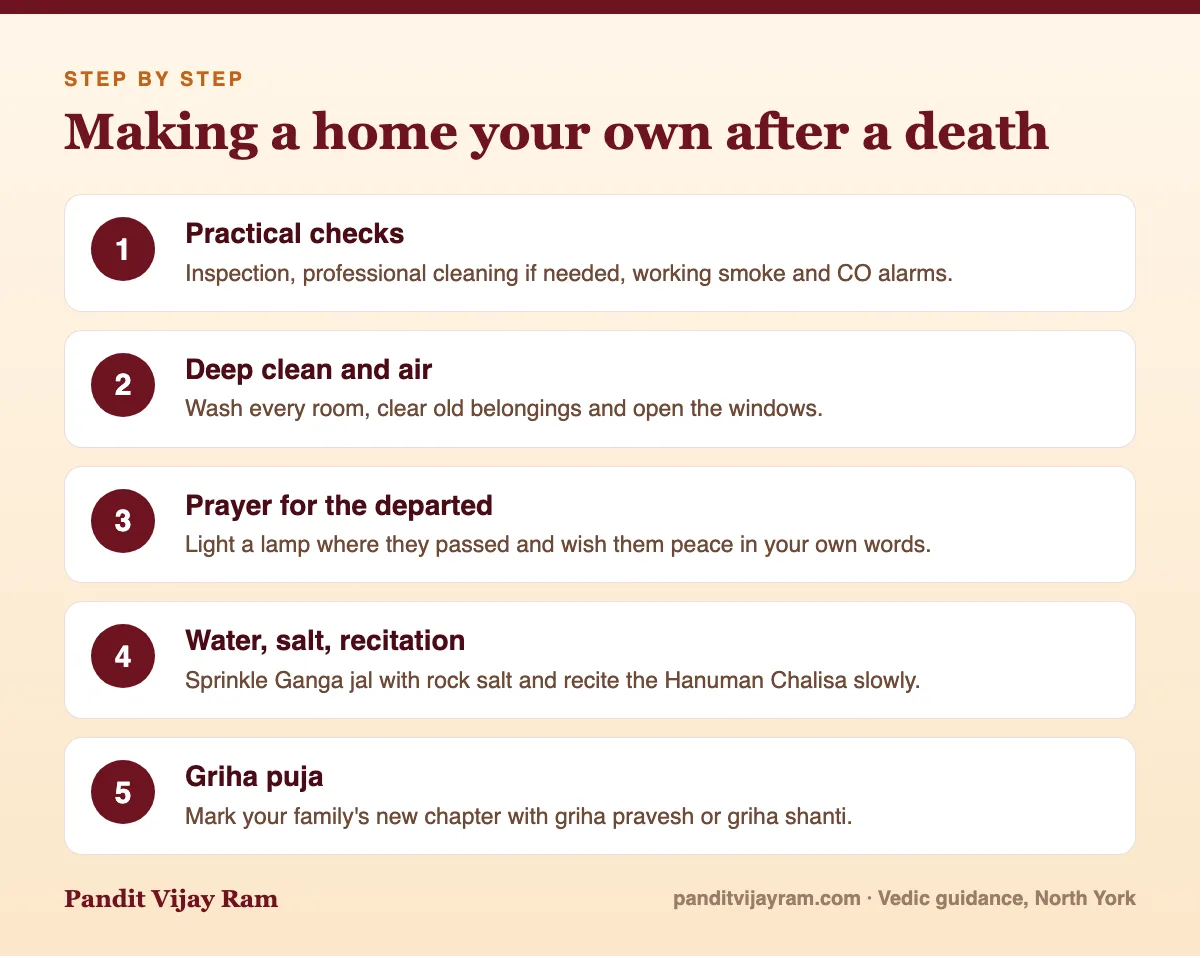
Begin after the practical cleaning is finished. Open the windows, clean every room thoroughly, then light a ghee lamp and offer a short prayer for the departed person's peace. Sprinkle Ganga jal or clean water with a little salt, recite a protective hymn, and if you wish, arrange a griha shanti or griha pravesh puja.
This is the order I suggest for a home where someone unrelated to you passed away.
- Practical cleaning first. Dust, wash floors and walls, and clear any belongings left behind. Donate or dispose of them respectfully.
- Fresh air. Open windows for an hour, even briefly in winter, to change the feeling of the space.
- A prayer for the person. Light a lamp in the room where they passed and say, in your own words, that you wish them peace and that you will care for the home kindly.
- Water and salt. Sprinkle Ganga jal or clean water with a pinch of rock salt in each corner, moving from the entrance inward.
- Recitation. The Hanuman Chalisa, the Gayatri mantra or the Mahamrityunjaya mantra are common choices. Recite slowly, once in each main room.
- A household puja. A griha pravesh or griha shanti puja marks the start of your family's life there. A pandit can guide this.
Avoid smoke-heavy methods in condos and rentals, and never leave a flame unattended. If after all this the home still feels deeply unsettled, a consultation through the negative energy removal service can look at the situation with you, beginning with ordinary explanations.
What does Hindu tradition say about a spirit staying in a house?
Tradition holds that the soul normally moves on after death, helped by the family's rites. The idea of a preta lingering is linked to rites left undone or a sudden, troubled death. Even then, the remedy is prayer and shraddh for the departed, offered with compassion, not fear of the person who lived there.
The Garuda Purana and household custom describe the period after death as a journey. During the first days the soul is called a preta, a departed one, and the family's offerings support it. Through later rites, especially the ceremony that unites the departed with the ancestors, it is understood to find its place among the pitrs.
Folk belief adds that a soul may linger when death was sudden or violent, or when no one performed the rites. Whether you hold this belief literally or not, the traditional response is gentle: feed the needy in that person's name, light a lamp, and if you know the family, let them know you are praying for their loved one.
I find it useful to separate three situations:
- You simply know someone died there. A prayer and a household puja are enough.
- You feel uneasy but nothing specific happens. Rest, routine and recitation, with patience.
- You notice repeated disturbances after ruling out wiring, pests, gas and health. Speak to an experienced practitioner.
More on caring for departed loved ones is in the guide to the spirit of a deceased relative, and the wider magic and entities hub collects related questions.
When should I get help with unease in a new home?
Get practical help first for anything physical: smells, damp, faulty wiring or alarms. See your family doctor if you are not sleeping, feel panicky or low for more than a couple of weeks. Seek spiritual guidance when the ordinary checks are done and you would like a structured blessing or a second view.
People sometimes wait too long because they feel embarrassed, or rush to a costly ritual because someone frightened them. Neither helps. A sensible order keeps both your home and your peace of mind safe.
- Home inspector or contractor for odours, staining, damaged floors, ventilation or anything that worries you physically.
- Licensed electrician or gas technician for flickering lights, tripping breakers or a carbon monoxide alarm.
- Family doctor for insomnia, panic, low mood or grief that is not easing. In a crisis in Canada, call or text 9-8-8.
- A grief counsellor or support group if the story has opened old losses of your own.
- A pandit or spiritual guide for griha shanti, a household havan or a calm conversation about what you are feeling.
When I speak with a family in this situation, I ask what they have already checked and how they feel in the home during daylight. Very often the honest answer is that daytime is fine and nights are lonely. That points to comfort and routine more than to any entity.
The bottom line
A house where someone died is almost always as safe as any other home once the practical checks are done. Unease often comes from knowledge, tiredness and grief, and it usually fades with rest and routine. A simple prayer for the person who passed, a thorough cleaning and a household puja are the respectful way to begin your own life there.
Key takeaways
- Death has occurred in most older homes, and Hindu tradition does not call such a home unlucky.
- Check cleaning, odours, alarms and repairs, and ask a lawyer about disclosure questions.
- Knowing about a death sharpens attention to ordinary sounds, which is normal.
- A prayer for the departed, water and salt, recitation and a griha puja bless the home.
- See your doctor for poor sleep or anxiety that lasts, and an electrician for wiring concerns.