
Clearing Pitru Dosh: Ancestral Blockages and Shraddh Remedies
Pitru dosh remedies are something families often ask about when a problem seems to run through generations: marriages delayed for several siblings, children arriving late, or a business that never quite settles. Some hear the term from an astrologer back home and come to me in North York worried that their ancestors are angry. They are usually relieved to hear that the tradition sees things more gently. In Vedic thought, pitru dosh describes an unpaid debt of remembrance, not a curse. The remedies are acts of gratitude and care. This article explains what pitru dosh is, how a practitioner looks for it in a kundli, and the household rites of tarpan and shraddh, including Pitru Paksha and the custom of feeding cows, crows and the needy. It also covers how to adapt these customs in Canada, where rivers and temples are not always nearby. In more than forty years of practice I have seen that sincere remembrance steadies a family in ways that are hard to describe and easy to feel. You do not need to be afraid to begin.
What is pitru dosh in a birth chart?
Pitru dosh is a chart pattern read as an ancestral imbalance, often linked to unperformed rites or unresolved family karma. Astrologers look at the Sun, the ninth house of father and lineage, and their relationship with Rahu, Ketu and Saturn. It is a reason for remembrance, not a sentence of misfortune.
Vedic tradition speaks of three debts every person carries: to the sages, to the gods, and to the ancestors, the pitru rin. The debt to the ancestors is repaid by remembering them, continuing the family line with good conduct and offering the rites that sustain them. When those duties lapse, or when there is unresolved suffering in the lineage, astrologers say the chart may reflect it as pitru dosh.
Common chart indications include:
- The Sun joined by Rahu or Ketu, sometimes called grahan dosh.
- Rahu or Saturn placed in the ninth house, the house of father, dharma and ancestors.
- The lord of the ninth house weak, combust or afflicted.
- Saturn and the Sun in strong opposition or conjunction.
None of these placements is rare. Many people have one of them and live full, settled lives. A practitioner reads the whole chart, the current dasha and the family history before saying pitru dosh is active. A single combination on its own is not enough.
What makes the reading meaningful is the match between the chart and lived experience: delays that repeat among siblings, an ancestor whose final rites were never completed, or a death that happened suddenly far from home. The kaal sarp and pitra dosh service describes how this assessment is carried out.
How do you perform tarpan for ancestors at home?
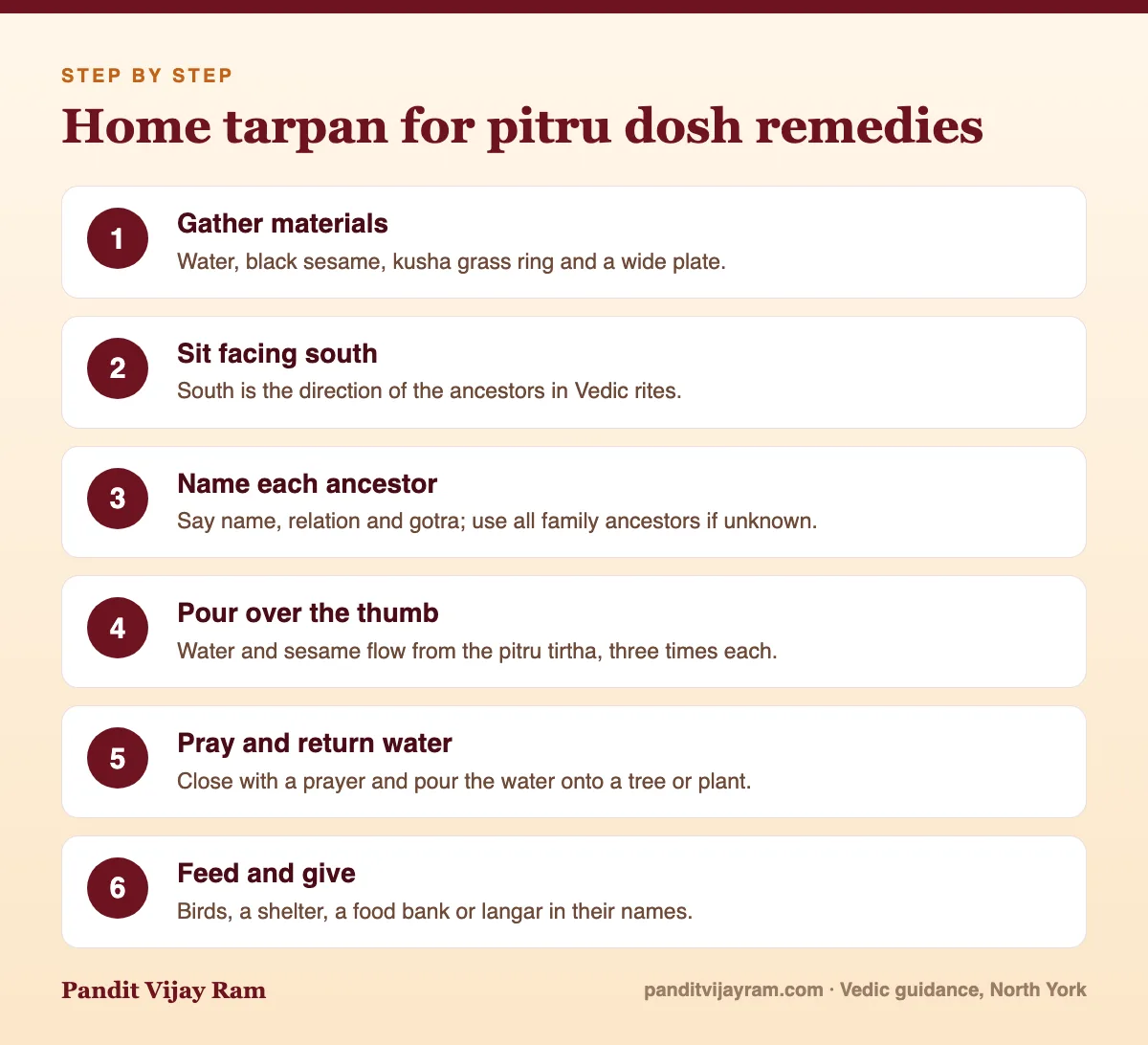
Sit facing south with water, black sesame seeds and a kusha grass ring on the ring finger. Call each ancestor by name and gotra, and pour water mixed with sesame from the palm over the base of the thumb onto a plate. Recite a short prayer, then pour the water onto a plant.
Tarpan means satisfying or refreshing. It is the simplest ancestral offering and can be done by any family member, not only on special days.
What you need:
- A copper or brass vessel of clean water, with a little Ganga jal if you have it.
- A spoonful of black sesame seeds, kala til.
- A few blades of kusha grass, or a ring made from it, called a pavitri. Indian grocery stores in the GTA often stock it before Pitru Paksha.
- A wide plate or tray to catch the water.
The method:
- Bathe and wear clean clothes. Sit facing south, the direction of the ancestors.
- Those who wear the sacred thread move it to the right shoulder, the apasavya position, for ancestral rites.
- Place the kusha ring on the ring finger of the right hand.
- Take water and sesame in the cupped right palm. Name the ancestor, their relation to you and your gotra if known.
- Let the water flow out over the base of the thumb, the pitru tirtha, onto the plate. Repeat three times for each person, starting with father, grandfather and great-grandfather, then the maternal side.
- Close with a short prayer asking them to accept the offering and bless the family.
Pour the collected water onto a tree or garden plant rather than down the sink. If you do not know names, say all the ancestors of my family. Sincerity matters more than precise wording.
When is shraddh performed, and what happens during Pitru Paksha?
Shraddh is performed each year on the lunar tithi of an ancestor's death and during Pitru Paksha, the fortnight of the waning moon set aside for ancestors. Families offer pinda, cooked rice balls with sesame, feed a priest or guests, and give food to animals and the needy. The fortnight closes on Sarva Pitru Amavasya.
Pitru Paksha falls in the dark half of the lunar month of Bhadrapada in the southern reckoning, or Ashwin in the northern, usually in early autumn. Its exact dates change each year, so check a local panchang or ask your temple. During these days many families avoid starting new ventures, buying major items or holding celebrations.
A household shraddh often follows this pattern:
- Choosing the day. The tithi on which the ancestor died. If it is unknown, the final day, Sarva Pitru Amavasya or Mahalaya, is used for all ancestors together.
- Preparing the food. Simple sattvic dishes, often kheer, puri, a lentil and vegetables the person liked, cooked without onion and garlic.
- Pind daan. Small balls of cooked rice mixed with sesame, honey and ghee, placed on kusha grass and offered with mantras.
- Panchabali. Portions set aside for the cow, the dog, the crow, ants and the devas before the family eats.
- Feeding a guest. Traditionally a learned brahmin; today many families also feed elders or people in need.
- Daan. Gifts of food, clothing or money in the ancestor's name.
Many priests today accept daughters, wives or other relatives performing shraddh when there is no son, and some families share the role among siblings. For the earlier rites that close mourning after a death, see the guide to cleansing the home after a death.
Why do Hindus feed crows, cows and the needy for ancestors?
Crows are traditionally seen as messengers who carry offerings to the ancestors, cows represent nourishment and gratitude, and feeding the hungry turns remembrance into living service. Together these acts express the idea that ancestors are honoured best through generosity to other beings, not through ritual alone.
The custom of setting aside food for animals before eating is old and widespread across India. In ancestral rites it carries special meaning. Many families wait for a crow to take the first portion of shraddh food, reading it as a sign that the offering has been accepted.
Adapting this in the GTA takes a little thought:
- Crows: place a small portion of plain rice or roti on a high, clean surface such as a balcony ledge or garden wall, and remove what is left after an hour. Leaving food out longer attracts rats and raccoons and may break local rules on feeding wildlife.
- Cows: few families have access to one. Some temples and farm sanctuaries in Ontario accept donations for cow care. Green grass or fodder given through them carries the same intention.
- Dogs: a donation of food to an animal shelter is a practical alternative to feeding street dogs.
- People in need: give to a food bank, sponsor a meal at a gurdwara langar or temple kitchen, or cook for an elderly neighbour.
- Ants and birds: a pinch of flour mixed with sugar near a garden tree, never indoors.
The point is not the species but the gesture of feeding life in your ancestors' name. A modest, regular act of giving is more in keeping with the tradition than one large display. The puja and anushthan page lists formal rites that can be arranged alongside these acts.
Do pitru dosh remedies need a pandit, or can families do them alone?
Families can do daily or yearly tarpan, simple shraddh, feeding and charity on their own. A pandit is helpful for pind daan with full mantras, Narayan Bali or Tripindi Shraddh, cases involving sudden or untimely death, and when the chart shows strong pitru dosh alongside other doshas. Neither path depends on fear.
A simple way to plan:
- On your own, any time: tarpan on Amavasya each month, lighting a lamp facing south in the evening for ancestors, reciting the Pitru Stotra or Gita chapter fifteen, feeding and charity in their names.
- On your own with guidance: a yearly shraddh at home, once a priest has shown you the sequence and the mantras for pind daan.
- With a priest: Narayan Bali for ancestors who died by accident or violence, Tripindi Shraddh when three generations have gone without rites, and pind daan at pilgrimage sites such as Gaya, Haridwar or Trimbakeshwar. Families in Canada sometimes ask a priest in India to perform these on their behalf, or arrange them during a visit.
Be wary of anyone who says your ancestors are cursing you and only an expensive ritual will stop it. That is fear selling, not Vedic teaching. The ancestors in this tradition are protective elders, and remedies are offerings of love.
Remember too that family difficulties often have practical causes: inherited debt, unresolved conflict, untreated health conditions. Address those alongside the rites. If you also want to understand how ancestral patterns compare with other kinds of block, the article on blocked energy in Vedic terms sets them side by side. More household practices are collected in the cleansing and protection hub.
The bottom line
Pitru dosh remedies are acts of remembrance rather than defences against angry spirits. Tarpan with sesame and kusha, shraddh on the ancestor's tithi and in Pitru Paksha, and feeding animals and the needy form the heart of the practice. Families can do much of it themselves, with a priest for pind daan and special rites. Approach it with gratitude, check practical causes alongside it, and refuse anyone who sells it through fear.
Key takeaways
- Pitru dosh is read as an unpaid debt of remembrance, not a curse.
- A single chart placement does not confirm it; the whole chart matters.
- Tarpan needs only water, black sesame, kusha and a south-facing seat.
- Shraddh falls on the death tithi and during Pitru Paksha.
- Feeding crows, cows and the needy can be adapted safely in Canada.