
Cleansing the Home After a Death in the Family: Sutak and Shuddhi

Cleansing after a death in the family is a question people usually ask while they are still tired, still receiving visitors and still arranging the funeral. You want to do right by the person who has gone, and by the elders who remember how things were done back home. Families in North York, Scarborough and Brampton often tell me they feel unsure because the relatives who knew the customs live far away. This guide explains what sutak means, why the home shrine is closed, how long the period lasts in different traditions, and the simple shuddhi steps that end it. It also covers what to do when a family cannot keep every rule in a Canadian apartment with jobs to return to. In more than forty years of practice I have sat with many grieving households, and I have found that the rituals help most when they are done with gentleness rather than worry. Nothing here replaces your own family priest or elders. Where your lineage differs, follow it. The purpose of shuddhi is to honour the person and steady the living, not to fear the home.
What is sutak after a death in a Hindu family?
Sutak after a death, also called patak or ashaucha in the texts, is a period of ritual impurity observed by close relatives. During it the family pauses temple visits, festivals and home puja. It is a time set aside for grief and for the rites that help the departed soul move on.
The idea behind sutak is not that the home has become dirty or dangerous. The older word, ashaucha, means a state in which the family is not ritually available for ordinary worship because their attention belongs to the person who has died. Relatives are expected to rest from celebration, cook simply and focus on the daily offerings for the departed.
Common customs during this period include:
- Covering the idols or closing the doors of the home mandir, and not lighting the usual morning aarti.
- Keeping a single lamp burning near the place where the body rested or near a photograph, often facing south, the direction associated with the ancestors.
- Avoiding temple visits, weddings, birthdays and festival cooking.
- Eating plain vegetarian food, sometimes cooked by neighbours or relatives rather than in the family kitchen.
- Reading the Garuda Purana, the Bhagavad Gita or the Ramayana in the evenings.
Sikh families usually hold a Sahaj Path or Akhand Path and close with the Antim Ardas rather than observing sutak in the Hindu sense. Muslim families follow their own mourning customs. If your household mixes traditions, the most respectful choice is to ask the eldest person on each side what they would like. For the full arc of the funeral rites themselves, the samskara called antyeshti, see the puja and anushthan services page.

How many days does sutak last after a death?
Most North Indian families observe sutak for thirteen days, ending with the terahvin. Many South Indian families close around the tenth or eleventh day, and some lineages count sixteen. Distant relatives may observe only three days. The nearness of the relationship and the family's own lineage decide the count.
There is no single correct number, and that is often the source of family tension. The texts on dharma give different counts for different relationships, and regional practice has added its own layers. A rough picture:
- Day 1 to 3: cremation, collection of ashes (asthi sanchayan) and the first offerings of water and sesame.
- Day 10: the dashgatra, when the ten pinda offerings are completed. In many families the sons have their heads shaved on this day.
- Day 11 or 12: the ekadashah and sapindikaran rites, which unite the departed with the line of ancestors.
- Day 13: the terahvin or tehrvi, with a havan, a meal for priests and family, and gifts to the needy.
Married daughters, cousins and in-laws often keep a shorter period. When a baby is born into the family during sutak, elders usually ask a priest how the two periods interact.
In Canada, work and school rarely pause for thirteen days. I tell families that keeping the spirit of the period matters more than counting every hour. Light the lamp, eat simply, skip celebrations and attend the key days. If a relative abroad is upset about a shortened routine, a call with your priest can settle it calmly. The guide to shraddh and pitru remedies explains the yearly rites that follow.
What is done on the 13th day to purify the house?
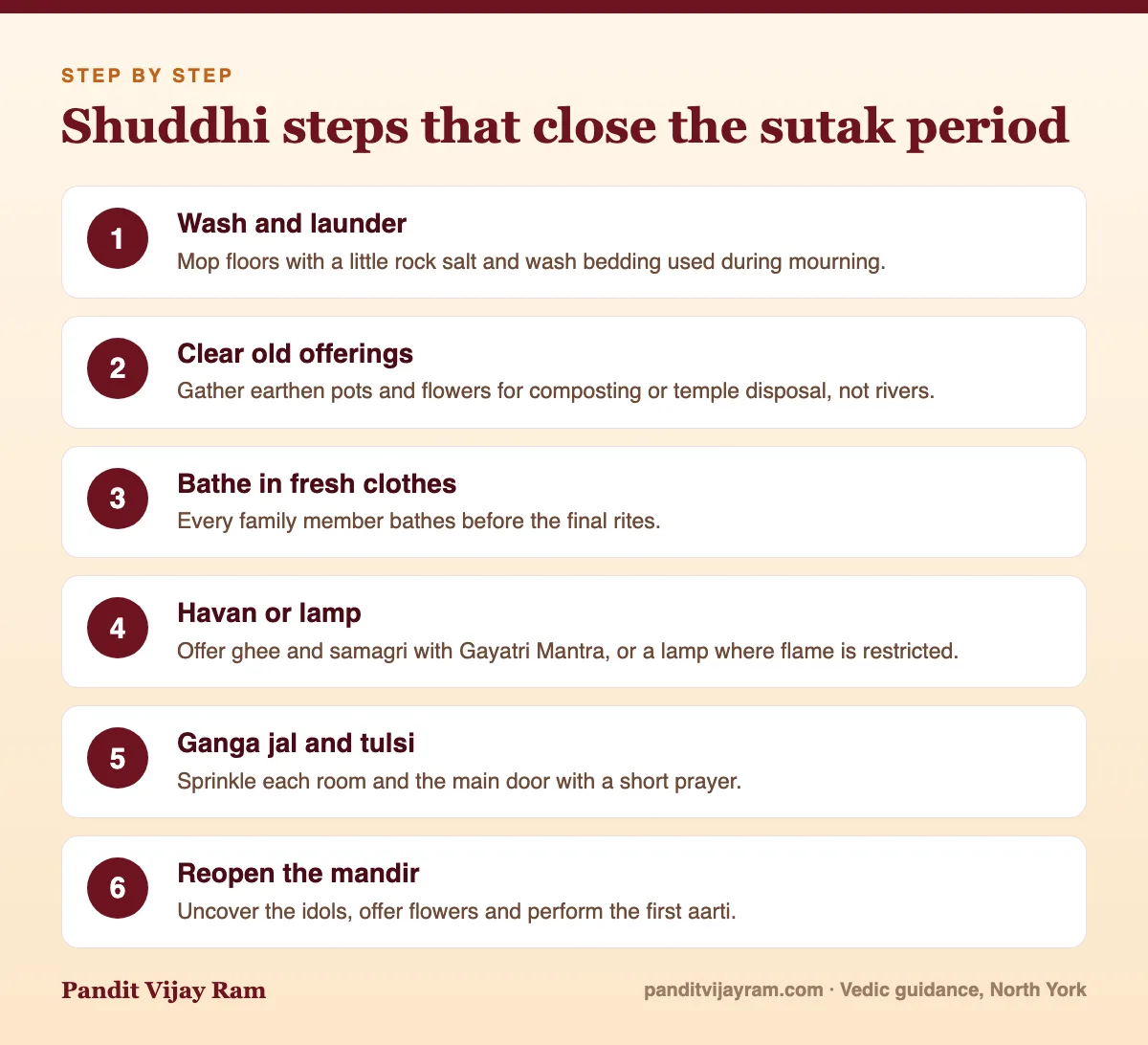
On the 13th day the house is cleaned top to bottom, ganga jal is sprinkled in every room, and a small havan with ghee and samagri is offered. The mandir is uncovered and the first lamp is lit for the deities again. A meal and charity close the mourning period.
The shuddhi on the final day is a gentle reopening of ordinary life. In many homes it follows a clear order:
- Washing. Floors are mopped, often with water mixed with a little rock salt or a few drops of gaumutra where the family keeps that custom. Bedding and clothes used during the period are laundered.
- Clearing. Earthen pots used for the daily offerings are taken out. Flowers and garlands from the photograph are gathered for respectful disposal.
- Bathing. Each family member bathes and wears fresh, clean clothes before the havan.
- Havan. A priest or senior family member offers ahuti with ghee, samagri and mantras such as the Gayatri Mantra. Some families use the Mahamrityunjaya mantra.
- Sprinkling. Ganga jal mixed with tulsi leaves is sprinkled through every room and at the main door.
- Reopening the mandir. Idols are unwrapped, wiped and offered fresh flowers, and the first aarti is performed.
- Feeding and giving. A meal is served, and food or clothing is given to the needy in the person's name.
If your building does not permit open flame, the article on havan for cleansing describes a smaller lamp-and-mantra alternative. The temple can also hold the havan for you.
Disposing of flowers and offerings in Canada
Rather than placing them in a lake or river, many families compost flowers or take them to a temple that collects offerings for respectful disposal.
Can you do shuddhi yourself without a priest?
Yes, the household part of shuddhi can be done by the family: cleaning, bathing, sprinkling ganga jal and reopening the mandir. The pinda offerings, sapindikaran and the terahvin havan are usually led by a priest who knows your lineage, though many temples in the GTA can guide you by phone.
Grief makes people doubt themselves. I often hear, what if we did it wrong and the soul cannot rest? My honest answer is that sincere effort counts. The scriptures describe these rites as acts of love and duty, not as tests with a penalty for a missed step.
A simple way to divide the work:
- Family can do: daily lamp and water offering, washing the home, sprinkling ganga jal, reading the Gita, feeding a cow or the needy, reopening the mandir with a short aarti.
- Better with a priest: the ten-day pinda offerings, the sapindikaran on the twelfth day, the havan on the thirteenth, and choosing the asthi visarjan arrangements.
- Ask a priest when: the death happened suddenly or far from home, the family cannot agree on the count of days, or a birth or wedding falls in the same window.
When the death was traumatic or unexpected, families sometimes ask whether a deeper negative energy assessment is needed. Usually the heaviness people feel is grief itself, and the right answer is time, company and the ordinary rites. I only suggest extra work when something specific continues well after the thirteenth day.
When is the heaviness after a death grief rather than something spiritual?
Nearly always. Poor sleep, crying, feeling the person's presence, low appetite and a quiet, heavy house are normal parts of grief. Ritual cleansing supports the mourning process but cannot replace it. If sadness stays intense for months or thoughts of self-harm appear, speak to a doctor or counsellor.
Families sometimes worry that a lingering sense of the person in the house means something is wrong. Many cultures, including Hindu ones, accept that the living feel the presence of the dead for a while. Dreams of the person, catching their scent or hearing their voice are common in early grief and are not a sign of a disturbed spirit.
Look at the ordinary causes first:
- Exhaustion from funeral arrangements and hosting visitors.
- Skipped meals and broken sleep.
- Money worries, legal paperwork and estate questions.
- Old family conflicts that surface around a death.
- Children who are frightened and need simple explanations.
Please see your family doctor if sleep does not return, if you cannot work after a reasonable time, or if a grieving parent or spouse stops eating. Grief counsellors and hospice programmes across the GTA offer bereavement groups. If anyone in the household is thinking of ending their life, call or text 9-8-8, Canada's Suicide Crisis Helpline, at any hour.
Spiritual care sits beside this help, not in front of it. The cleansing and protection hub has gentler practices for the months after, including the home mandir care guide for when the shrine reopens.
The bottom line
Cleansing after a death in the family closes sutak with care rather than fear. The length of the period depends on your lineage and relationship, so follow your elders where they differ from any general guide. The household can do most of the shuddhi itself, with a priest for the pinda offerings and the final havan. Above all, treat heaviness in the home as grief first, and reach for a doctor or counsellor when grief becomes too much to carry.
Key takeaways
- Sutak is a pause for mourning, not a sign the home is dangerous.
- Most families observe ten to thirteen days, but lineage and region vary.
- Shuddhi means washing, bathing, ganga jal, a small havan and reopening the mandir.
- A priest usually leads the pinda offerings and the thirteenth-day havan.
- Long or crushing grief needs a doctor or counsellor alongside any ritual.