
Diwali, Navratri and Holi in Brampton: Local Celebrations and Practical Rules
Celebrating Diwali in Brampton looks different from a generation ago. Families who once lit rockets in the driveway now gather at a City-run show, and the evening at home centres on diyas, rangoli, Lakshmi puja and sweets shared with neighbours. Navratri brings garba and dandiya to halls across the city, and Holi fills backyards and parks with colour each spring. Families from Brampton who visit me in North York often ask what is actually allowed now, and how to keep the rituals meaningful within the rules. This guide answers that using the City of Brampton's own pages: the fireworks by-law, open-air burning rules, park permits and fire safety advice for cultural celebrations. It also describes the kinds of public celebrations that happen each year, without dates, since those change, and offers a short, safe method for festival puja at home. In more than forty years of practice I have watched families adjust traditions to new places many times. The heart of Diwali was never the noise; it was the lamp, the prayer and the gathered family.
Are fireworks allowed in Brampton for Diwali?
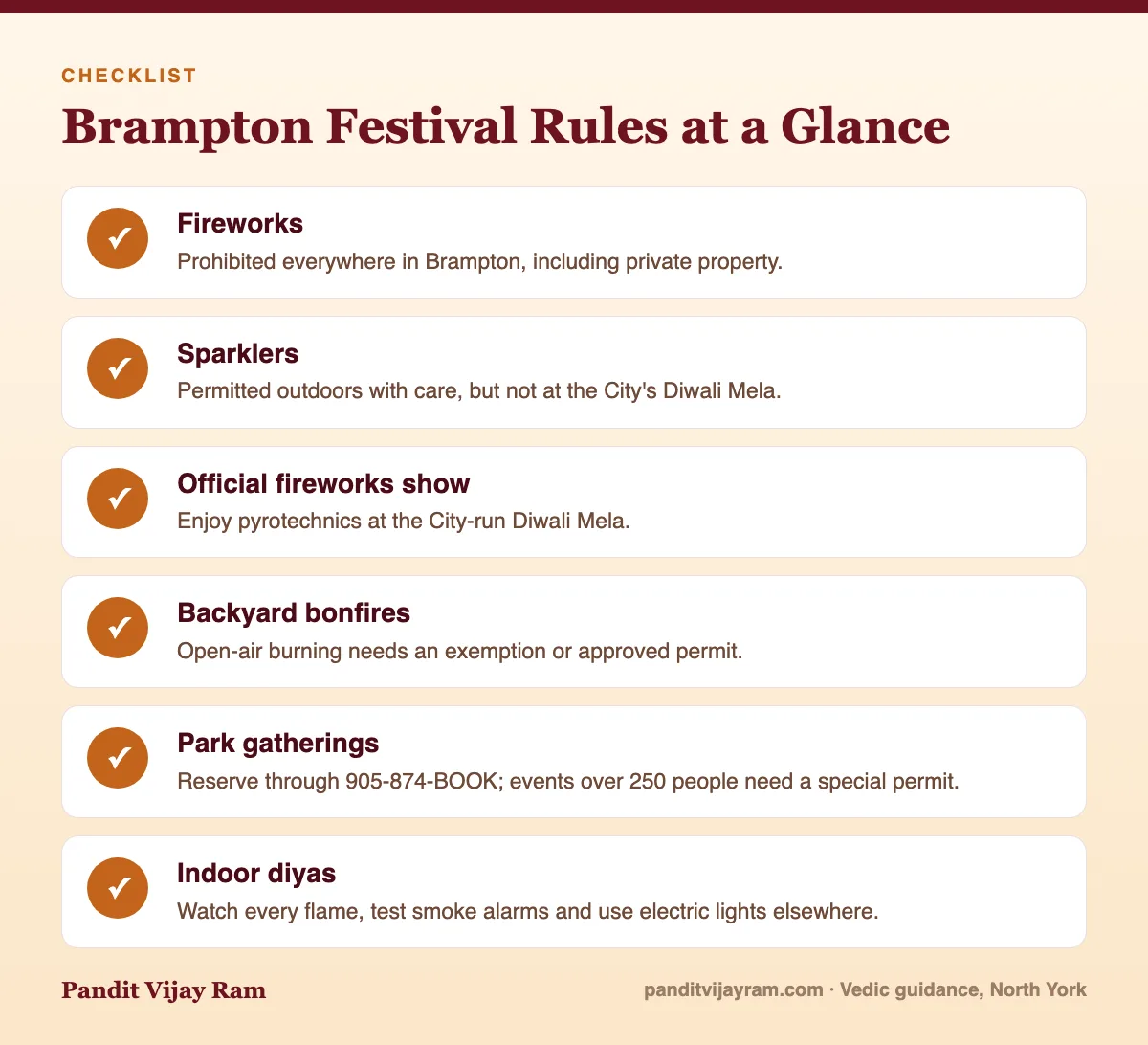
No. The City of Brampton prohibits all fireworks, including their use, sale, purchase, possession and discharge, at Diwali and every other time of year. Sparklers are the exception and are permitted. Residents are invited instead to City-led events with pyrotechnics, including Diwali, Canada Day and New Year's Eve celebrations.
For many years Brampton allowed short-range fireworks on private property on a few holidays, Diwali among them. That changed when council tightened the by-law, and the City's fireworks page now states plainly that all fireworks are prohibited in Brampton. The ban covers the use, sale, offer, display, purchase, distribution, possession and discharge of fireworks or explosives anywhere in the city.
A few points families often miss:
- It applies on private property. Your own driveway or backyard is included.
- Buying elsewhere does not help. Possessing fireworks in Brampton is itself prohibited, even if they were bought in another town.
- Sparklers are allowed. Use them outdoors, away from dry leaves and decks, with a bucket of water nearby for spent wires.
- Penalties apply. The City has said fines begin at five hundred dollars.
Brampton Fire and Emergency Services also warns that fireworks can ignite grass, roofs and decks, and that the noise distresses pets, wildlife and vulnerable residents. It suggests glow sticks, LED wands or community-run displays instead.
Rules elsewhere in the region differ, so a family celebrating with relatives in Mississauga or Toronto should check that city's own by-law. Our GTA Diwali fireworks rules guide compares them.
Where can families celebrate Diwali publicly in Brampton?
The City of Brampton hosts an annual Diwali Mela, a free family celebration with main-stage music and dance, food vendors, a professional fireworks display and, in recent editions, a drone show. Sparklers are not allowed at the event. Temples across Brampton also hold Diwali and Lakshmi puja gatherings for their communities.
When council banned private fireworks, it also directed staff to create an annual City-run Diwali event with pyrotechnics, similar to Canada Day and New Year's Eve. The result is the City's Diwali Mela, which has become a major civic celebration of the Festival of Lights.
What families can usually expect, based on the City's own announcements:
- Cultural performances on a main stage, including well-known Punjabi artists.
- Food vendors and activities for children and elders.
- A fireworks display, which is now the lawful way to enjoy fireworks in Brampton.
- Transit help, since parking is limited; the City has run a free Brampton Transit shuttle from points such as Mount Pleasant GO Station and Gore Meadows Community Centre.
Check the City's news page each autumn for the venue and timing. The City also reminds residents that persistent noise during the festival season can be subject to its Public Nuisance and Noise By-laws, so keep home celebrations considerate.
Temple celebrations run alongside the City event. Our guide to Hindu temples in Brampton introduces several mandirs and their customs. Families of Sikh heritage also mark Bandi Chhor Divas at gurdwaras around the same time, a distinct Sikh observance that deserves its own respect.
Can you light diyas, a havan or a Holika fire at a Brampton home?
Indoors, diyas and a small havan are possible with care, but Brampton Fire advises flameless or electric alternatives for rituals where possible and never leaving candles or incense unattended. Outdoors, open-air burning is not permitted in Brampton unless it meets specific exemptions or has an approved permit, which rules out a backyard Holika bonfire.
Brampton Fire and Emergency Services publishes clear guidance for celebrations. Open-air burning, including outdoor fireplaces, chimineas and bonfires, is not permitted unless it meets specific exemptions or you hold an approved permit. Approved gas appliances are treated differently. For indoor celebrations, the guidance is to use flameless or electric alternatives for rituals, celebrations and cultural practices, to keep candles away from curtains, decorations, bedding and furniture, and never to leave burning candles or incense unattended.
In practice, many Brampton families combine both:
- Real diyas at the altar, lit for the puja and watched closely, set on a metal tray.
- Electric diyas and string lights along windows, stairs and the porch, where real flames would be unwatched.
- A symbolic Holika Dahan with a single lamp and prayer at home, and the community bonfire left to an organised, permitted event.
Before guests arrive, test your smoke alarms; Brampton Fire specifically recommends this before hosting. Keep exits and hallways clear.
Our guide to Diwali diyas and fire safety covers placement in detail, and Holika Dahan and GTA bonfire rules explains how to keep the meaning of the ritual without a backyard fire.
What permits apply to Navratri garba or Holi in a Brampton park?
Brampton requires a permit to reserve a park for an event, booked through the City's facility rentals line, 905-874-BOOK. Outdoor community special events of more than 250 people on City property need a special event permit and a review by the City's Special Event Advisory Team, with applications submitted well ahead.
Navratri garba usually takes place in rented halls, temples and school gyms, where the owner's rules on capacity and sound apply. Holi is more often outdoors, and that is where City rules come in.
A simple decision rule for organisers:
- Small family Holi in your own backyard: no City permit, but keep noise reasonable and clean up colour from shared spaces.
- A gathering in a City park: the City says residents who want to reserve a park need a permit and should contact facility rentals at 905-874-BOOK.
- A public event for more than 250 people: a Community Special Event permit is required, organisers must apply to the Special Event Advisory Team, and the City asks for applications at least sixty days ahead.
The City's pages do not set a specific rule for colour powder, so ask when you book whether the park has restrictions and how cleanup will be handled. Choose natural, skin-safe colours, keep them away from eyes and water features, and bring bags for waste.
For fasting and devotional guidance during the nine nights, see our Navratri garba and fasting guide. Families marking the festival's close with girls' worship can read about kanya pujan during Navratri.
How can a Brampton family keep festival puja safe at home?
Choose one fixed, uncluttered spot for the altar, keep real flame only where an adult is watching, test smoke alarms beforehand, ventilate briefly after aarti and put out every diya before leaving the room. Safe preparation lets the family focus on prayer rather than worrying about fire.
Many Brampton homes are detached or semi-detached houses, often with family members on several floors and sometimes tenants in a basement unit. A festival puja should respect everyone sharing the building.
- Set the altar. Clean a table or shelf, ideally in the north-east, and place a metal tray under every lamp.
- Clear the space. Move curtains, paper decorations and rangoli powder away from flames.
- Test the alarms. Press the test button on each smoke alarm before guests arrive.
- Light with intention. Begin with Ganesha, then Lakshmi at Diwali or the Devi during Navratri, lighting only the lamps you can watch.
- Aarti and air. After aarti, open a window for a few minutes to clear camphor smoke.
- Close safely. Extinguish every real flame before leaving the room or going to sleep; leave electric diyas on if you like.
A step-by-step Lakshmi Ganesh puja at home guide explains the mantras and offerings. Families who want a priest-led havan or Lakshmi puja can read about our puja and anushthan services, and personal muhurat guidance for the festival is available through the Brampton astrologer page.
The bottom line
Diwali in Brampton is now celebrated under a full fireworks ban, with sparklers permitted and the City's Diwali Mela offering the lawful fireworks show. Open-air fires need an exemption or permit, so a Holika bonfire belongs at a permitted event, and park gatherings for Holi or Navratri need a City booking or special event permit. At home, watched diyas, tested alarms and a clear altar keep the festival safe and full of meaning.
Key takeaways
- All fireworks are prohibited in Brampton, including on private property; sparklers are permitted.
- The City's annual Diwali Mela includes a professional fireworks display.
- Open-air burning needs an exemption or approved permit, so backyard bonfires are out.
- Park events need a City permit, and public events over 250 people need a special event permit.
- Watch every real flame indoors and test smoke alarms before guests arrive.