
Don Mills Neighbourhood Guide: Community, Calm Places and Spiritual Support
Some neighbourhoods grow by accident. Don Mills was drawn on paper first. This Don Mills neighbourhood guide looks at how that plan still shapes daily life in this corner of North York: the winding streets, the parks tucked into the Don Valley, the shopping square at Lawrence and Don Mills Road, and the newer transit and cultural landmarks just to the south. It is written for families who live here, those thinking of moving in, and anyone who wants quiet places for a walk, a prayer or a few calm minutes. Every place named was checked against official or reliable sources, and none of them is connected to my work. In more than forty years of practice I have noticed that people who have one green place they visit often, and one small corner at home for prayer, carry stress more lightly. Don Mills makes both easy. Here is what the neighbourhood offers and how to use it well.
Why is Don Mills called one of Canada's first planned communities?
Don Mills was planned as a complete community by E. P. Taylor's development company and designed by Macklin Hancock, who drew on garden city ideas. It was divided into four quadrants, each meant to hold a school, a church and a park, all around a central shopping centre, with paths linking homes to green space.
Before the plan, this was farmland. European settlement in the area dates to the early nineteenth century, and the land stayed rural until after the Second World War. Taylor's company first called the project Yorktown. Hancock and his team borrowed from Ebenezer Howard's garden city movement and from Radburn, New Jersey, using winding roads, T-intersections and cul-de-sacs to slow traffic and pedestrian paths to connect parks, schools and the town centre.
The developer also controlled architecture, colours and materials, which is why the early houses share a clean modernist look. Lots were square, with houses facing the street on their long side. Rental townhouses and low-rise apartments were built in from the start so that people working in local industries could live nearby. Planners across Canada later copied the approach.
Knowing this history helps when you live here. The plan assumed people would walk to the park, the school and the shops, and those paths are still there. Many residents use them every day without knowing they were deliberate. If you are setting up a home in one of these houses, our home cleansing guide for Don Mills homes explains how the long, low layout suits a simple Vedic routine.

What are the best parks and ravines in and around Don Mills?
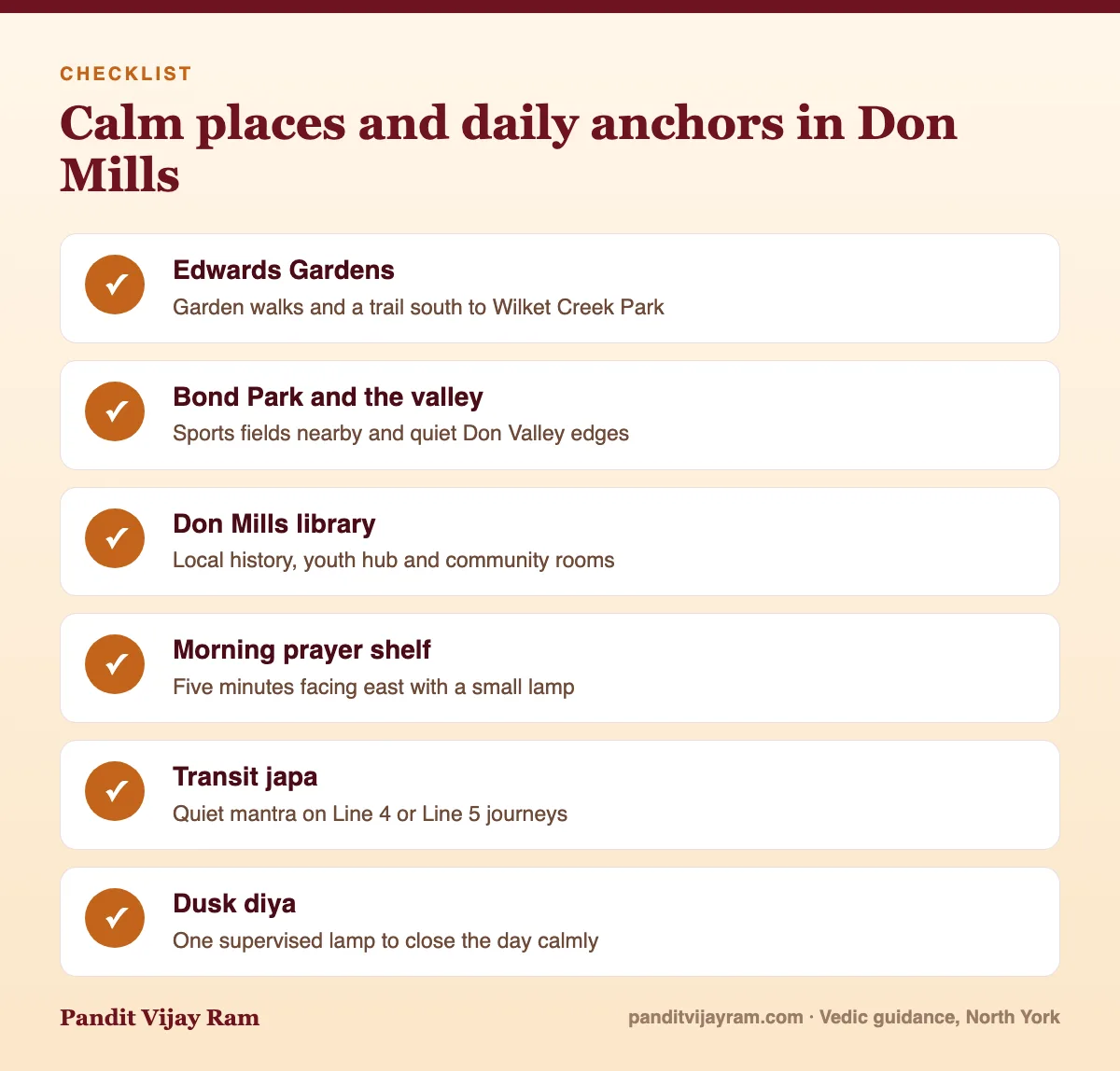
Don Mills sits beside the Don Valley, part of Toronto's ravine system. Inside the neighbourhood, Bond Park has sports fields and an arena, while Chipping Park and Moccasin Trail Park lie close to the valley. Just across Leslie Street, Edwards Gardens and the Toronto Botanical Garden link by trail to Wilket Creek Park.
Edwards Gardens is a City park at Lawrence Avenue East and Leslie Street, on the western edge of Don Mills. The City lists its main entrance on Leslie Street, just south of Lawrence, and notes that a south trail links to Wilket Creek Park and Sunnybrook Park. The Toronto Botanical Garden, within the same grounds, runs a teaching garden with the City and manages the paid parking.
Closer to home, Bond Park is the neighbourhood's sports and arena park, and Chipping Park and Moccasin Trail Park sit near the Don Valley's edge. These are good for an unhurried morning walk, and the valley trails make a longer loop possible on weekends.
A few ways families use these places spiritually, without disturbing anyone:
- Walk silently for the first ten minutes, then repeat a short mantra under your breath with each step.
- Sit on a bench at the garden and notice five things you are grateful for.
- Carry offerings home rather than leaving flowers, coins or food in the park.
That last point matters. Ravines are protected natural areas, and offerings left outdoors attract animals and litter the valley. Our guide to disposing of puja items respectfully in Toronto explains better options, and community gardens across the GTA covers places where you may grow tulsi and puja flowers.
How do you get around Don Mills by transit?
Several TTC bus routes cross the neighbourhood. To the south, Line 5 Eglinton has Don Valley station at Don Mills Road and a surface stop at Aga Khan Park and Museum. To the north, Line 4 Sheppard ends at Don Mills station, connecting across to Line 1 at Sheppard-Yonge station.
For decades Don Mills relied on buses and cars. That has changed. Line 5 Eglinton opened in phases, and its Don Valley station, formerly called Science Centre, sits where the line meets Don Mills Road. East of it the line runs at street level, with stops including Aga Khan Park & Museum. For a resident near the southern end of the neighbourhood, that puts the crosstown line within a short bus ride.
At the northern end, Line 4 Sheppard runs east from Sheppard-Yonge to its terminus at Don Mills station, further up Don Mills Road. From there, Line 1 connects to Willowdale, Downsview and downtown.
Practical tips for getting about:
- Plan bus-to-train trips with the TTC trip planner, because schedules change.
- Allow extra time in winter, when walking paths to stops can be icy.
- For in-person consultations in North York, transit is usually easier than finding parking at busy times.
Clients sometimes tell me the commute is part of the calm. A twenty-minute ride with a mala in your pocket is a fine time for quiet japa. Our article on mantras for clearing heaviness lists short ones that suit a busy journey.
Where are the community hubs in Don Mills?
The Shops at Don Mills, at Lawrence Avenue and Don Mills Road, is the neighbourhood's open-air centre, built around a central square. The Don Mills branch of Toronto Public Library sits on Lawrence Avenue East at Donway West. Just south, the Aga Khan Museum and Ismaili Centre share a cultural complex and public park.
The Shops at Don Mills replaced the original Don Mills Centre and was laid out like a main street around a square with a fountain, historical plaques and a clock tower by Douglas Coupland topped with miniature houses that echo the area's homes. Condominium buildings have been developed alongside it.
The Don Mills library branch, at 888 Lawrence Avenue East, has a local history collection, a Youth Hub, adult literacy tutoring, a meeting room, an auditorium, art exhibit space and large collections in Chinese, French and Japanese. It is one of the best places to learn about the neighbourhood's past.
The Aga Khan Museum, devoted to Islamic arts and culture, sits in a landscaped complex with the Ismaili Centre and a public park. It is a calm, beautiful place, and visitors of every faith are welcome. I mention it because respecting each other's sacred and cultural spaces is part of living well in a mixed neighbourhood.
The City is also planning a new Don Mills Community Recreation Centre on Don Mills Road near Eglinton Avenue, with a pool, gymnasium, ice arena and park. For places of worship, see our North York temples and community centres guide, and for agencies and helplines, the Don Mills family and newcomer support guide.
How can Don Mills residents build a quiet daily spiritual practice?
Keep it short and tied to places you already use. A five-minute prayer at a home shelf each morning, a silent walk in a nearby park, and a lamp at dusk are enough to steady most people. Consistency matters more than length, and nothing about it needs special equipment or a large house.
A routine I often suggest to families here has three anchors:
- Morning, five minutes. Wash, face east, light a small lamp at the prayer shelf and recite the Gayatri Mantra or a Ganesha prayer. If the house is still asleep, a whisper is fine.
- Midday, a walk. On a work-from-home day, a short loop to Bond Park or towards the valley clears the head better than another cup of tea.
- Dusk, one lamp. Light a ghee diya, sit for a few breaths, and let the day settle. Our guide to clearing your energy before sleep adds a simple night mantra.
Practice should never become another source of guilt. If you miss a day, begin again the next morning. If worry keeps you awake for weeks, see your family doctor; prayer works best alongside care, not as a replacement for it.
Growing a tulsi plant is another gentle anchor. Don Mills backyards get good summer sun, and the plant can come indoors for the winter. Our tulsi care guide for Canadian winters explains how.
How can people in Don Mills reach in-person spiritual guidance?
Vijay Ram ji is based in North York and offers in-person consultations there for Don Mills residents, who travel to meet him, as well as phone, video and WhatsApp sessions. A first conversation usually covers what is happening at home, any practical causes, and whether a kundli reading or simple remedies would help.
People from Don Mills come to me for many reasons: a child struggling at school, tension between generations, a new home that does not yet feel settled, or simply a wish to understand their birth chart. I begin every consultation with ordinary questions about health, sleep, work and family, because those often explain more than any planet.
What a consultation can include:
- A kundli reading focused on the question you bring, explained in plain language.
- Prayers, mantras or a lamp routine suited to a busy household.
- Guidance on a family puja when a fresh start would help everyone.
I am not affiliated with any park, library, museum or centre named in this guide. I simply think good neighbourhoods are easier to live in when you know them well. The Don Mills astrologer page explains how to book, and families living nearby can also read the North York page. If health and energy are your main concern, the health and wellbeing guidance page describes what I can and cannot offer.
The bottom line
This Don Mills neighbourhood guide shows a place still shaped by its plan: paths to parks, a shopping square at its heart, and the Don Valley at its edge. Edwards Gardens, Bond Park and the valley trails offer calm, while the library, the Shops at Don Mills and the cultural complex to the south bring people together. A short daily practice tied to these places, and in-person guidance in North York when needed, can help any household here feel more settled.
Key takeaways
- Don Mills was planned as a complete community around four quadrants and a central shopping centre.
- Edwards Gardens, Bond Park and the Don Valley trails are the area's calm green spaces.
- Line 5 Eglinton and Line 4 Sheppard now frame the neighbourhood to the south and north.
- The Don Mills library branch holds a local history collection and community programmes.
- A five-minute morning prayer and a dusk lamp make a steady practice in any Don Mills home.