
Mantras for Negative Energy Removal: Gayatri, Mahamrityunjaya and Durga Kavach

People often ask me for one mantra that will make the heaviness go away. I understand the wish. When the home feels tense or the mind keeps circling, a short verse you can repeat anywhere feels like something solid to hold. For anyone searching for a mantra for negative energy removal, three names come up again and again in Hindu households in North York and around the world: the Gayatri Mantra, the Mahamrityunjaya Mantra and the Durga Kavach. In this guide you will learn what each one means, where it comes from, when it is traditionally recited, how many repetitions make sense, and how much pronunciation really matters. You will also find a simple starter routine you can keep for a few weeks. After more than forty years of teaching jaap to families, I can tell you that the mantra people keep up for months helps far more than the most powerful one they try twice. I will also be honest about what mantras cannot do, because they are prayer, not medicine.
What is the Gayatri Mantra and how does it protect you?
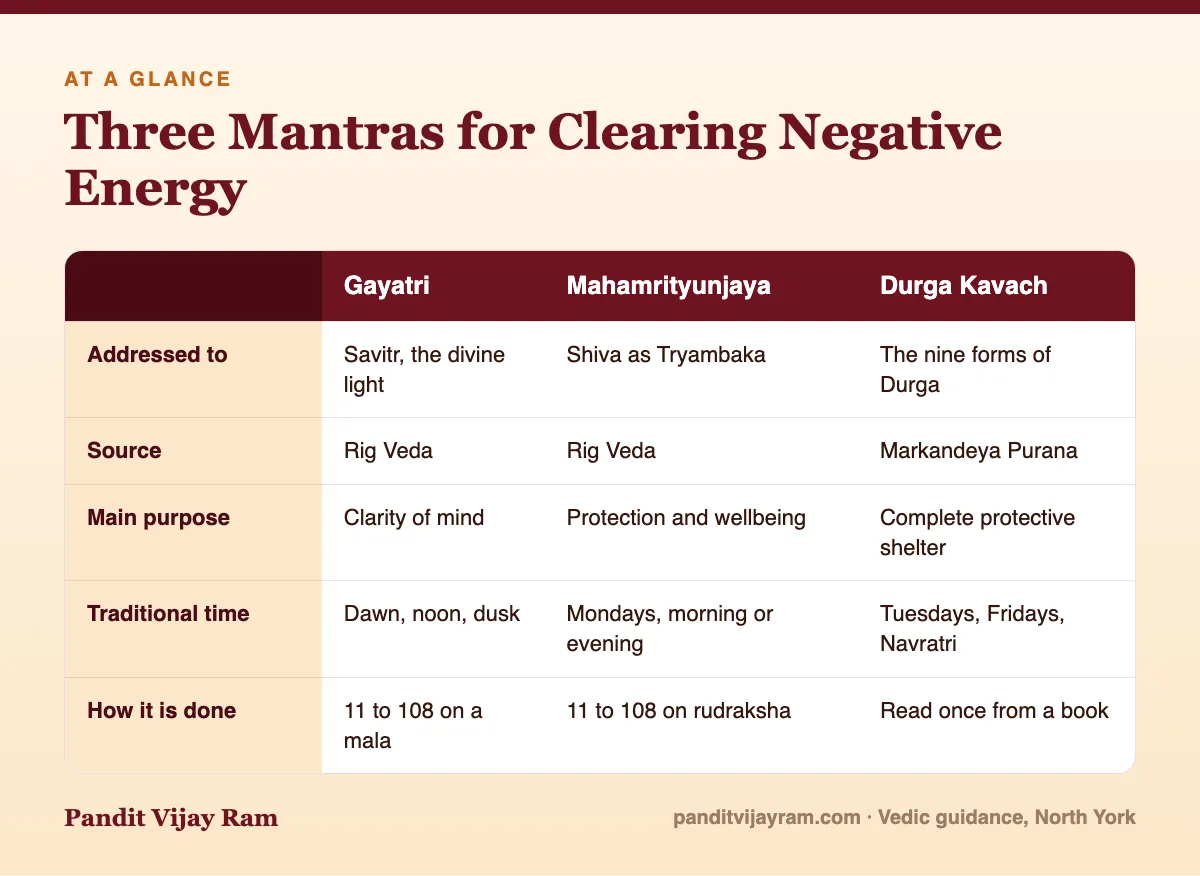
The Gayatri Mantra is a verse from the Rig Veda addressed to Savitr, the divine light of the Sun, asking that it inspire our understanding. It protects by clearing the mind rather than fighting anything outside. Traditionally it is recited at sunrise, noon and sunset, often eleven, twenty-one or one hundred and eight times.
The text most families learn is: Om bhur bhuvah svah, tat savitur varenyam, bhargo devasya dhimahi, dhiyo yo nah prachodayat. A plain translation: "We meditate on the radiant light of the divine Savitr; may it illumine our minds." The opening words bhur bhuvah svah name the earth, the space between and the heavens.
Why do people use it for negative energy? Because tradition holds that most heaviness enters through a clouded mind: fear, resentment and confusion. The Gayatri asks for clear thinking, and clear thinking is the best protection there is.
Practical points:
- Time: the three sandhyas, dawn, midday and dusk. Morning after bathing is the most common.
- Direction: facing east at sunrise, or north.
- Count: eleven for a daily habit, one hundred and eight on a mala when you have time.
- Who may recite: some lineages historically restricted the Gayatri to those who received initiation through the sacred thread ceremony. Many teachers today encourage everyone to recite it. Follow your own family's guidance with respect.
The Gayatri is also gentle enough for children and students; see how it fits a study routine in negative energy and students. For the wider family of cleansing methods, read what spiritual cleansing means.
When should you chant the Mahamrityunjaya Mantra?
The Mahamrityunjaya Mantra, also from the Rig Veda, is addressed to Shiva as Tryambaka, the three-eyed one. Families recite it during illness, fear, difficult planetary periods and after a death in the family. Mondays, early morning and evening are traditional times. It offers comfort and protection; it is not a replacement for medical care.
The verse reads: Om tryambakam yajamahe sugandhim pushtivardhanam, urvarukamiva bandhanan mrityor mukshiya mamritat. In meaning: "We worship the three-eyed one, fragrant, who nourishes all. As a ripe cucumber is released from its vine, may we be freed from death, and not from immortality." The image is gentle: release that comes naturally, at the right time, without force.
When someone in a family is in hospital, relatives often sit together and recite it. I encourage that, because it gives worried people a calm, shared task. I also say clearly that the doctors' treatment comes first and the mantra keeps everyone steady while it works.
How households usually practise it:
- Daily habit: eleven or twenty-one times in the morning, facing east or north.
- For a specific worry: one hundred and eight times daily for twenty-one or forty days, on a rudraksha mala.
- Larger anushthan: one hundred and twenty-five thousand repetitions completed by priests over days, with a havan. This is for serious occasions and needs proper guidance.
The mantra is associated with Shiva's protection, so many people combine it with offering water to a Shiva lingam on Mondays. The puja and anushthan page explains how a formal jaap is arranged when a family wants one.
What is the Durga Kavach and how long does it take to read?
The Devi Kavach, often called Durga Kavach, is the protective hymn recited before the Durga Saptashati, from the Markandeya Purana. It invokes the nine forms of Durga and asks the goddess to guard each part of the body and life. Reading it aloud takes roughly fifteen to twenty minutes; many read it during Navratri.
In the text, Brahma explains the kavach to the sage Markandeya as the most secret protection for humankind. It names the nine Durgas, Shailaputri, Brahmacharini, Chandraghanta, Kushmanda, Skandamata, Katyayani, Kalaratri, Mahagauri and Siddhidatri, and then asks particular forms of the goddess to protect the head, eyes, heart, limbs, home, family and wealth.
It is longer than the other two mantras, so it is read from a book rather than repeated on a mala. Suggestions for reading it well:
- Use a reliable printed text in Devanagari with transliteration. Gita Press editions are common in GTA households and temples.
- Read slowly rather than racing. A clear, unhurried recitation is better than a fast one.
- Best occasions: Tuesdays, Fridays, the eight days of Navratri, and times when the home feels unsettled.
- Simple setup: a lamp, a red flower, and a picture of Maa Durga.
Families sometimes worry that reading the kavach incorrectly will bring harm. I have not seen sincere devotion bring harm. Read what you can, learn as you go, and listen to recordings by trained priests. For households wanting a full Durga anushthan, the Durga puja and havan service describes it.
How many times should a mantra be chanted, and does pronunciation matter?
One hundred and eight is the traditional full round, counted on a mala of one hundred and eight beads plus a guru bead. Eleven or twenty-one repetitions suit a short daily habit. Pronunciation matters as a mark of care, so learn from a trusted teacher or recording, but sincere effort with imperfect Sanskrit is still valid prayer.
Here are the counts and rules most families follow, set out simply:
- 11: a daily minimum, two to five minutes.
- 21: a common count for a specific intention over a set number of days.
- 108: one full mala, roughly ten to fifteen minutes for the Gayatri or Mahamrityunjaya.
- Multiple malas: for an anushthan, under guidance.
Mala rules that come up often: hold it in the right hand, move beads with the thumb and middle finger, do not use the index finger, and do not cross the guru or sumeru bead. At the end of a round, turn the mala and go back. Rudraksha is traditional for Shiva mantras; tulsi for Vishnu forms; sphatik or red sandalwood for the goddess.
On pronunciation, I try to be honest. Sanskrit sounds have precise forms, and priests train for years. Most lay devotees will never match that, and the tradition knows it. Listen to a recording by a priest, say it slowly, and correct yourself over time. Do not let fear of a wrong syllable stop you from praying at all.
A sensible caution: intensive jaap of many thousands, done alone with fasting and little sleep, can leave some people anxious or exhausted. Increase gradually and ask for guidance first. The negative energy removal service can help plan a longer practice safely.
Can mantras alone remove negative energy?
Mantras steady the mind and, in tradition, invoke divine protection, which many people experience as lighter energy. They work best with practical changes: sleep, honest conversations, a clean home and medical care where needed. If heaviness continues despite steady practice, look for ordinary causes and consider a fuller assessment rather than simply chanting more.
I have seen mantra practice make a real difference to people. They sleep better, argue less, feel less afraid. I have also seen people use chanting to avoid a doctor or a difficult conversation, and the heaviness stayed.
Here is how I suggest people think about it:
- Mantra plus action. Chant the Mahamrityunjaya, and also keep the hospital appointment. Recite the Gayatri, and also go to bed earlier.
- One mantra, kept well. Switching between many mantras each week rarely helps. Choose the one that suits your situation and stay with it for at least forty days.
- Watch for anxiety. If chanting turns into compulsion, or you fear something bad will happen if you miss a round, talk to your family doctor. That pattern can be a sign of anxiety that deserves care.
- Get a reading if stuck. A chart can show whether a planetary period needs a specific remedy.
Black magic concerns call for different protective recitations, such as the Bajrang Baan, which carry their own cautions; those are covered in mantras for black magic removal. More cleansing guides are listed on the cleansing and protection hub.
The bottom line
A mantra for negative energy removal works through steady, sincere repetition, not through speed or volume. The Gayatri asks for clarity, the Mahamrityunjaya for protection and wellbeing, and the Durga Kavach for the goddess's full shelter. Choose one, keep a modest count for forty days, learn the pronunciation gradually, and pair the practice with practical and medical care where needed.
Key takeaways
- Gayatri for clarity, Mahamrityunjaya for protection, Durga Kavach for full shelter.
- Eleven a day kept up beats one hundred and eight done once.
- Learn pronunciation from a priest's recording, without fear.
- Intensive jaap needs gradual build-up and guidance.
- Mantras support medical care, never replace it.