
Court Case Astrology: What a Chart Can and Cannot Tell
A summons arrives, a hearing date is set, and suddenly your mind runs through every possible outcome at three in the morning. Many people facing a legal matter turn to court case astrology hoping for reassurance or a clear answer. Clients in North York and around the GTA bring me family court files, employment claims, small claims disputes and criminal charges, often with deep fear. I understand the wish to know what will happen. This guide explains what Vedic astrology traditionally reads in legal matters, including the sixth house and the prashna method, why no honest astrologer can promise you a win, why your lawyer must always come first, and which prayers help you stay composed through a long process. Across more than forty years of practice I have met many anxious litigants, and the most useful thing I can usually offer is not a prediction but steadiness, so you can make good decisions with your lawyer and speak truthfully in court.
Which house shows court cases in Vedic astrology?
The sixth house is the main house of litigation, opponents, disputes and debts. The seventh describes the other party in a case and contracts. The eighth shows obstacles and sudden setbacks, the twelfth losses and expenses, and the ninth dharma and justice. Jupiter is linked with law and fairness, Saturn with delay and lengthy processes.
Traditional texts and teachers assign legal matters to several houses. A practitioner reads them together rather than drawing conclusions from one placement.
- Sixth house. Litigation, rivals, quarrels, service and debt. Its lord and occupants are central to any reading about disputes.
- Seventh house. The opponent, the other party to a contract, and open adversaries.
- Eighth house. Obstacles, sudden reversals and lengthy complications.
- Ninth house. Dharma, higher principles and, in some schools, judges and justice. Others look to the tenth for authority figures. Schools differ, and I say so plainly.
- Twelfth house. Expenses, losses and, in older texts, confinement.
- Eleventh house. Gains and the fulfilment of aims.
Planetary indicators matter too. Jupiter is the natural significator of law, wisdom and dharma. Saturn governs time, delay and long procedures. Mars brings conflict and assertiveness, and the sixth house is one of the upachaya houses where malefics are often said to help a person overcome opponents.
These are frameworks for reflection. They describe themes in a person's life, not facts about a particular case. For broader guidance on legal and enemy matters, see our enemy and court case guidance.

Can astrology tell if I will win my court case?
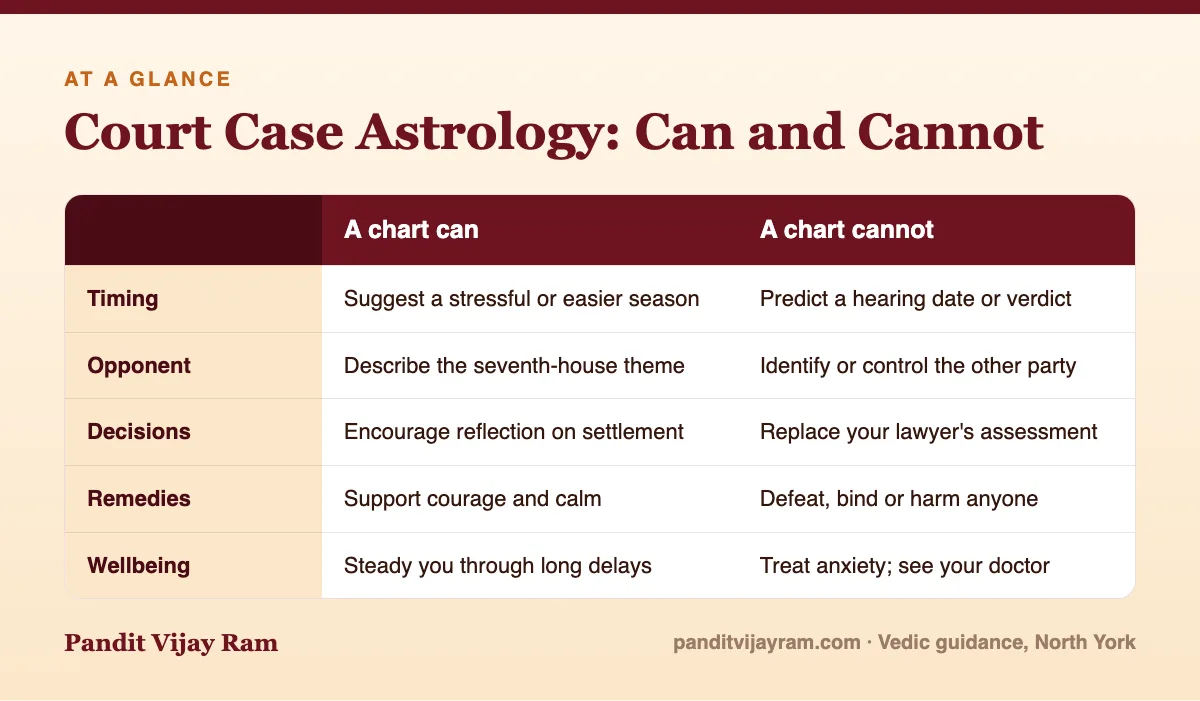
No honest astrologer can promise a court result. Outcomes depend on evidence, law, procedure, the quality of legal advice and decisions by judges or juries. A chart may describe a challenging or supportive period, but treating that as a verdict can lead to dangerous choices, such as refusing a fair settlement or neglecting preparation.
I am asked this question more than any other in legal consultations, and I always give the same answer. I cannot tell you that you will win, and I would distrust anyone who says they can.
Consider what decides a case:
- the evidence and how it is presented;
- the law that applies in your province or country;
- the procedural steps and deadlines;
- the strength of your lawyer's preparation;
- the other party's position and willingness to settle;
- the judgment of a court.
None of these appears in a horoscope. A chart can, at most, describe a season of stress or ease in your own life.
The harm of false prediction is real. I have met people who refused a reasonable settlement because someone told them the stars had promised victory, and people who stopped preparing because they believed the outcome was fixed. Both were badly served.
Watch for warning signs in anyone offering "court case win" services: fixed fees for a result, pressure to pay more as hearings approach, or claims of controlling a judge. These are exploitative. If you have been targeted, the Canadian Anti-Fraud Centre takes reports.
For the related question of being falsely accused, our guide to facing a false accusation puts legal and emotional steps first.
Why should you see a lawyer before an astrologer?
A lawyer understands the law, deadlines, evidence rules and your options, including settlement. Missing a filing date or saying the wrong thing can harm your case in ways no prayer can reverse. In Ontario, Legal Aid Ontario, community legal clinics, duty counsel at courthouses and the Law Society's referral service can help people find legal assistance.
When someone comes to me with a legal problem and no lawyer, my first advice is always practical. Here is the order I suggest:
- Read every document carefully and note all dates, especially response deadlines.
- Get legal advice promptly. If cost is a concern, ask about legal aid eligibility, community legal clinics or duty counsel at the courthouse.
- Find the right specialist. Family, criminal, employment, immigration and estate law each need different expertise. The Law Society of Ontario offers a referral service, and other provinces have similar bodies.
- Gather evidence. Emails, texts, contracts, photographs, receipts. Give copies to your lawyer.
- Follow advice on communication. Avoid discussing the case on social media or contacting the other party without guidance.
- Ask about settlement or mediation. Many disputes resolve outside court.
- Then, if you wish, seek spiritual support for calm and courage.
For immigration matters, consult a lawyer or a licensed immigration consultant and rely on official sources rather than social media advice.
Business disputes have their own dynamics, which the post on business partnership disputes addresses. In every case, I see my role as supporting your peace of mind while your legal team does its work.
What is prashna kundli for legal problems?
Prashna, or horary astrology, casts a chart for the moment a sincere question is asked rather than for a birth time. It is traditionally used for specific questions, including disputes. The ascendant represents the person asking and the seventh house the opponent. It offers a reflective snapshot, with the same limits on certainty as any reading.
Prashna is one of the oldest branches of Jyotisha, and it is often used when a birth time is unknown or a question is urgent. The chart is drawn for the time and place the question is put to the astrologer.
In a dispute question, a practitioner typically considers:
- The ascendant and its lord for the person asking, and their strength.
- The seventh house and its lord for the opposing party.
- The sixth house for the dispute itself.
- The Moon for the flow of events and the questioner's state of mind.
- Relationships between these factors, such as which lord is stronger or applying aspects.
Some traditions say the question must be sincere and asked once, not repeated until a pleasing answer appears. I agree; repeated asking is usually anxiety, not inquiry.
I use prashna carefully in legal matters. It can help a person reflect on whether to seek settlement or press on, and it can point to a period that calls for patience. It never replaces legal assessment of the facts.
The method itself is explained in more depth in our post on prashna kundli. A birth-chart reading for longer life themes is a separate exercise, and the two answer different questions.
What are calm court case remedies in Vedic tradition?
Helpful remedies support courage, clarity and truthfulness: Hanuman Chalisa for strength, Ganesha mantra before hearings, Jupiter prayer on Thursdays for wisdom and fairness, and Durga prayer for protection. Charity and honest conduct are traditional supports. These remedies help you face the process steadily; they are not intended to defeat or harm the other side.
I keep legal remedies simple and focused on the person, not the opponent. A routine for the weeks before and during a case:
- Daily: light a lamp and recite the Hanuman Chalisa or a shorter Hanuman mantra for courage.
- Before each meeting or hearing: Om Gam Ganapataye Namah eleven times, asking for clear speech and a calm mind.
- Thursdays: prayer to Guru, the planet Jupiter, linked with justice and wisdom. A yellow flower and a lamp are traditional.
- Saturdays: during a lengthy case, a Shani prayer for patience with delays.
- Charity: feeding people or donating in a spirit of humility, not as a bargain.
- Truthfulness: speak honestly to your lawyer and the court. Dharma begins there.
Some people ask specifically about Baglamukhi puja for court cases. That tradition exists, and I discuss it honestly, including its ethical limits, in the article on Baglamukhi puja.
If the case involves someone actively threatening you, the guide to protection from enemies covers practical and spiritual safety. Report any threat to police.
Legal stress affects sleep and health. If anxiety is overwhelming, please speak with your family doctor.
The bottom line
Court case astrology can describe stressful seasons through the sixth house, the seventh-house opponent and current dashas, and prashna can offer a reflective snapshot. No chart can predict a verdict, and promises to win a case are a warning sign. A lawyer, legal aid or a community legal clinic must always come first. Calm remedies such as Hanuman, Ganesha and Jupiter prayer help you face the process with courage and honesty.
Key takeaways
- The sixth house is the main house of litigation in Vedic astrology.
- No astrologer can honestly promise a court outcome.
- Get legal advice first; legal aid and clinics help with cost.
- Prashna offers a reflective snapshot, not a verdict.
- Remedies support courage and truthfulness, never harm to the opponent.