
Diwali, Navratri and Holi in Thornhill: Local Celebrations and Practical Rules
Planning Diwali in Thornhill raises a question most Hindu families elsewhere never face: which city's rules apply to my street? Thornhill sits on both sides of Yonge Street, so a family on Centre Street in Vaughan and cousins on John Street in Markham can face different fireworks and fire rules on the same night. I often hear from households in North York and York Region who discovered the difference only after a bylaw officer knocked. This guide sets out what each city's official pages say about fireworks and open-air fires, where Navratri and Holi gatherings usually happen, and how to keep diyas safe at home. It avoids dates, because festivals follow the lunar calendar and city rules are reviewed. In more than forty years of Vedic practice I have learned that a festival kept within the rules feels lighter, because nobody is anxious about a fine. Check your own city's page each season before you buy anything.
Can you set off Diwali fireworks in Thornhill?
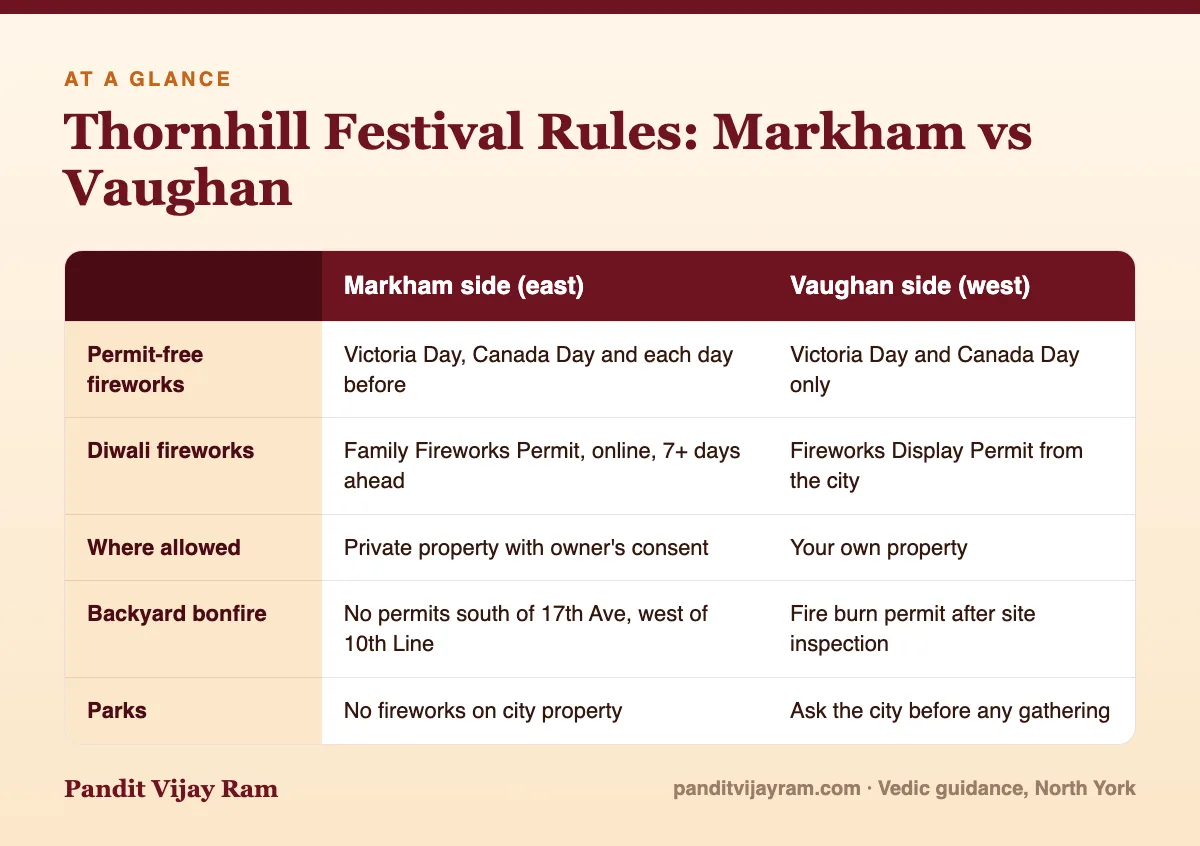
Only with a permit, on either side of Yonge Street. Markham allows family fireworks without a permit on Victoria Day, Canada Day and the day before each. Vaughan allows them on Victoria Day and Canada Day. Diwali is not on either list, so apply to your city well ahead of the festival.
Use this decision rule before buying a single sparkler:
- Find your side of Yonge Street. East means the City of Markham; west means the City of Vaughan. Your property tax bill names the city.
- Markham side. The city's family fireworks page says permits are not required on Victoria Day and the day before it, or on Canada Day and the day before it. All other days need a Family Fireworks Permit, applied for online at least seven days before the event. Fireworks may be set off only on private property with the homeowner's consent, and never on city property such as parks, fields and roads.
- Vaughan side. The City of Vaughan says consumer fireworks may be set off without a permit only on Victoria Day and Canada Day, until 11 p.m., on your own property. Any other day requires a Fireworks Display Permit from the city. Vaughan has been reviewing its fireworks by-law, so check its current page each year.
- Condo or rental? Your condo board or landlord can forbid fireworks even where the city would issue a permit.
Many families now enjoy sparklers at a temple or community display and keep home celebrations to lamps and rangoli. For a city-by-city comparison, see Diwali fireworks rules across GTA cities. Neighbours to the west can read festival rules for Vaughan, and those to the east the Markham festival guide.

Is a Holika Dahan bonfire allowed in a Thornhill backyard?
Almost certainly not on the Markham side, and only with an inspected permit on the Vaughan side. Markham requires a permit for every open-air fire, including fire pits and chimineas, and does not issue them for locations south of 17th Avenue and west of Tenth Line. Vaughan requires a fire burn permit for all open-air burning.
Holika Dahan, the bonfire on the eve of Holi, recalls the story of Prahlada's faith surviving the flames that consumed Holika. Families naturally want to recreate it. In a suburban Thornhill yard, the rules point elsewhere.
The City of Markham's open-air fire page states that all open-air fires, including fire pits, fire drums and chimineas even with a lid, need a permit, and that burning permits are not issued for locations south of 17th Avenue and west of Tenth Line (Reesor Road). Thornhill's Markham half sits well inside that zone. The same page notes that outdoor appliances fuelled by propane or natural gas, regulated by TSSA and installed by a licensed contractor, are the only outdoor burning allowed in a typical subdivision without a permit.
On the Vaughan side, Vaughan Fire and Rescue Service requires a fire burn permit for open-air burning, and a permit is issued only after the site is inspected. Temporary fire bans in dry weather can cancel permits already granted.
Gentle alternatives keep the meaning intact:
- Join a community Holika Dahan organised by a temple with the right approvals.
- Light a single ghee lamp at home, recite the Narasimha or Prahlada story, and offer a coconut and grains.
- Write the habits you want to release on paper, then tear it and discard it respectfully.
Our wider guide to Holika Dahan bonfire rules and safe alternatives in the GTA covers more options.
Where do Thornhill families celebrate Navratri, Diwali and Holi together?
Most public celebrations happen at mandirs just outside Thornhill, in rented community halls and in school gyms booked by cultural associations. Garba nights fill large rooms during Navratri, Diwali dinners gather extended families, and Holi colour play needs open space with permission from whoever owns it.
Because Thornhill has no large mandir of its own, festival life spreads across several venues. The closest temple is Vishnu Mandir on Yonge Street in Richmond Hill, and our Thornhill temples and community centres guide lists the public halls on each side of Yonge.
Navratri. Nine nights of devotion to the Goddess often mean garba and dandiya in a hired hall. Organisers should confirm capacity, music volume and finishing times with the venue in writing. Fasting families can find practical advice in our Navratri in the GTA guide.
Diwali. Lakshmi puja is usually a household event, followed by visits to relatives and a temple darshan. Large community dinners often book halls months ahead, so start early.
Holi. Colour play is joyful and messy. A private backyard with the owner's consent is the simplest choice. A city park is public land, so ask Markham or Vaughan recreation staff whether a group gathering needs a booking before you invite anyone. Choose skin-safe colours and agree on a clean-up plan.
Wherever you gather, keep the spiritual core visible. Begin with a short prayer, explain the story to children, and end with prasad. A festival that feels like a party only can leave people tired rather than uplifted.
How can you keep Diwali lamps safe in a Thornhill home?
Place each diya on a metal tray away from curtains, saris and children's reach, and never leave flames unattended. Test smoke alarms before the festival. In a condo, read the building's rules on open flame, and use LED diyas on balconies, in windows and anywhere you cannot watch.
Thornhill has every kind of home, from older detached houses on quiet crescents to newer condos near Yonge and Bathurst. The fire risks differ a little, but the basic habits do not.
- Fewer real flames, well watched. One or two ghee lamps at the shrine carry the full meaning. String lights and LED diyas can decorate the rest.
- Stable surfaces. A steel thali on a hard counter is safer than a wooden shelf or carpeted floor.
- Clothes and hair. Loose dupattas and silk saris catch fire quickly. Tie them back when you light the aarti.
- Alarms. Ontario's Fire Code requires working smoke alarms in homes; test them the week before the festival and never cover one to stop it chirping.
- Kitchen crowds. Festival frying and many guests are a classic fire mix. Keep a lid nearby to smother a pan fire.
Condo living has its own considerations, covered in our guide to fire-safe diyas in condos and apartments. If you plan to cleanse the home before Lakshmi arrives, our home cleansing guide for Thornhill housing suggests smoke-free methods that suit any building.
A careful home is itself an offering. Lakshmi is traditionally welcomed into a clean, bright, peaceful house, not a frantic one.
How do you keep Thornhill festivals meaningful and neighbourly?
Plan the puja first and the party second. Choose a muhurat, prepare samagri early, and explain the story to children. Tell close neighbours about guests and parking, finish loud celebrations at a sensible hour, and clean shared spaces. Devotion that respects others carries a calmer energy into the year.
Thornhill is a mixed neighbourhood where Hindu, Jewish, Christian, Muslim and many other families share streets. Festival seasons overlap, and goodwill grows when everyone sees care in each other's celebrations.
A simple plan for the household:
- Fix the muhurat. Lakshmi puja is traditionally timed to the evening of Amavasya. Use a Toronto panchang, or ask a pandit to calculate the window for your location.
- Prepare quietly. Clean the home, set the altar and gather samagri a day early. Our step-by-step Lakshmi–Ganesh puja for Diwali at home explains the order.
- Speak to neighbours. A short note about extra cars or late visitors prevents most complaints.
- Share sweets. Mithai across the fence is an old and effective form of diplomacy.
Some families want a larger observance, such as a Ganesh or Lakshmi havan performed by a priest. Vijay Ram ji can perform a Ganesha puja and havan on your family's behalf and explain each step by video. He also meets families for in-person consultations in North York. For local details, visit the Vedic astrologer page for Thornhill.
Festivals return every year. Keeping them simple, lawful and kind lets their meaning deepen with each season rather than fading into stress.
The bottom line
Diwali in Thornhill means checking which side of Yonge Street you live on before buying fireworks, because Markham and Vaughan set different permit-free days and both require permits for Diwali. Backyard bonfires for Holika Dahan face tight limits on both sides, so temple events and symbolic home rituals are the safer path. Careful lamps, tested alarms and considerate neighbours keep every festival calm and meaningful.
Key takeaways
- Markham rules apply east of Yonge Street; Vaughan rules apply west of it.
- Neither city lists Diwali as a permit-free fireworks day.
- Markham issues no open-air burning permits for Thornhill's area; Vaughan inspects before permitting.
- Temples and booked halls host most Navratri and Diwali gatherings.
- One watched ghee lamp carries the full spiritual meaning of Diwali.